





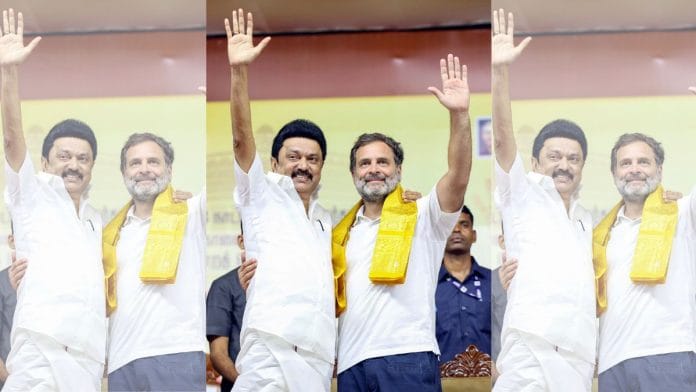



Chennai: The ruling DMK and Congress have finally sealed a seat-sharing deal after several hours of uncertainty that saw the Congress high command deploy P. Chidambaram to break the impasse ahead of the Tamil Nadu assembly polls. The Congress will contest in 28 seats and one RS seat has been reserved for the party.
A DMK source said the alliance talks concluded smoothly. “A grand alliance has been formed with 21 parties. For the past two years, BJP and AIADMK have been saying that the DMK alliance would break apart. They have been proven wrong.”
“In the history of Tamil Nadu politics, this is the first time a single alliance has faced elections for the fourth time without breaking apart or weakening, while also adding new parties,” the source added.
Congress MP Manickam Tagore said individuals may have differences, but the party is “bigger than any one of us”.
“When leadership decides, we accept it with discipline-because unity is our greatest strength,” he wrote on X Wednesday.
Girish Chodankar, the All India Congress Committee (AICC) in-charge for Tamil Nadu who headed the alliance negotiation committee, had previously clarified that his party would not accept anything less than 34-41 seats. However, negotiations hit a wall post-28 February, prompting the Congress leadership to intervene.
Chidambaram and TN Congress President K. Selvaperuthagai met Chief Minister M.K. Stalin for Tuesday’s talks. DMK Deputy General Secretary and MP Kanimozhi Karunanidhi was present at the meeting too.
While DMK had unofficially set a deadline of 3 March to complete its seat-sharing talks with the Congress, the Stalin-Chidambaram meeting ultimately paved the way for the final seat-sharing discussions Wednesday, ending the stalemate.
Before the meeting, the DMK had offered the Congress 25 assembly seats, matching its 2021 tally, along with one Rajya Sabha seat. The Congress has been demanding 34 to 41 assembly seats and two Rajya Sabha seats.
However, State Congress President K. Selvaperuthagai had dismissed reports that the DMK had set a formal deadline for Congress to respond to a seat-sharing offer.
DMK Organising Secretary R.S. Bharathi said, “We have conveyed our offer. The final negotiations will be made by our leader, who will announce the same,” Bharathi said.
Also Read: Impact of Bhupen Borah’s exit from Congress & DMK-Congress alliance in Tamil Nadu
The grounds of the negotiations
The Congress, which contested 25 seats in the 2021 Tamil Nadu polls and won 18, has been flexing its muscle in the seat-sharing talks this time amid its main rival Bharatiya Janata Party’s aggressive bid to expand in the state. The Congress has not been in power in Tamil Nadu since 1967, but has had a larger presence in the state than the BJP.
The Congress would not want to cede any space for national parties, including the BJP, in Tamil Nadu politics and would like to capitalise on any anti-BJP sentiment in the state as a national party. So, it is jostling hard with its ally, DMK, for more space.
The presence of actor-turned-politician Vijay’s Tamilaga Vettri Kazhagam (TVK) this time had boosted the Congress’s bargaining strength. However, Congress leaders and analysts feel that while it has a bargaining chip, it cannot afford to let its ties with the DMK sour over seat-sharing.
Arun Kumar, Assistant Professor, Political Science, VIT Chennai, told ThePrint, “This time the only reason for stern negotiation was TVK. Congress cannot afford to leave DMK without knowing the real strength of TVK on the ground. It was only in 2014 that Congress contested the parliamentary elections alone, and only in Kanyakumari could it retain the deposit. They do not have an adequate hold on the vote bank.”
“The Congress and communist parties can together win the elections by being a part of the alliance, as they bring together the minority and backward classes, but leaving the alliance would have been a mistake,” he added.
However, with the DMK having brought in newer partners into its alliance this time, and with other allies such as Viduthalai Chiruthaigal Katchi (VCK) also bargaining for more seats, the ruling party was unable to entertain the Congress’s demands beyond a point.
Why Congress leadership intervened
Senior Congress leaders believe that going too hard on the DMK may have backfired, as the party has limited options in Tamil Nadu on its own.
In the seat-sharing talks, Congress has limited leverage against the DMK. Now, it is no longer indispensable for giving expression to the state’s anti‑BJP sentiments.
The DMK has taken a clearer opposing stance to the BJP.
A Congress functionary told ThePrint, “The DMK has been a long-time ally, and they backed Rahul Gandhi within the INDIA Bloc, giving the strongest support to the alliance. The [Congress] party would not want to lose the alliance on the grounds of these differences, because even it knows the value of the DMK, regionally and nationally.”
The Congress is expected to hold a rally in Chennai soon, but functionaries said that it might not be a major show of strength by the party by itself.
“Breaking the alliance would isolate the party in Tamil Nadu, and the strength of the alliance is already established. It would be difficult to establish a strong, proven vote bank to counter DMK on the seat-sharing talks,” another Congress party functionary said.
Before Chidambaram met Stalin Tuesday, Congress leaders Sonia Gandhi, Mallikarjun Kharge, and K.C. Venugopal had a meeting regarding the seat-sharing stalemate.
DMK Spokesperson Saravanan Annadurai told ThePrint, “With P. Chidambaram here for talks, the intention is to finalise the seat sharing and end the negotiations.”
Earlier Tuesday, Saravanan Annadurai, speaking to reporters, said that the Congress had expressed its commitment to resolving the seat-sharing stalemate and being a part of the DMK-led alliance.
Commenting on speculations that the Congress was looking to the TVK for an alliance, Saravanan Annadurai said that no one wanted to form an alliance with TVK. “There are too many issues…Let it (TVK) resolve them, then it can talk about all the other issues,” he emphasised.
Why Congress had more to lose
While TVK is a bargaining chip, the Congress lacks real options and needs to do much more to stay relevant in Tamil Nadu politics, according to analysts.
Sunilkumar V.M., an electoral analyst and political science faculty at a private university in Chennai, told ThePrint, “Compared to Congress, VCK has shown their power with a stronghold on minority votes, which is reflected in party meetings and other protests, but such a show of strength has not been showcased by Congress in the last few years.”
“Many senior leaders are also losing their ground in areas of their dominance. In the INDIA bloc, the DMK extended full support to Rahul Gandhi. The DMK has taken a strong stand against the BJP; even the Congress has not. If the alliance breaks, it will lead to more damage to the Congress than to the DMK, as the latter is also considering minor parties, with the minority vote banks, such as the Indian Union Muslim League, for alliances,” Sunilkumar V.M. added.
Winning from areas such as Ponneri, Sriperumbudur, Erode, Sivakasi, and Vilavancode, the Congress secured 4.29 percent of votes in the 2021 Tamil Nadu assembly elections. But it also lost key battles in Uthangarai, Kallakurichi, and Coimbatore to the AIADMK or BJP.
Now that Chidambaram has intervened, the involvement of senior Congress leaders in Tamil Nadu politics needs to be something more than increasing the party’s visibility, Professor Kumar said.
Although Chidambaram has intervened, the commitment of Congress leaders, such as Rahul Gandhi, Kharge, or Sonia Gandhi is questionable because they don’t visit Tamil Nadu as frequently as BJP leaders, he said. “Congress leaders need to be more involved.”
The DMK, meanwhile, has strengthened its options with new partners, such as IUML and Desiya Murpokku Dravida Kazhagam (DMDK), and older partners, such as the VCK, Communist Party of India and the Communist Party of India-Marxist. This allows the DMK to compensate for any Congress shortfall if talks break down.
DMK’s minor allies
Given that the newer or more assertive partners have specific vote banks or vote banks in politically sensitive areas, the DMK doesn’t have much room to accommodate the Congress’s demands.
For example, DMDK is a significant “vote-diverting” force among sections of the Most Backward Classes (MBC) and certain Other Backwards Classes, especially in parts of southern and central Tamil Nadu, commanding a substantial vote share in select constituencies. DMDK can help the DMK in fragmenting the NDA alliance in OBC‑heavy belts.
Moreover, party leaders say, the DMDK has announced an alliance with the DMK for the first time. Now, the DMK would not want to walk back on its word regarding the promised seats, just to give more to the Congress, as they would not want the party to lean towards the opposition.
Similarly, IUML can attract Muslim voters, especially in Ramanathapuram, Tirunelveli, Kanyakumari, and some pockets in Madurai and Coimbatore.
IUML has explicitly opposed the BJP in Tamil Nadu, strengthening the DMK’s ideological stance as a secular and minority‑friendly alliance. Diminishing IUML’s allocation of seats would invite strong criticism.
Earlier Monday, Viduthalai Chiruthaigal Katchi (VCK)—led by Thol Thirumavalavan—had their first round of seat-sharing talks with the DMK. The party demanded 12 seats, nearly double the seats it contested in 2021, while stating that it does not seek power sharing.
However, Kumar said no party can replace the Congress for Tamil Nadu’s DMK, as it has a strong electoral base in Kanyakumari and other southern districts. It acts as a catalyst for the DMK, added Professor Kumar.
“Without the Congress, the DMK would have a challenge in these regions, which is why it is agreeing to give almost 30 seats,” said Kumar. “All the parties, including the minor parties, need to increase their vote share and political presence, so their share of seats cannot be reduced.”
(Edited by Madhurita Goswami)
Also Read: Bargaining chip? Rahul’s phone call with Vijay stirs speculation amid strain in DMK-Congress ties