





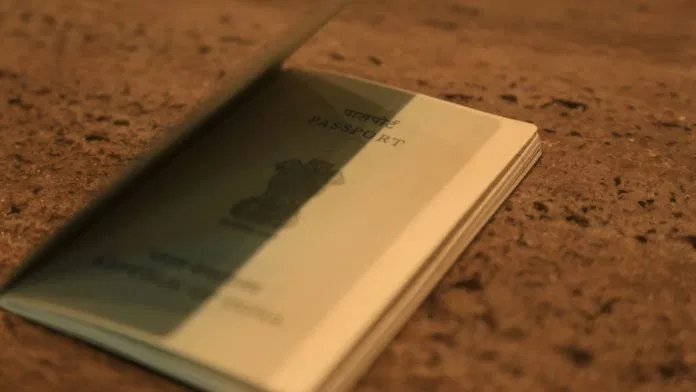



I have been in a relationship with a passport brahmin, my husband, for almost a quarter of a century at the time of writing.
Marriage is the easiest way to upgrade your passport. And yet, I have hung on to my Indian travel document. My relationship to it is akin to having a bad boyfriend, based on an impractical— my friends tell me, wrongheaded—affection. It’s about romantic notions rather than bald facts. It pays no heed to the tortured realities of visa applications and routine humiliations at the hands of immigration officials in a bad mood. It erects barriers—both corporeal and metaphorical—between me, and my husband and children, who are all Spanish citizens.
And yet, I have hung on to it, mulishly, not always able to explain why. When I try and examine the reasons, they are confused. There is love and loyalty mixed in, but at the heart of the decision, lies guilt. I am troubled by the notion that were I to trade up for mere convenience, I would be selling out. Amassing greater ease to a life that has already been given more than its fair share by the roll of the cosmic dice feels gluttonous. Indian independence, its existence as a free country, was so hard fought for. Its future is far from secure. I have a personal and emotional investment in its ongoing struggles. My passport, I have convinced myself for years, is proof that I have skin in that game. But what is really at the root of my reluctance to swap passports is the unarticulated need to atone for my privilege as a high caste, English-speaking, culturally advantaged Indian. It’s the guilt from the obscenity of belonging to India’s one per cent. The one thing that puts me on an equal footing with every other Indian, regardless of caste or creed, is my passport. If I suffer from trudging about the land of visas, it’s a suffering I share with my compatriots.
The extent of this ‘sharing’ is overstated, of course. Journeying in visa country is easier for people like me who know worthies able to intervene on their behalf at a pinch. Who have laptops and electricity that enable them to fill out online forms, and the economic means to be able to pay for visas. Nonetheless, an Indian passport grounds me. It reminds me, as the writer Tabish Khair has put it, of ‘how marginal I am in the global heart of whiteness … of what I share with the Nepalis, Algerians, Nigerians and Pakistanis …’ and other Indians.9 I am not in any way ‘better’ than them. So why should I be able to breeze through immigration lines, while they queue and quake, always on the edge of being hauled off to airport interrogation rooms? While musing about his decision not to apply for the Danish passport that he is eligible for, Khair says that to do so would imply that he somehow thinks of Denmark as superior to India, whereas he knows that ‘the heart of whiteness is lit with lamps of blood …’ The idea of ‘upgrading’ one’s passport to that of a rich, invariably white, country, has undertones of native informant, collaborator, Judas. Those of us born only a few decades after the end of the colonial period, are vulnerable to that effect. Or at least, I am.
Yet, there is also a part of me that is annoyed by what can feel like false dichotomies. Why can’t I love India and Spain? Why can’t I have two passports? The latter is more of a rhetorical question, the literal answer being that the Indian Constitution does not allow dual citizenship. India requires strict monogamy. The constitutional framers believed that multiple passports would lead to divided loyalties that would ultimately threaten the integrity of the Indian Union.
And yet, cosmopolitanism has roots in India too. It is not merely a Western conceit. India’s first Nobel laureate, the poet- philosopher Rabindranath Tagore, wrote: ‘I, who have the amphibious duality of nature in me, whose food is in the West and breathe air in the East, do not find a place where I can build my nest. I suppose I shall have to be a migratory bird and cross and recross the sea, owning two nests, one on each shore.’
It’s as if he were writing of me, to me. I was born a mongrel: a north Indian and a south Indian, a Hindu and an atheist, an English-speaker with un-English skin, a half-caste with cultural capital. My mother’s family was from the Lucknow-Allahabad area in Uttar Pradesh, but she had grown up in Bombay and Calcutta where she had been educated by nuns in missionary- run convents. Her father used to eat his rotis with a fork and knife. She read English literature at university and wore sarees with great elegance.
There was hardly a superstition that she didn’t believe in: numerology, vastu (a belief in architectural principles being capable of creating positive force fields), no cutting of nails at night. She liked Krishna and Ganesha, and also used to take me to visit a small church behind Khan Market, a shopping complex in New Delhi.
My father is a Tamilian, who had been born in Gujarat. He went to school in Dehra Dun. At university in England, he spent most of his time betting on horse races and card games. That perhaps foreshadowed his becoming an economist by training. He is an atheist, a writer, a reader. He likes a good beef burger whenever he can get hold of one.
Before I began primary school, I had two ‘best’ friends from my neighbourhood in Delhi. One was Sadia, a Muslim who lived a few houses down from us. I remember visiting her extended family in Old Delhi on occasion. Her dad would load up her, her brother, her mother (shrouded in a burkha for the outing) and me on to his two-wheel scooter to take us there. We ate the best food at Sadia’s home.
Then there was Simrin, a half-Sikh, half-American girl, with light brown hair and almost-green eyes, in whose home I saw bottled water for the first time. It was an amazing thing to me that there were people who paid for water in plastic bottles as if it were Campa Cola.
Once I began school, many of my new friends were Punjabi Hindus with immigrant backgrounds—families who had left Pakistan immediately before Partition. I learned to love the open-heartedness of their homes, the kineticism of the dancing at their celebrations and their easy generosity.
In short, I grew up in love with India, its multiplicities, and ease with contradiction. Being Indian at that time allowed me to be this complicated messy thing. It allowed me to be more and greater—instead of being reined in and tightly delineated.
I grew even more complicated as I travelled. Over the last quarter of a century, the love I had grown up with for India has expanded until I have fallen in love with the world. Beijing’s hutongs, Indonesia’s sambals, Brussels’ antique markets, Oxford’s libraries, Spain’s flower-filled balconies and Tokyo’s dentists—these are all joy-giving affirmations that I feel pride in. ‘Look!’ I want to tell people, ‘Come and see these things. Aren’t they glorious?’
In effect, I have collected so many identities that I feel like I am building a luminescent shell within which I shelter, snail- like. I have become a little Chinese and a little Spanish, with a splash of Japanese. I prefer using chopsticks to forks. I have embraced Spanish nationalism when it comes to wine. I have learned to eat dinner at 6 p.m., thanks to living in Tokyo and to drink hot water because of my years in China. I call French fries ‘frites.’ And the sentences I exchange with my husband, are in our own special patois:
‘Chalo chalo, aren’t you ready yet?’
‘Belum. I can’t find my chanclas.’
Birth is a lottery, and not everyone can fly. Political realities are grimmer than ever: asylum seekers being pushed back at sea, students denied visas over social media posts, entire nationalities deprived of the right to mobility. But sometimes, we are fettered by the mind rather than circumstances. And in that case, it’s a tragedy not to soar. We all have it within us to be boundary-crossing cranes, even though it can seem as if we must fly ever higher to reach the other side.
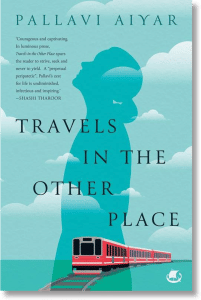 This excerpt from ‘Travels in the Other Place’ by Pallavi Aiyar has been published with permission from Westland Books.
This reminds me of a line from the movie Platoon where a black man tell Charlie Sheen’s character
“You gotta be rich in the first place to think like that. Everybody know the poor are always being fucked over by the rich. Always have, always will.”
This is such an entitled thought process and completely false. Any and all privilege was taken away on 7th August 1990 when VP Singh implemented the Mandal commision recommendations.
I highly encourage the author to take up Spanish citizenship and experience the joys of speedy immigration. Your life will be much happier and you will free yourself from all this guilt within an hour of getting the new passport.