





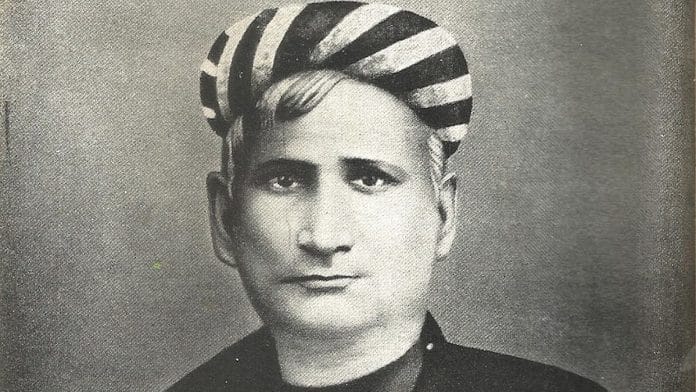



It is most likely that Bankim wrote the third (Tumi Vidya) and fourth (Tvam Hi Durga) stanzas when he decided to bring the song into his novel Anandamath. In 1937, at the height of the debate regarding Vande Mataram and its status as a national song, Tagore wrote to Nehru. The first two stanzas were entirely acceptable to him, he said, but he disassociated himself from the rest of the song.
He said he could understand why they might hurt Muslim sensibilities given the context, ‘… but a national song though derived from it which has spontaneously come to consist only of the first two stanzas of the original poem need not remind us every time of the whole of it, much less of the story with which it was accidentally associated’. Nehru said something similar in turn to Ali Sardar Jafri in his letter of 1 September 1937: ‘Nor are we concerned with the idea that the author of the book, which contains this song, had in his mind when he wrote it, because the public does not think on those lines.’ He also felt that the song as a whole and its words were ‘harmless’ and ‘nobody can take exception to their meaning’.
Tagore’s attribution of accidentality to the song’s role in the novel Anandamath is inaccurate because the song did play an important role within the narrative.
I have been unable to find any commentary by Tagore on the lyrical content beyond the first stanza, but assume that when he refers to the song’s ‘tenderness’, he meant only that one stanza. I surmise from all this that Tagore’s fascination for the song, besides its historic catalytic role, lay in the magic of its first stanza.
Vande Mataram in Anandamath was a political device that necessitated the writing of the new stanzas. But Tagore’s personal affiliation with Vande Mataram and admiration for Bankim made it difficult for him to accuse the author of weaponising his own song. Sabyasachi Bhattacharya has observed that the song comes in at crucial moments in the story: ‘Below the surface of the novel there is this moral core and this is where the song marks the moment of significance. If we analyze the narrative in this way, it may explain the centrality of the song in the novel, apart from the obvious didactic function of the song.’
It can be hypothesised that Bankim saw in the second stanza a possibility to turn the song into a Hindu nationalistic outcry, a sensibility that Anandamath cradled. Oral history suggests that Ramchandra Bandopadhyay, who proofread Bangadarshan, a literary magazine started by Bankim, came to him asking for matter to fill up a page in the magazine. He saw a piece of paper lying on the desk and read it. It was Vande Mataram. Bandopadhyay felt the song was not bad and could be used. Bankim, who is said to have been annoyed with this suggestion, put the manuscript away, replying that the value of the song would be realised only later and that he might not even be alive when that happened. Another version of the same story has Bankim prophesying that the significance of the song would be realised twenty-five years hence, and that the song would become the Bengali anthem. One more account of the story has Bankim quickly writing the first two stanzas just to fill up space in a forthcoming issue.
Also read: How a Bengali woman became doctor to the King of Nepal in the 19th century
Anandamath is set in the late eighteenth century, during the Bengal famine. In the story, Bankim frames the issue around one primary evil: the tyrannical Islamic ruler Mir Jafar. But the revolutionists who call themselves ‘children of the motherland’ are not only fighting an oppressive power. The entire Muslim community is their enemy, and the intention is to get rid of them. They attack and kill Muslims, pillaging and setting fire to their homes and villages.
Some scholars have suggested that the conflict is political rather than religious in nature. But the words and actions of the characters make it very difficult to accept such an explanation. Vande Mataram is the symbolic, aesthetic and emotional cog that drives an angry religious fervour. It is the song of initiation for new volunteers joining the band of Hindu sanyasin warriors. Without a doubt, it is a call to preserve ‘Hindu’ culture—a violent, anti-Muslim war cry.
There is nothing congenial about its role in the novel. Within this context, the song’s direction changes, its invocatory affection is lost. The British are accused of allying with the Muslims and are treated as something akin to collateral damage. Ironically, the novel ends with the hope that the British will continue to rule. In other words, the British traders (East India Company) need to become administrators. In the final scene, a mystical saint explains that it is only through the reign of the British that Indians can educate themselves and gain material knowledge. This, he says, can then lead to the acquisition of interior knowledge and the establishment of the one true Hindu religion.
One translation states it thus: ‘The Santan rebellion has come only to put the British on the throne.’ Another thus: ‘The rebellion was raised only that the English might be initiated into sovereignty.’
According to Sureshchandra Samajpati, when he asked Bankim which of his novels he loved the most, he did not name Anandamath. ‘I said to him, “as a patriotic work Anandamath is superb”. He replied, “In that sense it could be said that the novel is good, but there is little art in that.”’
This observation says something about how Bankim viewed his novel after many years had passed.
 This excerpt from ‘We, the People of India’ by TM Krishna has been published with permission from Context.