








I returned from New York in 2018 after spending some eighteen years outside India and experienced a Rip Van Winkle moment, awakening to a somewhat changed social scene. I found in Jayati Puri a resident daughter to guide me through the maze!
One of the many affinities she and I shared was our love of the sari—a case of love me, love my sari! And the only gifts we exchange on birthdays and festivals are saris and she will probably inherit my collection. She enthusiastically provided interesting insights for this book. My reconnecting with fellow sari lovers and ardent advocates, authors, historians, experts on Indian art, craft, and culture, Alka Pande and Malvika Singh, also inspired me and reignited a sense of purpose in me.
Giving the sari a prominent place in my professional life apart, what I think has encouraged my fidelity to the sari is the example set by the faithfulness of my life partner and soulmate Hardeep Singh Puri, a Sikh, to his turban. It’s seven metres of unstitched muslin cloth which he ties around his head every day, verily beating the artistry and intuition of a sari-wearer like me.
I have reached a stage where I can reflexively open up the six yards of the sari, tuck one layer around my waist into the petticoat, make pleats with my right-hand thumb and baby finger turning backwards and forwards, adjust the length in front, and insert the material again into my petticoat, pull the rest of the garment around my hip, and drape it across my chest, and finally let the pallu drop down over my shoulder and down my back in less than five minutes. Depending on the type of material and manner of draping, the sari itself moves to create a different form and silhouette every time.
Turban-tying requires more than just practice. It is like fashioning a new sculpture every time with the coils of the turban having to align themselves perfectly every time it’s tied to achieve that certain look. There has been a kind of jugalbandi, a duet, between Hardeep
and me—on taming the unstitched river of cloth we drape ourselves in. For him, it has literally been ordained by his religion as part of the Khalsa Panth, the ‘pure path’. In my
case, it’s an unspoken, unconscious cultural and religious edict that I follow.
For both of us, it is an act of daily perfection-seeking, almost a prayer. We also follow the astrological colour code suggested by Malati—we match our turban and sari to the ruling planet of the day: sky blue, white, or silver for Monday; red for Tuesday; green for Wednesday; purple or yellow for Thursday; bright blue for Friday; black or dark blue for Saturday, and yellow or orange for Sunday.
Also read: Marxist painter Frida Kahlo had a deep interest in Hindu spirituality, read Upanishads
Beyond the jugalbandi of my sari with his turban, Hardeep has been an avid participant in my sari romance and the sari became intertwined with our love story before and after our marriage. I was amused when I saw how my Punjabi Sikh father-in-law B. S. Puri and Hardeep praised or critiqued the saris my beautiful mother-in-law Kundan Kaur invariably wore in preference to salwar–kameez. I seized on that tradition to engage him in appraising the saris when on occasion he would accompany me for sari-buying, and would ask him how I looked in a particular sari.
I also loved the fact that he was willing to go to the ends of the earth to get me rare, unique saris. He would drive me from Tokyo to Yokohama to get newly released Japanese polyester photo-print saris with irises and chrysanthemums blooming on them, or from Geneva to Lyon for the French chiffon handpainted and Chantilly-scalloped lace saris. And his generosity in always encouraging me to buy more of the saris when we came on home leave from our postings abroad is always a cherished memory with me. I still value the collection of four rare, twill, double-shaded designer silk saris with Persian and Indian motifs from the Vichitra sari boutique in Delhi which he almost compelled me to buy in orange, pink, bottle green, and Wedgewood blue! Though now well worn and twenty-four years old, these saris still sparkle with the love of my life partner!
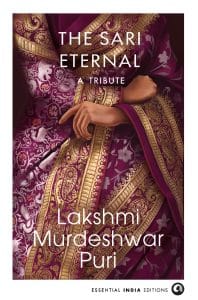 This excerpt from ‘The Sari Eternal’ by Lakshmi Murdeshwar Puri has been published with permission from Aleph Book Company.
Thanks for publishing the human side of those we often only see from a political angle. It brought a smile to my face to think of the ordinary human feelings in the most powerful people of the land.
Is this article worth publishing?