





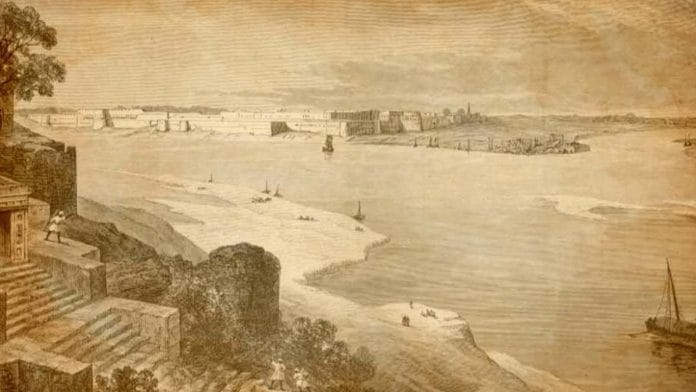



Prayagraj, also called Prayag formerly Allahabad or Ilahabad city, is situated at the confluence of the Ganges and Yamuna (Jumna) rivers, about 65 miles (100 km) west-northwest of Varanasi (Benares).
The ancient name of the city is Prayaga (Sanskrit for “place of sacrifice,” Prayag in modern Hindi) and is believed to be the spot where Brahma offered his first sacrifice after creating the world.
It is best known as host to the mind-boggling number of Kumbh pilgrims who visit this endearing city every 12 years According to Hindu mythology for the Prakrishta Yagna’ Lord Brahma chose a piece of land on the earth on the confluence of the three rivers – the Ganga, the Yamuna and the mytical Sarswati. The land being surrounded by these 3 rivers would serve as the prime and central altar and came to be known as ‘Prayag’ today. The Prakrishta Yajna was performed here by Lord Brahma That is how it received its ancient name Prayag. Allahabad is also called Tirtha-Raja, kingofallholy places.
Prayagraj has a rich and varied history, which is deeply embedded in various areas throughout the city. The ruins of Kaushambi, which was once the capital of the Vatsa kingdom and later a thriving center of Buddhism, is located towards the southwest of the city, on the banks of the Yamuna River and provides an interesting insight into a long forgotten era. Prayag’s importance in the ancient Buddhist period of Indian history is attested by the inscriptions on a pillar attributed to the 3rd-century-BCE Mauryan emperor Ashoka. The pillarwhich is believed to have been erected in a nearby locality and moved to Prayagraj in Mughal times still stands inside the gateway of the old Prayagraj fort, which is situated strategically at the confluence of the two rivers. The site’s religious importance to Hinduism persists. Each year a festival takes place at the rivers’ confluence, and every 12th year a much larger festival, KumbhMela, is attended by millions of devotees.
On the eastern side, across the Ganges River and connected to the city by the Shastri Bridge is Jhunsi, which is identified with the ancient city of Pratisthanpur, the old capital of the Chandra Dynasty. About 58 kilometers northwest of this location is the medieval site of Kara. with its impressive wreckage of Jayachand’s fort. Sringverpur another ancient site discovered relatively recently, has become a major attraction for tourists and antiquarians alike. The Puranas record that Yayati left Allahabad and conquered the region of Saptha Sindhu. His five sons Yadu, Druhyu, Puru, Anu, and Turvashu became the main tribes of the Rig Veda. When the Aryans first settled in what they termed the Aryavarta, or Madhyadesha. Allahabad was an important part of their territory. The Vatsa (a branch of the early Indo-Aryans) were rulers of Hastinapur (near present-day Delhi), and they established the town of Kaushambi near present day Allahabad. They shifted their capital to Kaushambi when Hastinapur was destroyed by floods. In the times of the Ramayana Allahabad was made up of a few rishis’ huts at the confluence of the sacred rivers, and most ofwhat is known in India as the “Vats” countryside was made up of jungles. Lord Rama, the main protagonist in the Ramayana, spent some time here, at the Ashram of Sage Bharadwaj, before proceeding to nearby Chitrakoot.
Also read: First review of Satyajit Ray’s Pather Panchali—moment for India to shake the world awake
The Doaba region, including the city of Prayagraj, was controlled by several empires and dynasties throughout Indian history. It initially became a part of the Mauryan and Gupta empires of the east and the Kushan empire of the west, before becoming part of the local Kannauj empire which became very powerful in northern India. Objects unearthed in the city indicate that it was part of the Kushana empire in the first century CE. In his memoirs on India, Hui en Tsang, the Chinese chronicler who traveled through India during Harshavardhana’s reign (607-647), wrote that he visited the city of Prayag in the year 643.
When Muslim rulers arrived in India, the city was annexed by Mohammad Ghori in 1193, and became a part of the Delhi Sultanate. The Mughals eventually took over control of the region from the rulers of Delhi and under their rise, the city once again rose to prominence. Acknowledging the strategic position of the city in the “Hindustan” region at the confluence of its defining rivers, with immense navigational potential, the Mughal emperor Akbar built a magnificent fort on the banks of the holy Sangam, and re-christened the town as Illahabad (or Allahabad) in 1575. The Akbar fort is made up of an Ashokan pillar and a number of temples, but at the time was largely a military barracks. On the southwestern extremity of Allahabad lies Khusrobagh, which houses three mausoleums, including that of Jehangir’s first wife, Shah Begum.
It was initially from Allahabad that Prince Salim, later to become emperor Jehangir, revolted against his father, the Mughal emperor Akbar. In 1602, prince Salim held a parallel imperial court in Akbar’s fort, ignoring the royal summons to leave Allahabad and proceed to Agra. While there was a high degree of familial struggle between the two, before his death in 1605, Akbar did name Salim his successor, and he eventually became known as Jehangir. Before colonial rule was imposed over Allahabad by the British, the city was rocked by Maratha incursions. This strong influence has been commemorated through the presence of two beautiful eighteenth century temples with intricate architecture.
In 1765, the combined forces of the Nawab of Awadh and the Mughal emperor, Shah Alam II, lost the Battle of Buxar to the British. Although the British did not take over control of the states immediately, they did establish a garrison at the Prayag fort, clearly realizing the city’s strategic position as the gateway to the northwest of India. Governor General Warren Hastings later seized Allahabad from Shah Alam II and gave it to Awadh, alleging that he had placed himself in the power of the Marathas.
 This excerpt from ‘Temples of Awadh’ by Vipul B Varshney has been published with permission from Kiva Prakashan.