








For generations, people in the hills and valley coexisted—sometimes in harmony, sometimes in tension—but always interwoven through trade, education, intermarriage, festivals, and shared histories. The differences were not the danger. It was the inequality, the lack of representation, and the disregard for indigenous rights that created deep fractures.
In recent years, those fractures widened—especially with attempts by the Manipur state government, as reported widely in the media, to unilaterally alter land ownership rules in tribal areas. For tribal communities, land is not just property—it is ancestry, memory, sovereignty. These state-led moves were seen as direct threats to indigenous identity and survival. The violence that erupted in Manipur in 2023 did not come out of nowhere. Its roots ran deep—nourished over years by political posturing, judicial missteps, administrative overreach, and a dangerous flood of hate-fuelled rhetoric.
One of the most volatile flashpoints was the renewed push by sections of the Meitei community for inclusion under the Scheduled Tribe (ST) category. This demand, which intensified between 2022 and 2023, was framed by Meitei advocates as a corrective for historical injustices and cultural preservation. However, for the tribal communities—particularly the Kuki-Zomi/Mizo and Naga peoples—the move was seen as an existential threat.
Already dominant in the state’s political, bureaucratic, and economic structures, the Meiteis benefit from OBC (Other Backward Class) status and occupy the fertile Imphal valley. For the tribal groups, the prospect of Meiteis gaining ST recognition raised alarm bells. It was not merely a contest over labels but over land, autonomy, and the legal safeguards governing the hill regions—areas that constitute nearly 90% of the state’s territorial expanse yet contain only about 41% of its population. However, this figure requires careful qualification: a substantial portion of the hill terrain is not fully habitable or conducive to dense settlement, rendering the uncontextualized use of the 90% statistic analytically misleading and empirically inaccurate. Moreover, the difficult and fragmented terrain has historically limited infrastructure expansion, service delivery, and economic development in the hill districts, creating structural challenges that continue to shape disparities in access, opportunity, and state presence.
The tribal fear was clear: that ST status would open the door for Meiteis to claim land in protected hill areas—lands that have historically been the cultural and ancestral heartlands of tribal life. It would tip an already unequal balance further, eroding the constitutional protections that were designed to ensure tribal survival in a system where they have long been politically marginalised.
The tipping point came in March 2023, when the Manipur High Court issued a controversial directive, asking the state government to consider the Meitei demand for ST status. To tribal communities, this was more than just a legal order but a sharp warning shot.
The response was swift. Protests erupted across the hill districts. What began as political resistance quickly spiralled into something far darker. The situation, already fragile, collapsed into chaos and carnage.
What followed was not inevitable—but it was, perhaps and in retrospect, foreseen.
Then came the night of May 3, 2023, and the aftermath…
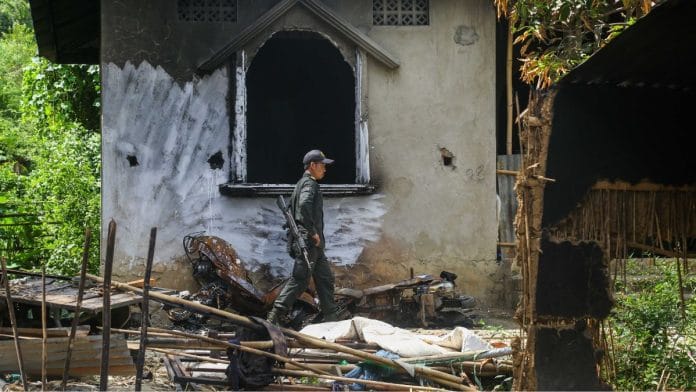
That night, the simmering tensions erupted into a firestorm. Coordinated attacks allegedly and as widely reported were led by Meitei groups like “Arambai Tenggol and Meitei Leepun” who targeted Kuki-Zomi/Mizo colonies in Imphal with “handmade petrol bombs” and churches. State forces, expected to protect all citizens, were either absent or complicit. That night, in neighbourhoods across Imphal, terror struck like a storm. The soundscape was unforgettable—the metallic clang of electric poles being beaten, the deafening bursts of gas cylinders exploding, and the raw, unfiltered wailing of families in fear. The Kuki-Zomi/Mizo residents of Imphal ran—some barefoot, some with nothing but the clothes on their backs—fleeing through alleyways, jumping walls, hiding in gutters. Some made it out. Some did not.
In those early hours and chaotic days that followed, the Assam Rifles became an unexpected lifeline. Their camps, though never meant for civilians, turned into makeshift rescue shelters—the only places of relative safety amidst the violence. People huddled in corners, unsure of who or what might come next.
What happened was not a riot. It was not a spontaneous clash.
Over 60,000 people were displaced.
Entire communities were uprooted.
Villages razed.
Lives destroyed.
Children torn from their beds.
Elders left to run.
Women brutalised in silence.
And homes—my home, among many others—was lost.
The national response was deafening in its silence. No justice. No truth commissions. No peacekeeping. The state failed its people, and the centre turned its face away. We were made invisible—to the media, to the government, and often, even to our fellow citizens.
Also read: Why many Japanese people struggle to explain if they’re Shinto or Buddhist
The Poems: A Map of Grief and Witness
Out of this rupture came these poems.
I did not set out to write a book. I was trying to breathe. In the aftermath of what happened to my family, and so many others who are on forced exile, I wrote to survive. I wrote because silence was the alternative, and silence is dangerous. Word by word, the house began to come back—not in stone, but in spirit.
This collection is structured like a walk through the house we lost:
The Gate, where all visits began—and where our final departure began too.
The Garden, tended by care and patience.
The Granary, holding not just rice, but years of survival and ceremony.
The Library, where my father read and rooted us—his wisdom lining the shelves, his silence full of knowing.
The Kitchen, where my mother’s spices became stories—simmering memory into every meal.
The Trees—mango, avocado—each planted by hand, each bearing fruit and history, now silenced by fire.
The Pigeons, Palte, cooing from the rooftops—our morning blessings in feathered form.
The Trampoline, a place of joy, where children once soared—carefree, weightless, unafraid.
The Piano, where my niece’s fingers danced on the keys—each note a love letter to the life we built.
Each poem is a room.
Each room is a story.
Each story is a life.
But the poems don’t end with memory. They move into what came after: escape, exile, grief, and the long silence of the nation. There is a little girl, my niece, who misses her pink room and unicorn. My father who asks daily to go home. The silence of children too traumatised to cry. And the stories of violence—including those that women’s bodies now carry silently—that most of the country refuses to speak of.
Still, these poems do not exist to shock.
They exist to remember.
They exist to resist.
They exist to refuse disappearance.
 This excerpt from ‘Requiem for a Home in Manipur’ has been published with permission from Copper Coin Publishing.