





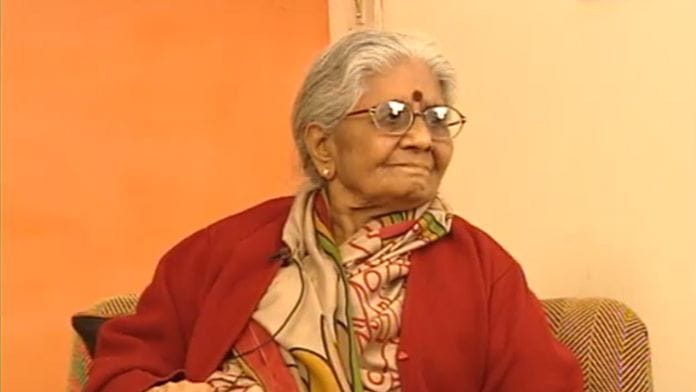



We signed the wedding register and exchanged garlands in Govindji Kanodia’s lawn. Thakore Saheb stood in for Rajendra’s father and the school president Shri Bhagwatiprasad Khaitan took on my father’s role. That evening, we hosted a reception on the same lawn, where the menu was decided by Madan Babu and Pratibha Aggarwal. The dinner was hosted by Govindji and we spent our first night in Bhanwarmalji Singhi’s house. This is how we had a real participative wedding.
Yes, in Agra, in Rajendra’s house, all the rituals and ceremonies were done with great joy, and after that Rakeshji welcomed us at the Delhi railway station with his warm, affectionate hugs. Satyendra da (Satyendra Sharat) and Usha Bhabhi lovingly hosted a dawat, a party, for us and I understood, not just understood but realized deep within myself, that from now on, this was going to be my family. I would have to spend my life with them and move towards my goals while living in their midst. Still insisting that he had to set himself up financially, Rajendra stayed back in Delhi and after four or five days, I left for Calcutta by myself, but I never felt alone at the time, because asleep or awake, I always felt Rajendra’s presence within me.
For four months, we went back and forth on whether I should go to Delhi or Rajendra should return to Calcutta because Rajendra had not been able to set up a stable financial base in Delhi. I had a job in Calcutta and though it would be a stretch, we could run the house on my salary. I’d never hankered after luxuries, but I didn’t have the courage to move to Delhi on the basis of uncertain royalty payments. I didn’t want economic insecurity to suck out all the pleasure and enjoyment right in the beginning of our new life together. Finally, Rajendra agreed to come to Calcutta and I began running around trying to find a house.
That was a strange experience. Jijaji, the broker and I would see four or five houses every day. I’d see five houses but like only one and if the rent was within my means, I would heave a sigh of relief. Once everything was more or less settled, the landlord would ask me, ‘What does your husband do?’ With great pride I would say he’s a writer, but the moment he heard this, the landlord’s attitude would change and he’d give such an evasive reply, I’d be speechless! Such disrespect for a writer in Calcutta, a city supposed to be a stronghold of music, art and literature. Is the respect for writers and artists confined to the stage? Do they have to go through such humiliating experiences in their dayto-day lives? And why just Calcutta, isn’t it the same everywhere else too? Even today, there hasn’t been any change for the better.
Also read: First review of Satyajit Ray’s Pather Panchali—moment for India to shake the world awake
After a month of running around, we found a flat on CIT Road, [which was] small, pretty and pleasing. The good offices of someone we knew helped make it available to us. I decorated it with a lot of love and care, and in April, we took our first step into our new household. I had many dreams and aspirations about married life but very soon, the clash between Rajendra’s ‘writerly compulsions’ and my own expectations of life after marriage began and could never be resolved. Everyone thought, and I did too that being in the same profession, with similar interests, life would be so easy! I felt I would find the high road as far as my writing was concerned, but while there are advantages to being from the same profession, there are also a whole lot of difficulties, at least that has been my experience.
Books, journals, discussions and arguments over what we had read and written, meeting and getting to know other writers—I found a suitable environment when it came to writing but I didn’t have the opportunity to take full advantage of this environment. Till now, I hadn’t ever had the responsibility of running a house, but I was mentally completely prepared for it. Not just prepared, I looked forward to it eagerly, along with the hope and assurance that we would together share the ups-and-downs and responsibilities of our life together.
But no sooner had we started our life together than Rajendra, in the name of a writer’s compulsions, presented me with the latest ‘pattern’ of marriage—‘parallel lives’. ‘Look, we will live under the same roof,’ he said. ‘But our lives will be our own—we will not interfere with each other, we will be independent, free, separate.’ I was speechless! I was not familiar with this very modern concept of living, not just unfamiliar, I had never even imagined such a scenario in my mind. Nor had Rajendra indicated anything like this when we were friends. I had come with him to dispel distances, to become one, for us to become immersed in one another.
After listening to him, I felt that while I’d been given the reassurance of a common roof over our heads, the ground had been pulled away from beneath my feet. The one question that hammered away at me was this—what was the need for a roof then? What was the point? Rajendra had a roof over his head, I had a roof over my head, so I understood this much at least—this idea of parallel lives that had suddenly cropped up in Rajendra’s mind had come from somewhere else. But Rajendra has never had the courage to accept reality with any honesty (at least not in my context), that’s why he habitually dug out some formula or the other to cover every lie, every obstinate idea, indeed every unjustifiable act—sometimes invoking modernity, sometimes in the name of his writing and sometimes some other concocted bit of philosophy that could prove him right.
Those days, he’d found the word ‘parallel’ in circulation and sought to give it a more comprehensive context by naming a collection of short stories he edited, Ek Duniya Samanantar (A Parallel World). Anyway, the situation was such that the start of our life together (that’s what he had printed in the invitation card—sahjivan samarambh (the beginnings of a life together) began with a bizarre kind of rupture.
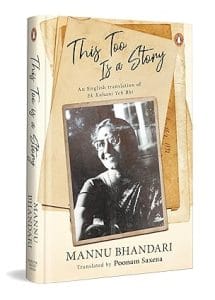 This excerpt from ‘This Too Is a Story’ by Mannu Bhandari, translated by Poonam Saxena, has been published with permission from Penguin Random House India.