








My father had stacked all his manuscripts— handwritten pages—carefully in his study. I asked him what was the most precious thing that he had left behind. For a man who barely had time to put on his shoes, I wondered what it could be. I already knew, but I wanted to hear it hoping it might ease the heaviness in the room. His eyes welled up. I knew I had touched the rawest part of his wound.
‘My books and my typewriter,’ he said.
I’ve seen him wipe away tears more times than I can count. His love for books ran deep—they weren’t just possessions. He drew his identity from the words he read and the stories he wrote. Losing them was like losing a part of himself. It was he who taught me to love books and stories. He was the one who wrote many tales of the tribes. And now, he had left all of that behind.
‘What is the most precious thing we left behind?’ It’s a question I often ask myself and others from my old neighbourhood or friends who once lived in Imphal like us, whenever our paths cross.
I first met Lamhoihching at a family gathering in Imphal a decade ago. A musician and singer, she was a familiar presence at such events, her voice strong and clear—impossible to forget. On the morning of 4 May 2023, Lamhoihching and her family fled their home in Langol, seeking refuge at the nearest army camp. A chilling pattern had emerged in Langol a few months earlier—around February—when about twenty-five homes belonging to hill tribes were visited by strangers claiming to be government officials. They were of course, Meiteis who went door to door, demanding identity papers. After each visit, a red cross was marked on the door. Only the tribal homes were singled out—and every one of those homes was later attacked.
When I asked Lamhoihching if she believed the violence was planned, she fell silent. I had hoped for some reassurance, or at least a sign that I wasn’t alone in my fears. But all she said was, ‘I only wish I had taken our family album.’
Also read: The mystery of an Islamic-style mausoleum in Dhaka Christian Cemetery
She had hoped—perhaps a little too optimistically— that she would return the very next day. But that day never came.
Lamhoihching grew up in Imphal, and much of what made up her world was carefully stored in different corners of her home. It was in the kitchen, where she cooked countless meals alongside her mother; in the rooms where she shared moments with her siblings; in the garden, where every plant she tended became a part of her. It was in her guitar, and in the songs she sang with all her heart.
‘The photo album must have been burnt to ashes,’ she whispered one afternoon when I met her in Gurgaon, where she had found work as a music teacher at an upscale school. Lamhoihching had sung many of the songs my father had written. Whenever my father brought his newly composed lyrics, she was ready with the melodies. They had made a great team.
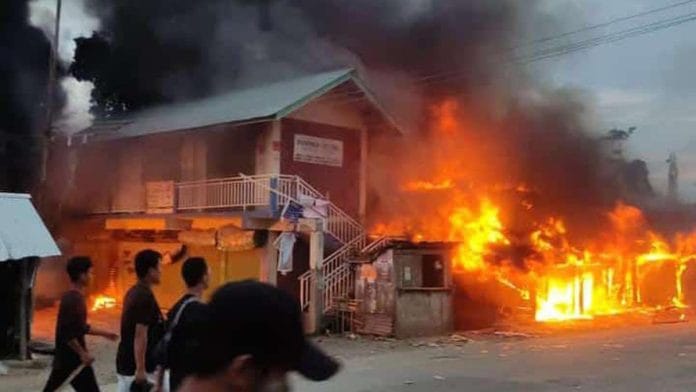
For Rosie, my neighbour who jumped over a seven-foot fence to escape that night and broke her leg in the process, it was her dog that stood out among all that she left behind. At first, Rosie and her family were hiding in an empty house in the same neighbourhood, and they brought their dog with them. But when the rescue team arrived, they had to f lee quickly and the dog was left behind. Three days later, when their house was burnt and the structure was still standing, the dog was there, waiting patiently among the blackened ruins. A photograph of the dog sitting outside the burnt house was captured by the media days later. I often think of that dog and of our own pigeons and I carry the same pain and weight in my heart.
Kim and her siblings were another family I finally met in Delhi, after years of living side by side in the same neighbourhood. Their house stood right on the street that runs through the colony. That day, as flames and smoke swallowed Paite Veng, they stepped outside, stunned by the chaos around them. Kim climbed into a waiting army van, and as it moved through the street, she saw overturned cars, homes engulfed in fire, and the church we once attended as children burning before her eyes. Gates were flung open, and crowds scattered in every direction, desperate to escape. Time and again, she looked back, struggling to make sense of the devastation. In the frantic rush to safety, the only thing she managed to grab was the Bible from her bedside.
Months later, when I met her again, I asked what she remembered leaving behind. Her parents had passed away within months of each other, and Kim was still carrying that fresh grief when everything else was ripped away—her home, her sense of belonging, her identity.
‘I wish I had taken our family album,’ she said softly. ‘At least the photos of my family—then my parents would have still been with us.’
She longed for that album filled with old photographs—snapshots of her childhood, her late grandparents, and her beloved sister. Her mind also drifted to the diaries she had kept over the years, where she had poured out her heart, capturing the highs and lows of life in vivid detail. Now, those precious pages were gone, lost forever.
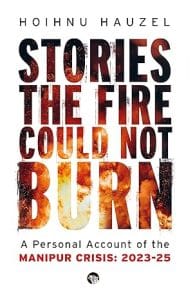 This excerpt from ‘Stories the Fire Could Not Burn’ by Hoihnu Hauzel has been published with permission from Speaking Tiger Books.