








I was supposed to finish writing this book earlier, but I missed my deadline. Luckily, I did not have to pay the kind of penalty for overshooting the time limit that the original meaning of ‘deadline’ suggests.
The word itself contains a clue as to its old meaning. Two clues, actually: ‘dead’ and ‘line’. It was a line in a prison yard. If you crossed it, you were shot dead. Such was the violent beginning of this word.
The term arose during the American Civil War, most likely at a prison camp in Andersonville, Georgia, which was notorious for the hellish conditions under which it kept its prisoners. The Civil War was fought from 1861 to 1865 between the northern US states that made up the Union and the southern US states that had broken away to form the Confederacy. The prisoners at this camp were northerners—aka Yankees—who had been captured by the Confederates of the south.
The earliest reference to ‘deadline’ in this sense has been found in the diary of William Williston Heartsill, a prisoner, dated March 1863:
The guard lines are drawn in; making our play grounds much smaller and cutting us off from our best well of water, this is done for no other purpose under the sun but to interfere with our only enjoyment and to grind us to the lowest depth of subjugation. The the [sic] two sutler stores are moved inside the dead-line, all right Mr Lynch we may meet you when we will have “the say” on you.
Also read: Salman Khan didn’t like how ‘Hum Dil De Chuke Sanam’ ended. He wanted Nandini to choose Sameer
You get a better sense of its violent meaning from this description in an 1864 report by the United States Sanitary Commission:
Twenty feet inside and parallel to the fence is a light railing, forming the “dead line,” beyond which the projection of a foot or finger is sure to bring the deadly bullet of the sentinel…
[…] One poor fellow […] was trying to wash his face near the “dead line” railing, when he slipped on the clayey bottom, and fell with his head just outside the fatal border. We shouted to him, but it was too late…
At some point in the nineteenth century, the word deadline started being used in printing presses in a different sense (though still not the current one). There was a safe zone in which you had to set the type for printing. If you set it outside this zone, it did not get printed; it was ‘dead’. The line demarcating this zone was known as a deadline.
Today, a deadline is simply a time limit for completing something—usually not a life-or-death situation. Often, you can even get an extension on the time limit. I, for example, was not shot dead for missing the original deadline for this book, so here you are, reading it!
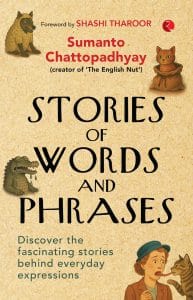 This excerpt from Sumanto Chattopadhyay’s ‘Stories of Words and Phrases’ has been published with permission from Rupa Publications.