








NAMIT: While the Hindutva world view is driven by a small cadre of ideologues who weaponize religion for political gain, it now resonates widely with middle-class Hindus. They respond enthusiastically to its feel-good myths and the aggressive new Hinduism championed by Prime Minister Narendra Modi and the Sangh Parivar. Modi understands their cultural inferiority complex and speaks directly to it—offering slogans like ‘Vishwa Guru’ and ‘Viksit Bharat’. Such bromides have been central to his appeal, partly helping mask his failures of governance.
But where does this inferiority complex really come from? Has it been building up over a long period of time?
ROMILA: I don’t think so. A cultural inferiority complex has to be measured against or compete with a superior culture. In the past, I don’t know of any Indian culture conceding that another culture, local or distant, was distinctly superior. Every new culture that came in with migrants, traders, armies or whatever, came and settled in the Indian subcontinent and became a part of Indian culture. The interface with the locals did make it different from region to region but no single one was acknowledged by all the others as superior to them. This was not new. Knowledge in India related to mathematics and the proto sciences had been circulating in the then known world over the centuries. Unfortunately, this branch of knowledge has not been properly integrated into Indian history, so we seem not to ask for illumination on how it interfaced with other patterns of culture. This is crying out to be done. Let’s not forget that during the Mughal period prior to the coming of the Europeans, the Indian economy seems to have been more successful than that of the countries with which it traded. It was an incredibly wealthy empire, hence the mind-blowing luxuries embedded in the style of elite living. Mathematics and technologies were exchanged as part of the regular scholarly interactions across Asia. Indian scholars and their work, which could perhaps be called proto science, drew much attention from other Asian scholars.
The nineteenth century saw something of a reversal in the fortunes of Asia vis-à-vis Europe. Asia’s economic status did not remain as high as before. It could have been that its resources and their organization declined and at the same time Europe was able to mobilize new resources as well as considerably improve its technological knowledge and practice, and thus gain a dominant position. The Industrial Revolution introduced a new technology that vastly improved production in Europe and colonialism brought the raw material that was needed for this new technology to be much more productive than before. Indigenous Indian technologies seem not to have been improved upon to compete with the European equivalents, so they too tended to get left behind. So far the discussion on Asia and Europe in this period has been largely about their respective economic status, but it would also be worth examining the role of technology in economic production.
Associated with the decline is the fact that on previous occasions when new people migrated into and settled in India, whatever wealth they created, they ploughed it back into India and there was a turnover of resources and patterns of life. The conquerors settled in India. But with colonialism the colony was denuded of wealth-producing resources, poverty increased and little was done to create patterns of culture that were conducive to greater prosperity all round. There was the constant supervision of an alien people who regarded Indians as inferior. This was sought to be justified by theories of race, claimed as knowledge, and which underlined the theory of inferiority of the Indian. The consistent repetition of inferiority did the damage. The imposition of a new technology introduced by the colonial power not only set aside the traditional Indian systems of knowledge, but these also tended to get dismissed in the general admiration of the technology from the West.
The two-nation theory also had a role in these changes. During the Mughal period, there was interest in and praise for traditional culture, such as the philosophical and religious dialogues, the Bhakti and Sufi traditions, the evolution of schools of music, literature and language and suchlike. Indian mathematical knowledge, for instance, had been treated with much respect by scholars from the Arab world, yet now these received little attention. But the colonial notion of two nations in conflict was a disaster because one was said to dominate over the other and the two were projected as inferior to the British who regarded themselves as holding the balance. The colonials were concerned with all kinds of domination that would, above all, enable them to control the economy. It was beyond their comprehension that someone like Akbar, in a sense, transcended the two religious traditions, engaging in innovative religious thought in his search for a new faith. The colonial understanding was limited to seeing the situation only as Muslim domination. Then, after colonial assessments portrayed Muslim culture as inferior, it created an added sense of embarrassment to Hindus for having been ruled by a culture deemed inferior in their framework.
Also read: Caste Hindus lobbied the Constituent Assembly to defend untouchability as a ‘religious right’
NAMIT: Many colonial influences on history writing have been damaging indeed, as you noted earlier. The colonials followed that up with frequent suggestions of the inferiority of Indians, which they imagined as the cause of the social backwardness they saw in sundry practices of caste, gender and popular religion. The colonials saw Indians as racially inferior, indolent and incapable of self-rule. It’s true that a few colonials did appreciate aspects of Indian culture, but by and large, they devalued Indian art, literature, religion and aesthetics. They glibly denigrated Indian languages as crude and unfit for ‘proper education’. So yes, this colonial encounter did significant damage to the self-esteem of many upper-caste Hindus, who had long seen themselves as superior. Even post-Independence, this wasn’t helped by Western stereotypes of India as a godforsaken land of snake charmers, crushing poverty and rank superstitions.
I wonder how much of the upper-caste Hindu inferiority complex stems from the realization that modern knowledge systems have displaced and rendered many traditional ones obsolete—especially those rooted in the Brahmanical substrate. Ayurveda and Vastu Shastra, for instance, are now rightly regarded as pseudosciences. Among many modern Hindu elites, this seems to have produced a lingering sense of ‘we have lost out’, that if modernity—with its knowledge systems and values and notions of ‘progress’ and ‘development’—is the ruling game in town, then we have everything to learn from the West, while the world has little to learn from us, apart from a handful of soft cultural exports like yoga, spicy food, some music and traditional handicrafts.
And this sense of ‘defeat’—especially in a scientific-technological sense, which is the ultimate yardstick of the modern world and its big source of power—created a search for explanations. This search, far from provoking honest self-reflection, has led a significant section of Hindu elites to look for scapegoats. And the easy targets of blame become the Muslims and the colonial rulers. They destroyed our greatness, we are told. Before ‘the Mughals’—a catch-all term for all Indo-Muslim rulers—invaded and enslaved us, Hindus were prosperous, had great cities, flourishing science, technology, medicine, universities and a harmonious society. Women were held in high regard, Brahmins spread their love of learning and lived spartan lives, and caste was fluid and based on aptitude—feel-good stories with a slim basis in reality. Alongside, the same Hindu elites vastly overestimate India’s intellectual relevance in today’s world, which shows up in their cringe Vishwa Guru propaganda. Very little critical reflection is undertaken to try and understand one’s own culture as it really was—and is—with both its inadequacies and its upsides.
ROMILA: I think that is true to some extent and it did contribute to the general perception. There was little attention given initially to investigating knowledge systems other than what the British held. This was assumed to be the only viable one and all others judged by it. You know, what’s curious to me is that even today, our interest in the achievements of ancient Indians seems to be only skin deep. Why is there so little serious interest in investigating early Indian proto-scientific knowledge? By this I mean not just describing what was discovered, but analysing what the early scholars investigated and why, how they arrived at their conclusions, and how they used this knowledge to advance the technology of their times. Such fundamental questions remain unanswered. The systems involved in the production of this knowledge—however it is rated—have to be studied. Such a study in terms of analysing what is scientific about this knowledge and what is not, should be familiar to students.
As a contrast to this, let me mention an institute in Cambridge founded by Joseph Needham (1900–95), the English scholar of the history of Chinese science. It has published many volumes of quality research on traditional Chinese scientific knowledge. That’s not happening here. We keep talking about our scientific achievements. Which institute in India has produced a reliable multi-volume history of the sciences in pre-modern India?
In a way, we’re not taking ourselves seriously. We’re going on nurturing our resentment, complaining about how we were looked down upon, denigrated, victimized. In truth, we’re still looking down on ourselves. We should be examining our inheritance in a more serious, reliable way. Let me give you a personal example. The one major aspect of historical study that I have been obsessive about throughout my life and on which I finally wrote a stout volume, was historiography—the study of the writing of history by historians. My interest was drawn to it in the late 1950s, when it was commonly said that the Indians of earlier times lacked a sense of history and therefore wrote no history—unlike the ancient Greeks and the Chinese who wrote history. I could also have said either that there was a sense of history and quoted mythology—as some popular writers are doing today, or I could have set it aside and said that Indians were not interested in the past. But I decided to investigate what the interest in the past could have been and how was it given shape—a shape different from what the Greeks and Chinese gave it, but nevertheless worth investigating and discussing. Such investigations inevitably reveal new aspects of the culture of a society, and this is valuable.
NAMIT: Yes, how I wish I had a course in the history of Indian science and technology in college. In terms of research, we do have Debiprasad Chattopadhyaya’s History of Science and Technology in Ancient India (1986–96). More recently, historian of science Meera Nanda has illuminated some aspects of it too. Still, I agree that Indians have not done enough secular research in this area, or at least not prioritized disseminating or teaching it effectively to undergraduates and the public. That remains a significant drawback.
And even our yardsticks, shaped by colonial modernity, have long resisted looking at our cultural inheritance and knowledge systems associated with the non-elite sections of society, such as the ecological practices of adivasis. Or take the passive cooling structures that medieval Indian architects designed to regulate interior temperatures—how well do we understand them? Instead, some of us have been busy mythologizing ancient Indian techno-scientific achievements and basking in their fictional glory. I vaguely recall this joke I came across on social media: instead of striving to produce the best mathematics, literature and science in India today, Hindu hyper-nationalists spend all their time insisting that 5000 years ago their ancestors did the best mathematics, literature and science (laughs).
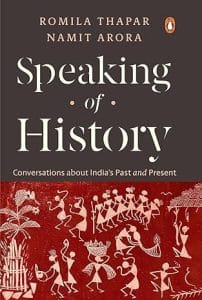 This excerpt from ‘Speaking of History’ by Romila Thapar and Namit Arora has been published with permission from Penguin Random House India.
Romila and Namit are the one’s who are full of inferiority complex. They love Mughals and the British. After they are products of British education system. Aurangzeb, Taimur, and others are responsible for the biggest genocide of Hindus. Had it not been for Guru Gobind Singh, Rana Pratap and Shuvaji Romila would be sitting in a veil somewhere. Namit would be leading a terrorist outfit somewhere.
You guys are sad losers. You are clinging to the straws. India is a majority Hindu country and Hindu values and ethos will prevail. Millions of people all over the world are taking up Hinduism. Some of the greatest European thinkers have said India is the mother of civilisation. But you are blinded by raw hatred of Hindus. There is no cure for you guys.
Did you hear the Vandematram being sung by Ethiopians in the presence of your nightmare
Modi?