






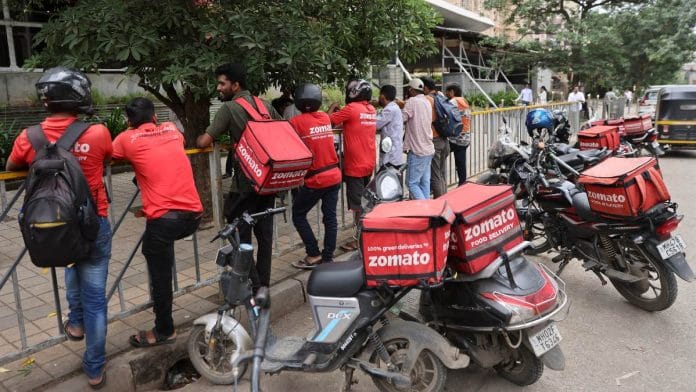



India rang in the new year with two parallel stories. One was celebratory: Zomato and Blinkit together clocked a record 75 lakh deliveries on New Year’s Eve, according to Deepinder Goyal. The other was anxious: gig-worker unions called an all-India strike over falling earnings, rising pressure, and basic rights.
In the afterglow, Goyal, Zomato co-founder and CEO of Eternal (the rebranded parent company that houses Zomato, Blinkit, and other businesses), put out a long thread on X that reopened a raw national argument. It was not merely about pay. It was about what the gig economy has done to class distance: it has brought inequality to the doorstep.
That diagnosis has power. But diagnosis is not a settlement. India now needs a middle path — one that preserves livelihoods and flexibility, yet hardwires safety and dignity into the model so the worker’s life is not the hidden “input cost” behind our convenience.
The false choice
The loudest voices offer a binary. Some say: “Ban or cripple quick commerce; it’s exploitation.” Others say: “Don’t moralise — these are jobs; people choose them.”
Both are incomplete.
A blunt ban rarely converts informal work into formal work overnight. It more often pushes workers back into deeper informality — cash, contractors, and invisible exploitation — while consumers regain comfortable distance. And yet, the libertarian shrug — “they choose it” — ignores the reality that platforms shape choices through algorithmic allocation, incentives, ratings, and sudden changes in payouts.
A middle path begins by accepting two truths simultaneously: That gig work is real income for millions, and that it is also real risk — fatigue, accidents, and medical shocks that can wipe out a household.
If we can build highways and insist on seatbelts, we can build the gig economy and insist on a safety floor.
What must be non-negotiable
The first plank should be simple and universal: every active gig worker must have meaningful life, health, and accident insurance, with a claims process that actually works.
Zomato itself states that delivery partners are provided “personal accidental life and health insurance.” The company’s disclosures also describe insurance coverage for death and disability and a claims process that can be initiated via the partner app.
That is good — only up to the point where it becomes performative. In India, the gulf between “coverage exists” and “claims are honoured swiftly” is where dignity often dies. What gig workers need is not only an insurance PDF. They need assisted claims: a guided, in-app, end-to-end pathway that helps with hospital linkage, documentation, follow-up, and settlement timelines.
Here’s the compromise India can live with: treat insurance as a built-in operating cost of every delivery and ride.
– Split the premium transparently between the aggregator and the customer.
– Add an explicit administrative top-up — say 10 per cent — ring-fenced for claim facilitation (helpline, hospital liaison, paperwork support, dispute escalation).
– Publish quarterly metrics: claims filed, accepted, rejected, median settlement time, and reasons for denial.
This is not unprecedented. Uber’s India Newsroom has described insurance for earners and riders “at no extra cost”, covering medical expenses, disability, and death for accidents occurring during trips arranged through the app. The point is not that Uber is perfect; the point is that the mechanism exists and can be standardised across platforms.
If prices rise modestly, it is not a moral failure. It is honesty. A delivery fee that includes safety is cleaner than a cheap delivery subsidised by risk.
Also read: Zomato founder Deepinder Goyal defends gig work. ‘It’s exposed guilt, inequality’
Working hours: easy to promise, hard to police
The second plank is fatigue management.
In a regimented factory, law and supervision can enforce an eight-hour shift and pay double wages for overtime. Gig work is not that environment. Partners log in and out of multiple apps, chase incentives, and extend hours because they need the money. A paper rule on “maximum hours” will fail if it does not match how work is actually organised.
But technology can do more than people admit. We already accept “screen time” warnings on our phones. We can accept fatigue warnings on delivery apps.
Uber shows what “doable” looks like. Its own help pages explain a driving-time limit: after 12 hours of driving time, drivers are prompted to go offline for a rest period, and the app sends notifications as they approach the limit.
Food and quick-commerce platforms can adopt analogous controls:
– A daily ‘active riding time’ counter (not just login time).
– Alerts at thresholds (for example, 2 hours left / 1 hour left / 30 minutes left).
– Mandatory breaks after sustained active riding.
– And — crucially — incentive design that doesn’t punish safer pacing.
If an app can predict demand spikes locality-wise, it can also predict fatigue risk user-wise. Speed is not the only thing algorithms can optimise.
The consumer’s role
The gig debate often pretends the consumer is a passive bystander. We are not. Every “deliver faster” expectation and every “free delivery” obsession is part of the pressure chain.
Indians also need to become better tippers — without drama, without condescension. Many of us living or travelling in the United States internalise that 15 per cent becomes the default tip, unless service is truly poor. We should bring some of that courtesy home. Even small, routine tips accumulate into meaningful monthly support — especially during peak nights like 31 December.
Platforms can help by making tipping frictionless and visible at checkout — nudging generosity as a norm, not an exception.
A parting shot to Deepinder Goyal
Goyal’s X post may have been triggered by a strike call and the moral noise around ultra-fast deliveries. But the public does not need only narrative brilliance; it needs leadership that converts visibility into reform.
So here is the ask: care not just about shareholders. Treat gig workers as the core stakeholders they are — the backbone that makes your brands possible. The minimum ethical bargain is not lofty rhetoric about progress. It is a hard safety floor: insurance that settles, fatigue controls that protect, and pricing that tells the truth about what dignity costs.
The doorbell is not the problem. The problem is whether we will keep outsourcing risk to the person who rings it.
KBS Sidhu is a former IAS officer who retired as Special Chief Secretary, Punjab. He tweets @kbssidhu1961. Views are personal.
(Edited by Aamaan Alam Khan)