







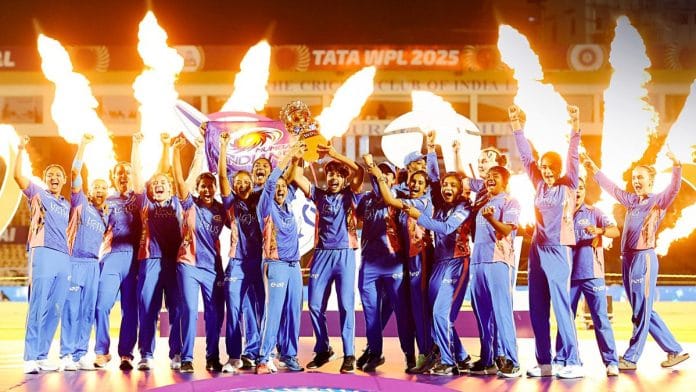



After India’s historic 2025 win at the ICC Women’s Cricket World Cup, something caught our eye. Many of the congratulatory posts were made by men. We initially dismissed the observation as purely coincidental. Perhaps our circle of female friends were simply less interested in sports. Curiosity gave way to inquiry. A closer examination highlighted that female viewership of professional sports remains alarmingly low.
According to a poll by YouGov conducted in January 2023, 58 per cent of men, in comparison to 33 per cent of women, are likely to have watched professional men’s sports in the preceding month. Similarly, approximately 31 per cent of men would have viewed women’s sports in the previous month in comparison to only 22 per cent of women. The FIFA Women’s World Cup 2023 became the most-watched female sports event in the world with an average viewership of 2 billion viewers. Yet, it falls short of the approximately 5 billion viewers for the 2022 FIFA Men’s World Cup. The statistical divide deepens when comparing avid male (44 per cent) and female (15 per cent) followers of sports events.
The persistently missing audience requires a look at deeper social conditioning, marketing strategies and economic structures. The reasons behind fewer female fans are systemic, not personal. The biological, psychological and economic angle requires closer inspection.
Allowing girls to enjoy sports
Psychologists Kay Bussey and Albert Bandura’s social cognitive theory of gender development explains how sports knowledge becomes codified as masculine. From early childhood, boys receive consistent modelling of sports engagement through parents, peers, and media, while getting evaluative feedback that reinforces sports interest as an expected competency. Girls receive messaging that sports are peripheral.
This is not about inherent interest but about differential reinforcement shaping self-efficacy beliefs around sports literacy. When a young boy asks about cricket statistics, he is encouraged to learn more, while a young girl asking the same question often receives gentle surprise or redirection. By adolescence, the gap widens dramatically, with research showing that girls who miss out on early sports socialisation exhibit significantly lower physical activity engagement in adulthood. Entire cohorts of women never develop habitual sports consumption in childhood and become a missing audience.
Stereotype threat, documented by Steven Spencer, Claude Steele and Diane Quinn in cognitive domains but increasingly recognised in sports contexts, creates a psychological taxation on female sports engagement. When women enter male-dominated sports environments, they face a latent threat that their presence might confirm stereotypes about women’s knowledge or investment. Women must constantly manage their legitimacy in ways that men do not. They hesitate before asking questions, fearing being perceived as uninformed, or overcompensate with excessive knowledge, transforming organic fandom into a performative exercise. Male-dominated sports spaces function as gatekeeping mechanisms where women must negotiate entry, making casual, enjoyable fandom feel impossible.
Also read: Nur Jahan to Chand Bibi—Indian women in sports have been erased from history
Sports marketing operates through masculine-coded narratives, marketing women around sports rather than into sports. Advertisements emphasise fashion and lifestyle rather than tactical appreciation or team loyalty. Women are positioned as peripheral consumers of lifestyle products adjacent to sports, not core consumers of sports entertainment.
This represents a massive market inefficiency: Women are roughly half the population and increasingly primary income earners, yet remain underutilised as revenue-generating audiences. Lower female viewership produces lower sponsorship revenue, constraining investment in women’s sports broadcasts and reinforcing perceptions that women’s sports are “niche.” This circular logic traps women’s sports in underinvestment cycles unrelated to athletic quality. Often, a chicken-egg situation is created wherein women’s sports receive less marketing, which in turn leads to low visibility, thus justifying a lack of investments and lower pay.
Reframing women as core sports consumers requires inclusive sports education, treating athletic literacy as a universal competency, marketing addressing women’s interests in tactical understanding, and commentary traditions welcoming female participation.
Women’s sports will not grow through athlete development alone but through making women’s consumption central to strategic planning. While women are encouraged to participate in sports activities, schools can introduce targeted measures to cultivate interest in sports by shaping conversations around recent matches. Teachers and parents can act as stakeholders by integrating sports viewership into everyday learning by treating women’s sports as cultural moments.
NEP 2020 recognises sports as a principal part of a child’s curriculum, but falls short in making provisions for the entry of girl children. Unless policies target young girls, a thriving sports culture for women cannot be built. As Holly Holm, the female professional boxer, explained, “Passion comes first, and everything else will fall into place”. Building an environment that encourages women to fall in love with sports is the first necessary step towards achieving sporting equality.
Namah Bose is a lawyer currently working with the Asian School of Cyber Laws and SettleWiseNow. She tweets @NamahBose. Saptarshi Gargari is a public policy researcher and co-founder of Citizens for Reform – India, a policy think tank. Views are personal.
(Edited by Theres Sudeep)
Encourage women sports in school. Then they would follow the same on TV.
Boys start playing outdoor aports early in life.
Some women don’t watch sports because they are busy smoking, drinking, and doing drugs.