






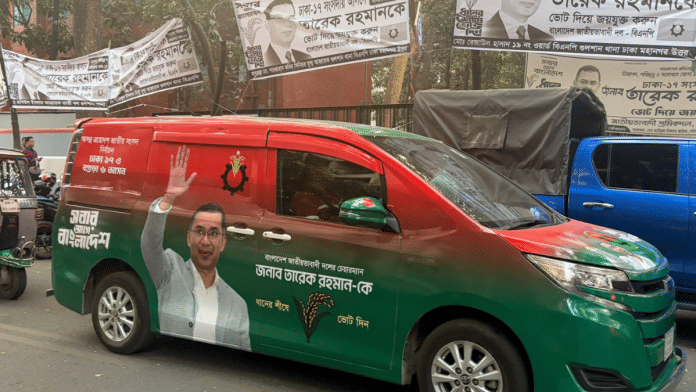



If one is to go by the adage ‘in every crisis there is an opportunity’, the result of the Bangladesh elections is not necessarily bad news for the Sheikh Hasina-led Awami League. It depends on how BNP’s Tarique Rahman wants to play it.
In the just concluded 13th national parliamentary elections, Bangladesh has given a decisive mandate to the Tarique Rahman-led Bangladesh Nationalist Party (BNP). The country’s largest Islamist party, the Bangladesh Jamaat-e-Islami, has emerged as a strong opposition, winning as many as 68 seats. A huge improvement given the fact that the party won only two seats in the last parliamentary polls it participated in in 2008. Where does that leave Sheikh Hasina and the Awami League, the largest party in Bangladesh?
A day after winning the Bangladesh polls, senior BNP leader Mirza Fakhrul Islam Alamgir said his party remains hopeful that India will extradite the former prime minister, asserting that the issue will not become a roadblock in ties between the two countries. On 17 November 2025, a special tribunal in Bangladesh had sentenced Hasina to death in absentia for crimes against humanity.
And it is not just Hasina who is a fugitive from the law in her country. Much of the Awami League’s senior leadership is either in India or have relocated to Western nations to escape prosecution, a huge number of the party’s rank and file are in jail in Bangladesh, even as the party’s political activities remain banned in the country. Given the circumstances the party finds itself in, and the decisive mandate given by the voters to the BNP, one would be compelled to think that the Awami League is staring at a long and lonely political winter.
Unless, the BNP wants to bring it back into the political game in order to divide the opposition space and cut a resurgent Jamaat to size.
Also read: BNP win in Bangladesh is a chance to reset Delhi-Dhaka ties—India is willing to forget the past
Tortured history, bitter rivalry
There is no love lost between the BNP and the Awami League. While between them the two parties have ruled Bangladesh for much of the 54-year-period of its independent history, its leaders have remained bitter rivals. If one were to write a book on the political history of Bangladesh, the Battle of the Begums, the tussle between the late Khaleda Zia of the BNP and Sheikh Hasina, would perhaps be the longest and the most compelling chapter. Both women ruled Bangladesh with iron fists, used the state machinery to crush the other and their tenures were marked by corruption charges and allegations of human rights abuse.
But by the mid-2010s, however, the battle between the begums had decisively tilted in favour of Hasina. She soon became Bangladesh’s longest-serving prime minister, and her tenure saw both impressive economic growth, and big infrastructure projects. Her critics accused her of centralising power, turning Bangladesh into a party-state by weakening institutions and targeting opposition while curbing media freedom.
Her rival Khaleda Zia, meanwhile, went to jail first on corruption charges and was later confined to her house, forcing her to all but withdraw from active politics, even as her party struggled to put up a meaningful challenge to the ruling dispensation. When the 7 January 2024 polls that brought Sheikh Hasina to power for a record fourth consecutive term (fifth overall) came, the BNP called for a boycott after the party’s demand for an election to be conducted by a neutral caretaker government was shot down.
Khaleda Zia is no more and her son Tarique Rahman has now returned to Bangladesh after 17 years of exile in the UK and is all set to become the next prime minister of Bangladesh.
In October 2018, Tarique Rahman along with 18 others were sentenced to life imprisonment for the 21 August 2004 grenade attack at an Awami League rally where Sheikh Hasina was present. After the fall of the Hasina government, Tarique and others were acquitted by the courts.
Given such bitter history between the two parties, why would Tarique Rahman lift the ban on the Awami League’s political activities and make it easy for the party leaders to regain lost ground in Bangladesh’s political landscape?
Also read: Bangladesh women take on Jamaat with memes and marches. Their future is at stake
The threat of Jamaat
For much of its political history in independent Bangladesh, the Jamaat was seen as a junior partner of the BNP. The party was also a coalition partner in the BNP-led government that came to power in 2001.
All that changed this year, when the party, now a rival to the BNP, polled around 30-35 per cent of the vote in roughly 225 constituencies it contested—a dramatic leap from its long-standing 5-10 per cent vote share.
“Jamaat’s jump from a 10 per cent party to one polling above 30 per cent reshapes the political map. For decades, Bangladeshi politics revolved around two poles: The Awami League and the BNP. With the Awami League banned and weakened, Jamaat has stepped into the vacuum as the principal challenger to the BNP,” Masum Billah wrote in The Business Standard.
“With 77 seats, we have nearly quadrupled our parliamentary presence and become one of the strongest Opposition blocs in modern Bangladeshi politics. This is not a setback; this is a foundation,” said Jamaat Ameer Dr Shafiqur Rahman.
What has also been worrying Bangladesh watchers is the Jamaat’s active diplomatic engagement with the US. “Despite their electoral loss, the Jamaat’s chokehold on Bangladesh’s societal narrative as well as mob behaviour remains,” geopolitical expert Sagorika Sinha told ThePrint. Sinha said the recent confirmation of support to the Jamaat from American intelligence ensures that the new Bangladeshi prime minister will have a difficult time directing Bangladesh without ideological compromise toward Jamaat absolutism.
With the Jamaat eating up almost the whole of the opposition space, it might just be prudent for Tarique Rahman to gradually bring back the Awami League into the game.
It is not that the BNP and the Awami League have never been on the same page before. In the late 1980s, Hasina and Khaleda joined hands in a broad alliance to demand the resignation of military dictator Hussain Muhammad Ershad, who finally had to step down on 6 December 1990.
It remains to be seen if Tarique Rahman lifts the ban on Awami League’s political activities in Bangladesh to curb the growing clout of the Jamaat. What he does about Sheikh Hasina is another matter.
Deep Halder is an author and a contributing editor at ThePrint. He tweets @deepscribble. Views are personal.
(Edited by Theres Sudeep)