





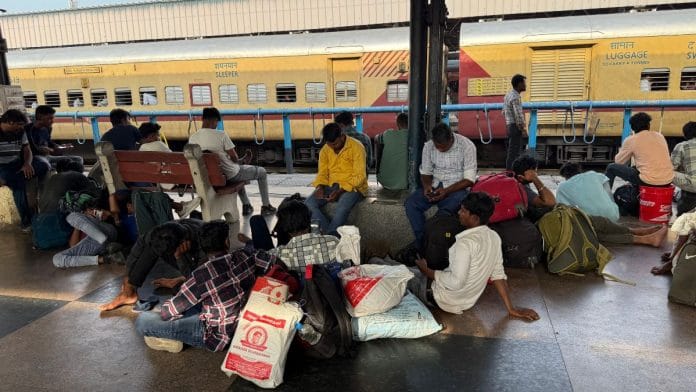



There is a larger issue to address with the census exercise: That of the disconnect between where people stay and work, and where they exercise their franchise. We know, anecdotally, that India is now a land of a million migrants who work outside their home states in urban centres—the new magnets of entrepreneurship—absorbing people from the hinterlands.
Construction workers who build infrastructure in Bengaluru, Hyderabad, Noida, Mohali, Gurugram and Mumbai are counted in Bihar, Jharkhand, Orissa and West Bengal. The hospitality and aviation industry has a substantial workforce from the Northeast.
And now even the leadership of regional political parties—be it the Dravidian parties in Tamil Nādu, or Shiv Sena in Mumbai, or the TMC in West Bengal and the Akali Dal in Punjab—has become conscious of the fact that their economies will not be able to function if the migrants feel insecure, unsafe and unwanted.
However, the census will count people on the basis of ‘where they are on the D Day’, whereas the electoral roll is based on where they were born and did their schooling. That is unless, as a matter of conscious choice, they get the name deleted in their janmabhoomi (place of birth), and register it in the karmabhoomi (place of work).
It is true that the Representation of Peoples Act (RPA) stipulates a six-month residency requirement, but the fact is that many migrant workers and their families continue to retain their vote in their native village. It certainly gives them a voice in the politics of their kanmabhoomi, but this is at the cost of disenfranchisement at their karmabhoomi.
Many don’t vote because travelling home is expensive. Others vote in villages whose issues they no longer experience, while remaining voiceless in cities whose governance affects them directly.
This creates a distortion. City planning is based on census populations, including migrants, but they cannot vote in municipal elections because they are registered as voters elsewhere. Urban governance becomes unaccountable to urban residents and rural areas receive allocations for citizens who are no longer there.
Also read: Population panic and Bimaru fears locked India’s seats. Census 2027 will show reality
Caste enumeration: the creamy layer
The widely accepted and uniquely Indian concept of ‘creamy layer’ was first suggested in 1969 by the Satavahana Commission appointed by M Karunanidhi, then CM of Tamil Nadu, in the context of reservations for Backward castes.
Although it was not accepted at that time, the imperative of political mobilisation, and judicial pronouncements led to the formation of Justice RN Prasad Commission to examine the creamy layer issue. It recommended two criteria to exclude the creamy layer among OBCs from reservation. These included wards of people who occupied constitutional positions like President, Vice-President, Supreme Court and high court judges, Group A service category, Colonel and above ranks in the Armed Forces, professionals in service, trade, business and industry, and property owners. The second criterion is the income/wealth test which takes into account the annual income of the individual. The cut off at present stands at Rs 8 lakh per annum.
This census will map both the numbers and the incomes of various caste groups, including the SCs and the STs thereby yielding granular data on the income, asset and wealth profile of all communities and caste groups. Although the PM has assured a delegation of BJP MPs belonging to the SC/ST that the government was not considering the creamy layer exclusion for them, the demand from those at the bottom of the pyramid in the SC/ST community is gaining ground, and is receiving support from several quarters.
Former CJI BR Gavai’s forthright support to the exclusion of creamy layer from the ambit of the SC/ST reservation has given greater heft to this argument. The Census results will provide the empirical details to make an informed decision. But one thing is for sure: The debate will indeed be acrimonious.
In any case, one must not forget that this was a transitional provision, and the idea of reservation was that over time social, cultural, educational and economic integration would obviate the need for its continuation over an indefinite period.
Also read: Census 2027 is special. It could undo the 1971 freeze on constituencies
The North-South divide
The North-South divide is indeed the ‘mother’ of all divides. Arguments for and against a new delimitation based on Census 2027 cuts across party lines. All the southern states are vehement in their opposition to a change in the status quo, with regard to allocation of seats in the parliament.
Writing in Open magazine Shashi Tharoor notes: “While there is some logic to the argument that a democracy must value all its citizens equally—whether they live in a progressive state or in one that, by failing to empower its women to reduce fertility, has allowed its population to shoot through the roof—no federal democracy can survive the perception that states would lose political clout if they developed well, while others would gain more seats in Parliament as a reward for failure.”
This is not different from what Chandrababu Naidu, or MK Stalin, or MA Baby have said on the issue.
Not to be left behind, the opinion from a former Supreme Court Justice J Chelameswar reads as follows: “When that (delimitation) happens states like Tamil Nadu and Kerala are going to lose a large number of constituencies that they have, while states like Bihar and UP, where population is not controlled will have more constituencies. What will be the state of federalism in India? What will happen to the concept of the Union of India as was contemplated?”
The feelings are indeed intense, for two ex IAS officers—former Cabinet Secretary KM Chandrasekhar and former RBI Governor D Subbarao—have also put forth similar arguments. Chandrasekhar has opined that “all south Indian states will stand to lose their political influence in comparison with the North”.
Subbarao noted that the ‘North-South divide’ has two dimensions—fiscal and political. For the last few years, some southern states have raised concerns that delimitation based on population growth may bring down the number of Lok Sabha seats in the South relative to the North, and this will increase the “unfair tax money devolution” to southern states. While Karnataka and Tamil Nadu received just 15 paise for every rupee tax contributed to the central tax pool, Bihar and Jharkhand got more than a rupee for every rupee they contributed’.
“So, what will happen then is a double whammy for the South that even as they lose political clout, they have to continue to subsidise the rest of the country,” he said, adding that he hopes that the governments can resolve this amicably because “we need to be a strong country”.
On the other hand, the MPs from the North argue that their seats should be increased to ensure that the voice of their electorate is in proportion to their southern counterparts. They contend that the current delimitation strategy disenfranchises residents of northern and eastern States by allocating fewer seats to them than if representation were equal.
For example, with equal representation, Bihar would receive 47 Lok Sabha seats instead of the current 40, and Kerala’s seats would decrease to 15 from the current 20.
his is the third instalment of a four-part series on the census in India, based on a keynote address delivered at the annual juridical conclave at NUJS Kolkata.
Sanjeev Chopra is a former IAS officer and Festival Director of Valley of Words. Until recently, he was director, Lal Bahadur Shastri National Academy of Administration. He tweets @ChopraSanjeev. Views are personal.
(Edited by Theres Sudeep)
There should be an exclusion criteria for income and wealth too.
If you have more wealth, then you get less relaxation in marks. Reservation percentage can remain, though. Inversely proportional.
All people should link their properties, esp lands with Aadhaar. All gold purchases linked to Aadhaar.
If someone has any unregistered assets, and they take reservations, then govt should take away that extra land/gold etc.