






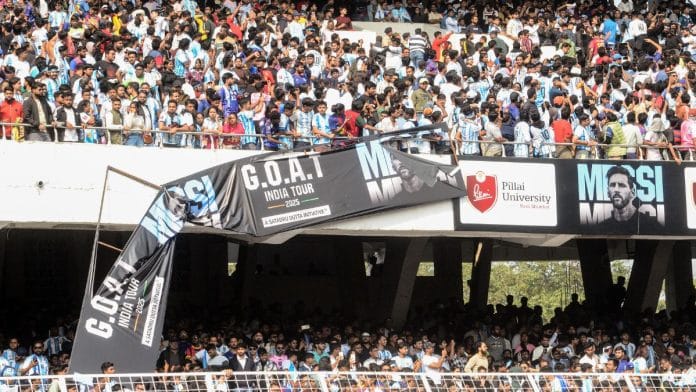



Lionel Messi, my children tell me, is a footballer of eminence. Being brought up on the memories of Buchi Babu a cricket aficionado and a lesser-known football enthusiast from an obscure corner of the world, then called Madras and now, perhaps, similarly positioned even as Chennai—I am impressed with the Argentine footballer’s popularity, but I must admit I am not carried away.
Anyway, Messi came to India, that is Bharat. He came to Calcutta (sorry Kolkata), the home of Mohun Bagan, Mohammedan SC and East Bengal FC, and redolent memories of barefoot footballers beating British regimental teams. And his visit was a disaster. Families shelled out their monthly incomes to get a glimpse of the semi-divine Messi. Instead, they got to behold the rotund bellies and the unseemly derrieres of our homegrown netas in jeans and not in dhotis.
And then Messi went to Hyderabad. Things turned out quite well there. The fans were happy. The place was peaceful. And presumably the semi-divine player was happy too. Mumbai was a little less organised, but on balance reasonable.
What does this tell you? Kolkata and West Bengal are almost beyond redemption. It was the prescient VS Naipaul who said that Bengal committed intellectual suicide. And now this humble writer is forced to say that Bengal is committing intellectual suicide on an industrial scale.
I lived in Kolkata some 50 years ago when the decline had already started. There was no former Chief Minister Bidhan Chandra Roy in the firmament. CMs Ajoy Mukherjee and Jyoti Basu represented the cowardice and incompetence of Bengali leadership, which, sorry to say, the Bengali public willingly and volitionally accepted and supported. Some decades later, I remember visiting my elderly Marwari friend in Kolkata, and I congratulated him on the improvement in the city’s power situation. He started weeping. Even though he knew that my association with Hindi was rudimentary, he said, “Asia mat kaho Rao Sahib. Hamne Karkhaney band kar diye hain. Isi liye power cut kum hain. Yeh koi tareeka hota hai?” (Don’t say that, Rao Sahib. We’ve shut down the factories—that’s why the power cuts are fewer. Is that any way to do things?)
He said that the power situation was improving, not from the supply side, but from the demand side. Factories were closing. Therefore, less electricity was being demanded. And that, in his opinion, was not the sensible way to solve the “power shortage” problem in the state.
I still go to Kolkata every few years. I visit Kalighat and the Dakshineswar Kali temple. And I try to find time for Kati Kababs at Nizams and breakfast at the Tollygunge Club. I even try to fit in College Street, the Coffee Shop, the National Museum, and Jorasanko. But I must admit that that whole experience is like a visit to a Museum-city. In all fairness, Paris seems quite similar. But in tropical Kolkata, the sense of decay is more immediate than in temperate Paris. The only redeeming feature, which I guess we can credit to the present dispensation, is that Prinseps Ghat looks really good. I don’t know who built the new bridge across the Bhagirathi to Dakshineswar, but believe me the new bridge is a godsend.
My Marwari friend’s lament haunts Bengal. Companies move away. Organised economic activity declines. Talented people leave not just for the West, but for Bengaluru, Mumbai, Chennai, Pune, Gurugram, Noida, and yes, for Hyderabad. All these places now have large-scale Durga Pujo activities. Gone are the days of pulsating businesses, vigorous capital markets and the famed Bengal renaissance. Lawlessness, thuggery, casual violence—these have become today’s theme songs.
Also read: Behind PM Modi’s choice of Nitin Nabin as Nadda’s successor—many explanations, only one reason
The underlying malaise
Infatuated with Marxism, one would expect that Bengali leaders would subscribe to “economic determinism” or at least to the idea that in the absence of a firm economic foundation, so-called cultural achievements eventually wither away. I have not read the state-sponsored textbooks in Bengal, but I am sure that they do not tell the students that the great artistic endeavours of several generations of Tagores were built on the bedrock of the fortunes accumulated by the Opium House, Tagore, Carr and Co. “Prince” Dwarkanath Tagore, who traded in many other goods was one of the wealthiest persons in the British Empire.
Opium may be politically incorrect today, but there are many other areas of economic activity and trade, all of which are being ignored by contemporary Bengal. The attempt is to keep talking about culture, arts, sociology, politics and an imagined Bengali identity. All of this, however, rests on an extremely rickety economic base. And not just rickety—the base may be disappearing altogether. Whatever economic activity exists is dominated by underworld rackets, extortion and dismal rent-seeking.
Just think about the fact that people in the state are willing to bribe their way into employment as government school-teachers, while independent surveys tell us that these teachers do not turn up to work. Their rate of absence from work is higher in poorer neighbourhoods than in richer ones. And the Teachers Unions are theoretically committed to the welfare of the poor!
Of course, this kind of thing happens elsewhere in India too. But in Bengal, it seems to have acquired a rare malignancy, which is causing the entire society to metastasise.
Has Bengal reached a point of no return? That’s difficult to say, simply because humans can never give up stray strands of optimism. The other intriguing question is whether other Indian states could become like Bengal. And what are the warning signals that other states should pay attention to? No one wants an RG Kar Hospital rape case or a messy Messi incident, which are actually symptoms of an underlying malaise. It would be wise for other state governments to send their officials to Bengal and ask them to prepare primers on what not to do.
Jaithirth ‘Jerry’ Rao is a retired entrepreneur who lives in Lonavala. He has published three books: ‘Notes from an Indian Conservative’, ‘The Indian Conservative’, and ‘Economist Gandhi’. Views are personal.
(Edited by Ratan Priya)
Are you planning to leave India as well after the India Open embarrassment, Jerry, or was your piece simply narrative-building rooted in familiar stereotypes?
The India Open did draw criticism—and rightly so—but by that logic, Indians themselves should also be subjected to the same sweeping scrutiny for being “obsessed with culture,” as you imply. So who, exactly, is expected to apologise now?
This is no longer a “Kolkata problem” or an expression of some so-called “Bengali weakness.” What is astonishing is how effortlessly an entire narrative has been constructed around a single incident. A case of plain mismanagement has suddenly been transformed into a civilisational report card on a state and its people.
If isolated failures are to be treated as evidence of societal decay, then what about the Kumbh Mela stampede? Did that reflect India’s overall moral or administrative collapse? If we are serious about generalisation, why not apply the same standard uniformly to the entire country? Of course, that would be politically inconvenient.
This selective outrage is precisely the problem.
What you present as analysis reads more like personal opinion masquerading as objective truth. The fallacy of hasty generalisation is on full display here. One incident—regardless of how unfortunate—cannot credibly be used to diagnose political, cultural, or social decay.
Such an incident could have occurred anywhere.
Linking administrative failure to political decay, and then further stretching it to question the “hollowness” of cultural practices, is intellectually hollow. Culture has little to do with crowd management failures, and invoking it only serves ideological ends.
Ultimately, the piece appears less like a genuine attempt at diagnosis or reform and more like a politically motivated commentary designed to appease a particular audience—rather than a serious, well-reasoned analysis.
Jerry are you planning to leave India as well after the India open embarrassment? Or was your piece narrative making based on stereotypes.
India open drew flak so Indians too should come under scrutiny for being obsessed with culture etc since. Besides, who should say sorry now?
It is no more a Kolkata thing or exposed Bengali weakness!
Personal opinion of your are not objective truth.
I’m amazed at how easily a whole narrative can be built around a single incident. A case of simple mismanagement suddenly becomes a “report card” on an entire state and its people.
What about the Kumbh Mela stampede? Didn’t that reflect India’s decay then? Before the release of Baahubali, fans were so desperate for tickets that the chaos almost turned into a stampede. What was that? Just a “fan moment”?
Yet when it comes to political convenience, one particular incident is blown completely out of proportion and generalized to judge an entire state. If we’re going to generalize, then why not apply the same standard to India as a whole? But of course, that wouldn’t be politically convenient.
It’s ridiculous.
It looks more like a personal opinion meant to satisfy or create a narrative rather than a genuine effort to improve something.
Making generalizations based on a single incident is nothing but pure logical fallacy.
Fallacy of generalization is being committed.
It could have happened anywhere.
Linking this incident to political decay is nothing but intellectual hollowness of the author.
Besides, questioning the hollowness of the cultural practices is not even related to the incident.
It appears to be a political piece meant to appease certain section rather than a well thought out analysis.
The author’s assertion that West Bengal is “beyond redemption” may be carrying things a bit too far as despite its multiple shortcomings the state still ranks as one of India’s top economies. West Bengal is also the largest economy in eastern India. The Messi episode in Kolkata, unfortunate as it was, cannot be used to justify the “beyond redemption” argument as worse instances have happened and continue to happen elsewhere too. As a respected business leader and seeming well-wisher of West Bengal, the author could have underlined specific measures through which the state can improve its act rather than apparently resort to the usage of words which may not prove of much help and possibly appear prejudicial to some. By the way, the Messi programs in Hyderabad, Mumbai and Delhi were also held due to the initiative taken by one enterprising “Bengali”.
Mr.Rao (1) 1st point do y know Kolkata is only city where Messi visited twice ? And both time organizer or the person who bring him was Bengali..yes its right.Much to pain your back right…you should give credit to the Bengali organisation who bring him to India..or should I say hyderabad ,Delhi and Mumbai 1st time ?
If recent event of alleged assault on a female Bengali singer is anything to go by, then even the cultural ethos of Bengal is being challenged by idelogy bordering on fantacism. Wake up call for many but then who are we kidding. Educated Bengalis have been immigrating to outside India as well as to other Indian states in since generations now.