










At first glance, it may not seem that the ongoing conflict between the United States, Israel and Iran has much to do with how India governs its technology ecosystem. Outside the defence domain, the link between kinetic conflict in West Asia and domestic tech policy appears tenuous. But Iran’s targeting of data centres in the United Arab Emirates and Bahrain brings tech policy into focus.
The war threatens the web of global connectivity that flows through these hubs. West Asian economies have invested significant petrodollars into digital infrastructure as part of long-term diversification away from hydrocarbons. The UAE has planned investments worth $44 billion in AI infrastructure and data centre expansion. India has similar ambitions as it expands its digital economy and the physical infrastructure that sustains it.
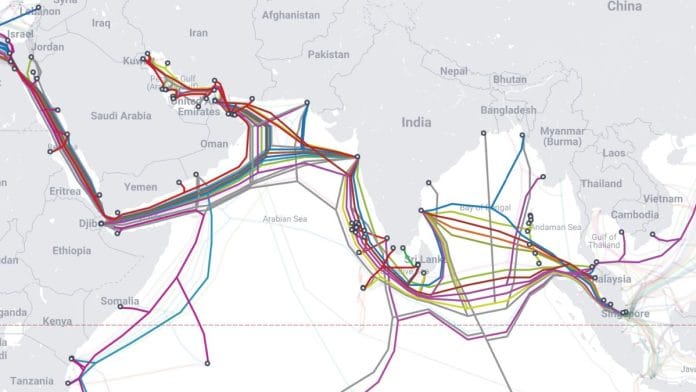
Connectivity risks are not limited to data centres. Wars in recent years have also demonstrated the fragility of submarine cables that carry a majority of global internet traffic. The conflict between Russia and Ukraine, for instance, is accompanied by repeated disruptions to cable infrastructure in the Baltic Sea.
Such developments arrive at a moment when calls for “tech sovereignty” are growing louder. This discourse is pronounced in Europe, whose policymakers have spent the past decade experimenting with various formulations of autonomy. For instance, the General Data Protection Regulation, the Digital Markets Act and the Digital Services Act embed market-access restrictions into their provisions. The intellectual spillovers of these debates have reached middle powers like India, where parliamentary committees and policy forums have occasionally invoked similar notions.
Yet tech sovereignty is not something that legislatures can deliver simply through new statutes or regulatory frameworks, as the European experience has shown. Many in Europe now demand a refreshed approach, belatedly sensing a lack of autonomy despite efforts. But achieving policy clarity requires a fundamental question to be answered first: What does sovereignty actually mean in an interconnected digital environment?
Policymakers and citizens mistakenly think of sovereignty as an amorphous construct that can be delivered through the right regulatory “stack” or through a set of trusted technologies. In some ways, this mirrors how the internet itself is commonly imagined—as something formless and intangible. For most citizens, the internet’s physical presence is limited to last-mile devices such as smartphones or home routers.
The internet, however, is fundamentally a story of heavy-duty, capital-intensive backbone infrastructure. Data centres, fibre networks, and submarine cables that stretch across oceans. These are each designed with redundancy in mind. This explains why attacks on data centres in the UAE and Bahrain have not severed these countries from the global internet.
India hosts seventeen international submarine cables and plans to expand both their capacity and the number of associated landing stations in the coming years. A 2025 report by New York-based Jefferies Financial Group projects India’s data capacity to reach 8 gigawatts by 2030. The events unfolding in West Asia should therefore prompt us to reconsider how we think about tech sovereignty.
Three ideas merit closer attention.
Also read: 2025 and India’s tech ambitions. What we got right and wrong
True technological resilience
First, policymakers should revisit the concept of “trusted partnerships”, which has underpinned much of the tech cooperation discourse over the past decade. These were often loosely defined frameworks with limited hard obligations, such as the initiative around ‘Trusted Supply Chains’, which emerged from the Quadrilateral Security Dialogue. Geopolitical shifts have exposed the limitations of such arrangements.
India should move toward binding agreements with key partners that contain clear commitments regarding the protection, hosting, and resilience of digital infrastructure. New Delhi has taken the first steps to incorporate tech into its new-generation trade agreements. Our 2022 free trade pact with the UAE, for instance, includes a digital trade chapter. However, related provisions remain best-effort commitments rather than enforceable obligations.
Second, India should broaden its conception of tech sovereignty by strengthening engagement between governments and the private sector. Much of the existing architecture for international dialogue is rooted in a traditional international-relations framework. Forums such as the Munich Security Conference or the Shangri-La Dialogue exemplify this model, where discussions are dominated by governments and security establishments, and the private sector follows. But the digital economy is heavily shaped by private actors who build, finance, and operate the internet.
In the earlier phase of globalisation, private companies were among the main beneficiaries of the international order shaped by diplomatic engagement. Today, they find themselves exposed to the risks generated by geopolitical rivalry. Governments therefore need to reimagine dialogue to prioritise confidence building, problem solving around ease-of-doing-business, and sustained engagement to encourage investment and trade.
Finally, true technological resilience cannot emerge if India’s tech ecosystem is insular. The success of our traditional information technology services industry was built on a strong export orientation. Continually diversifying economic relationships will help ensure that India’s new technology businesses, which run both infrastructure and the services running atop it, are not reliant on domestic demand alone.
The West Asian crisis reiterates that shocks in global markets transmit instability into the domestic economy. Sovereignty, in this sense, should not be interpreted as isolationism. Instead, it should be understood as the ability to engage and shape global networks without becoming vulnerable to them.
Vivan Sharan and Dr Ajai Garg are technology policy experts associated with Koan Advisory, New Delhi. Views are personal.
(Edited by Theres Sudeep)