






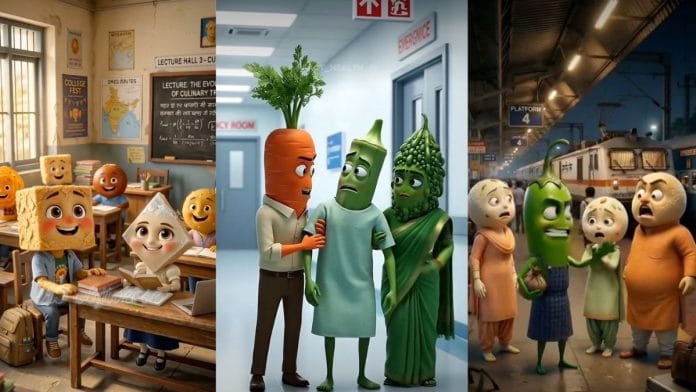



Yes, you heard it right. Strawberry is cheating on orange with banana. And it’s not happening in your fridge, but on Instagram’s hottest new genre of AI slop: Food videos.
The script for the AI food Viral Spiral is ever familiar. You’ve already met the cast of characters in cat reels: The suffering housewife, the closeted husband, the skinny vamp. And if there’s anything AI content ‘creators’ know, it’s rinse and repeat. Who can blame them—the thrilling encounters of Strawberita, Bananito, and Appletina have the internet in a chokehold. Even the staunchest of AI haters tell me they can’t resist the wacky stories.
The reels often come as part of a series and end on cliffhangers that haunt you. Will the mistreated daughter-in-law baingan triumph over her evil mother-in-law karela? Will the seductress tomato be punished for snatching aaloo away from his dutiful wife, gobhi? Will sweet rasmalai get to marry the love of her life, green chilli?
The commenters are familiar with the plot now. “Strawberita is always up to something,” is a recurring line. But the anticipation never stops—“next part” floods the comment sections.
Friends at the office have a serious complaint with these videos: What’s with the sexualisation of strawberries and tomatoes? Why are they always cast as villains, vamps, cheaters, and bar dancers? No one thought we’d need feminism for fruits, but anything is possible where AI is involved.
Also read: How the BMC elections killed AI Hulk
A sedative to war
If Western AI videos were obsessed with recreating Love Island and telenovela-style cheating storylines, Indian ones have gone back to their roots. We much prefer the sanskari slop: Jalebi marrying samosa, rasmalai rebelling against her parents, and rajma leaving India to be with the love of his life: Mexican taco. Desi Gen Z yearns for Star Plus.
Everyone around me has one question: Why can’t we stop the slop? First it was the cat videos, and now it’s food. What uncharted human recesses has AI tapped into that make it so addictive?
Let’s face it, movies are now an occasional indulgence. People won’t go to the theatres unless it involves some cute violence, CGI spectacle, and a heavy serving of propaganda. And who has the attention span for a daily soap? Content overload on streaming sites has its own demon. AI is actually doing some heavy-duty problem-solving for human fatigue.
Some might say Gen Z has fallen off the generational humour wagon: “How can you guys find these videos funny?” The answer isn’t in the videos themselves. It’s in news headlines.
What else can people paralysed by wars, plummeting economies, and thinning jobs do but scroll? That’s the sweet thing about late-stage capitalism: There are always sedatives at hand.
It’s not the first time a traumatised generation has found refuge in absurdism. In the 1950s, writers and artists explored the meaninglessness of their characters’ everyday actions. In 2026, we’re watching the amusing hallucinations of a sinister all-knowing machine. I, for one, think it’s just as deep.
Views are personal.
(Edited by Theres Sudeep)