






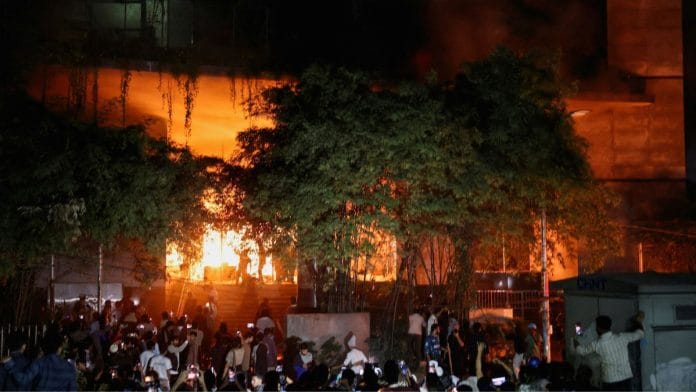



Mad violence unfolded in Bangladesh after anti-India youth leader Sharif Osman Hadi was declared dead. The attack on the Indian mission offices may come as a surprise to those who have taken an interest in the country only after the fall of the Sheikh Hasina government on 5 August 2024. In reality, it was the least surprising aspect of the violence. Sure, a red line was crossed with the attacks, but those with a finger on the pulse of our eastern neighbour would know that strong anti-India sentiment did not begin with the fall of Hasina.
The call to sever all ties with India began well before Hasina’s fall with the India Out campaign that called for a boycott of all Indian products from Bangladesh markets.
What’s more surprising is that the Islamist project in the country is in full swing despite the recent announcement that elections would be held on 12 February 2026. The attack on Chhayanaut office and prominent newspaper offices, as well as the public lynching of a Hindu man over alleged blasphemy, are strong indicators of a Bangladesh well on its way to Islamist rule, far away from electoral democracy. The announcement of the date for the next elections means very little.
Hadi’s story ends, Islamist violence begins
On 17 December, amid a deteriorating security situation and targeted hate speeches against India, the Indian Visa Application Centre in Dhaka was temporarily closed. The move came hours after India summoned Bangladesh’s High Commissioner in New Delhi, Muhammad Riaz Hamidullah, to issue a formal diplomatic protest over threats to the Indian High Commission in Dhaka and inflammatory anti-India statements from Bangladeshi political leaders.
Anti-India remarks became more powerful after the shooting of Hadi on 12 December, as the local press reported that the police suspected that gunman Faisal Karim Masud and his alleged accomplice Alamgir Sheikh fled to India shortly after the attack. “Investigators believe the pair crossed the border through Haluaghat in Mymensingh on Friday, according to information provided to the Dhaka Tribune by a police source on Sunday,” Dhaka Tribune reported on 14 December.
Thousands of protesters, including radical groups and student bodies such as the Inquilab Manch, marched toward the Indian High Commission in Dhaka on 17 December. A mob attacked the Indian Assistant High Commission in Chittagong on 19 December after Hadi was declared dead. These were highly condemnable acts that crossed a diplomatic red line, but were more populist and political protests; not necessarily Islamist in nature.
It is the attack on the free press, the lynching and burning of a Bangladeshi Hindu man, and the vandalism in the office of cultural centre Chhayanaut that had nothing to do with India or Hadi’s death, that raise alarm. Why were the offices of The Daily Star and the Prothom Alo newspapers (both belonging to the Transcom group) raided by a mob that looted cash, stole or destroyed about 150 computers, and set multiple floors of both buildings on fire?
The answer is simple. The nationwide emotional outburst over Hadi’s death was used to target all that stood for the idea of a progressive Bangladesh.
“Both these papers have been critical of Sheikh Hasina and supportive of the Yunus administration from time to time. The mob wrongly accused the papers of acting like Indian agents and set their offices on fire. The real issue is that both papers are widely recognised for their liberal, secular, and progressive editorial stances, something unwelcome in the radical Islamist reimagining of Bangladesh,” Bangladeshi journalist Sahidul Hasan Khokon told ThePrint.
Also read: Modi govt’s repeal of MGNREGA is all about extracting money from states, not reform
‘Sharia is in place’
For Bangladeshi Hindu rights activist Ranjit Roy, the public lynching of Dipu Chandra Das in Mymensingh district marks a new low for whatever remains of Bangladesh’s secular credentials. Roy told ThePrint that Hindus have come under targeted violence ever since the fall of the Hasina regime.
“But the manner in which the entire incident happened, the way Das was dragged out of a police station by a mob, stripped, lynched, hung from a rope and set on fire as a crowd cheered and recorded the incident on their phones is taken from the Taliban playbook. It was a loud and clear message to from the Islamists to the democracy-loving population of Bangladesh: forget the rule of law, Sharia is in place,” Roy said.
The attack on Chhayanaut office, one of Bangladesh’s oldest cultural centres, reflects radical Islamists’ intolerance for art and culture. A Bangladeshi actor told ThePrint on the condition of anonymity that actors have come under increased pressure from Islamists since the fall of Hasina.
“The Yunus government has also succumbed to that pressure in the past year by letting fake cases be filed against actors and actresses just to stop us from doing our work. But the attack on Chhayanaut was a final warning to us. There is no place for art and culture in new Bangladesh,” the actor said.
Bangladeshi political columnist SM Faiyaz Hossian told ThePrint that Hadi has become a cult in Bangladesh after his death. “Yunus has declared a public holiday and pledged to fulfil Hadi’s dreams. But what dreams were those? Watch his old videos. Hadi was a misogynist and a radical who gained notoriety for his vulgar rhetoric that crudely invoked women’s genitals. He became the symbol of mob violence and radicalisation while he was alive. After his death, even the government is celebrating him,” Hossain said.
Using Hadi’s death as an excuse, an attack was made on Bangladesh’s free press, minorities, and art and culture. It is in sync with the Islamist project in the country, and a message to anyone hoping for a return to electoral democracy on 12 February 2026.
Deep Halder is an author and a contributing editor at ThePrint. He tweets @deepscribble. Views are personal.
(Edited by Prasanna Bachchhav)
If the “praja” of Bangladesh wants a taste of Islamist rule, let them have it. But this time if a 1971 situation arises, I am leaning toward the side where India will be forced to expand its territory to accommodate persecuted minorities – religious and political.