






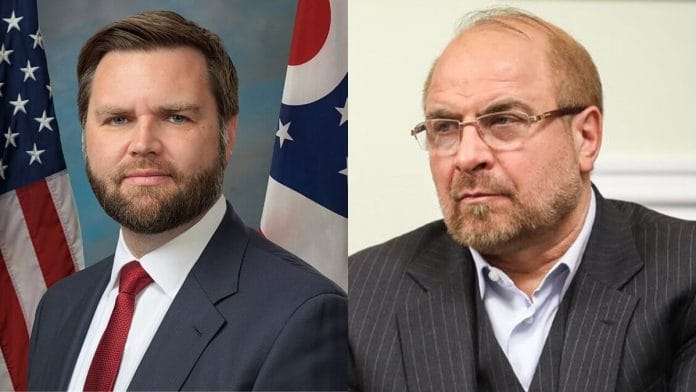



The recent, unprecedented US-Iran negotiations seemed serious enough and had the positive effect of establishing channels of communication between US Vice President JD Vance and the Iranian delegation led by Mohammad-Bagher Ghalibaf.
Even as they disagreed—it was unfair to expect success from just one meet, after all—both sides remained respectful and neither explicitly ruled out further meetings. But two key points must be noted before we discuss the latest development related to the naval blockade announced by President Donald Trump.
Iran’s priority: long-term deterrence
First, since early to mid-March, Iran’s primary objective has been clear: to establish long-term deterrence vis-à-vis the US by imposing strong economic and political costs on the Trump administration through its de facto low-cost blockade of the Strait of Hormuz. This deterrence—through pain—is seen as the only guarantee of the regime’s future survival, given that Israel and the US have adopted a ‘mowing the lawn’ approach toward Iran and given that the US feels free (in principle) to withdraw from any signed agreement with Tehran and re-launch attacks at will anytime. A Chinese security guarantee could have averted such a desperate approach, but Beijing is also understandably not too eager to provide such an assurance despite Iranian requests.
The meeting in Islamabad allowed the Iranian regime to test whether the US has reached such a threshold of pain and resultant course-correction. Unfortunately for the world, it got the impression (justified or not) that the US has not. This is, according to Iran, evidenced by the US’ ‘ambitious’ negotiating position, which seeks to extract a positive commitment against nuclear enrichment and capabilities as well as a return to the status quo ante on the Strait of Hormuz in exchange for defreezing Iranian revenues worth $27 billion.
For Iran, this was simply too much to give away for relatively little to no assurance against future attacks. The US adopts a perception framework that expects Iran to be more compromising after leadership decapitation, infrastructure bombing, and military neutering. On the other hand, the Iranian leadership assesses that it has been able to absorb the worst of the attacks and now has less to lose than before.
The preeminent strategist Thomas Schelling had famously described the relation between brute force and effective deterrence (the power to hurt) in the following way: “Brute force succeeds when it is used, whereas the power to hurt is most successful when it is held in reserve.” The US negotiating position sees only the former, while Iran remains focused on the latter. Hence, Iran’s approach has been more Schellingesque—in its listing of US commercial enterprises in the region as future targets, for instance.
Also read: India’s non-profits are in a regulatory hell—state surveillance to confiscation of assets
The rationale behind the blockade: It’s complicated
Second, the failure of the talks has also emboldened many within and outside the Trump administration (including the Israeli ambassador to the US) to advocate for continued war, given that the Iranians have shown themselves to be undeniably incalcitrant. This combination of Iranian dissatisfaction with the lack of behavioural shifts from the Trump administration and the simultaneous American scepticism toward peace talks with Iran is now moving the conflict to its next stage—a US-imposed naval blockade (or, out-blockading the Iranian blockade).
Blockades have historically been used by countries to deny an adversary the trade of goods and essentials with the aim of weakening the ability to continue wars and thereby force capitulation or surrender. Trump has already tasted some theoretical success with blockades vis-à-vis Venezuela and has imposed one around Cuba for the last few months.
In any case, the US’ alternative options such as indiscriminate bombing and ground operations, appear prohibitively risky and costly. So an easy-to-calibrate blockade aimed at vessels to and from Iranian ports and coastal waters has now emerged as a happy medium—the latest attempt at altering Iran’s decision-making matrix.
At one level, the idea is to weaken Iran’s finances and thereby alter its negotiating position. At another, the Trump administration aims to rope in third countries (particularly China) into putting pressure on Iran. It is worth recalling that Trump himself credited Chinese pressure last week for Iran’s assent to the ceasefire and subsequent talks with the US.
The CENTCOM announcement, meanwhile, is aimed at “all nations entering or departing Iranian ports and coastal areas”. This would, theoretically, apply to Indian and India-bound ships that are still stranded in the region. There is a clear intent to apply pressure on India and other Asian countries as well.
Likely prospects
There is a strong consensus among naval experts that a US blockade faces strong challenges. First, such a blockade will be very hard to impose from a logistical point of view and would require a greater number of ships in the region for regular interdiction operations. It is likely to face enforcement challenges, given that transit payments to Iran are done secretly and the toll payment system has not been uniform. Second, the blockade will likely entail high risks and costs, given the slew of asymmetric tools that still remain at Iran’s disposal in large quantities: fast-attack craft, missile boats, minelayers, midget submarines and drones. Iran has been preparing for such a war since the early 1990s, after all, a few years after the US destroyed half of its navy in 1988 in Operation Praying Mantis—incidentally, as retaliation after a US frigate hit an Iranian mine.
As of now, it is not very clear what shape or pattern of deployment the blockade will gradually settle into. If Trump was greatly bothered by rising global oil prices and economic disruptions in recent weeks, a blockade is likely to lead to much worse economic indicators by raising risks to maritime shipping as well as by removing Iranian oil from the international market. An intense escalation (more likely now than earlier) could include even attacks on the East-West pipeline, desalination plants, and oil facilities in the Gulf. Much would depend on how Gulf countries respond in the coming days.
It is possible that the economic/political hurt to the US may be greater than the resultant weakening of Iranian will through denied oil payments—assuming that the blockade is largely successful. If financial inducements related to sanctions relief weren’t sufficient to alter Iran’s baseline positions, then expectations of more economic hurt in achieving the same may be unfounded.
Also read: Operation Meghdoot—when Indian soldiers walked through clouds to beat Pakistan at Saltoro Heights
China will avoid being played by Trump
Most crucially, the Trump administration may fall short of both positive objectives: forcing an Iranian capitulation as well as embroiling China into the conflict in a manner that is simply too convenient for the White House. As Steven Bannon, former close advisor to Trump, recently noted, “Who can actually make a deal and enforce a deal? I know one group of people who can do it, and they live in Beijing.” Despite growing economic concerns, the Chinese leadership likely remembers Trump’s successful gambit to embroil China in a policy of maximum pressure against North Korea in 2018-19, only to be left out of the room when he repaired ties with Kim Jong Un without adequate consultations with Beijing.
The blockade remains compatible with ongoing negotiations.
Given the challenges, risks, costs, time-insensitivity, and unguaranteed success of a blockade that has been outlined, it will not be surprising if enthusiasm about it declines in the coming weeks. Perhaps Trump has been led to believe that the prospect itself could be enough to soften Iran’s negotiating positions—with some help from China. It is also worth noting that by choosing a blockade as the primary approach after failed negotiations, Trump is forsaking his earlier threat of attacks against power plants and plans to end the Iranian civilisation. Whether intended or not, a slow-moving blockade does a better job of preserving room for negotiations than an outright escalation toward attacking widespread civilian infrastructure.
However, if the blockade is seriously enforced as the last remaining source of hope, then the world is looking at much greater and longer-term instability than has previously been accounted for. Asian economies, including India, have the most to lose. The dynamic could get even more dangerous if Trump decides to reconcile with losses in mid-term elections—thereby removing political constraints vis-à-vis the conduct of the war. Strategic realities dictate that the Trump administration swallow the bitter pill, accept losses, and readjust its negotiating stance in order to prevent further losses. But such strategic realities appear to have had a weak hold in determining policies since 28 February.
Sidharth Raimedhi is a Fellow at the Council for Strategic and Defense Research (CSDR), a New Delhi-based think tank. He tweets @SRaimedhi. Views are personal.
(Edited by Prasanna Bachchhav)