






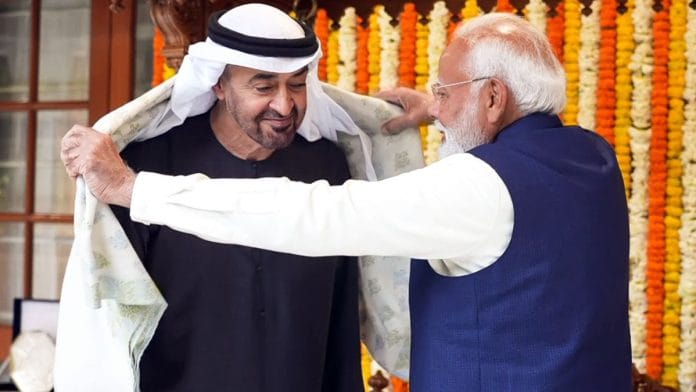



When UAE President Mohamed bin Zayed Al Nahyan arrived in India last week for a brief three-hour visit, the brevity and short notice inevitably drew attention. Compressed engagements like this are relatively rare in diplomacy, particularly when accompanied by a high-level delegation that included senior ministers and members of the Abu Dhabi and Dubai royal families.
This was not a visit that could have been scheduled months in advance or padded with symbolism. It was tightly focused and prompted by the immediacy of regional developments.
The significance of the visit lay precisely in this combination— limited time, expansive representation, and substantive outcomes. Visits of this nature do not occur when pressing issues are absent. They reflect a judgement, on both sides, that the moment demands alignment at the highest political level—not prolonged negotiation, but candid exchange.
Understanding the visit, however, requires moving beyond the false binary of routine diplomacy versus alliance-making. What unfolded was neither business as usual nor a dramatic inflexion point. Instead, it was an exercise in regional uncertainty management: a recognition that the fluidity of West Asia today calls for trusted partners to compare assessments, reduce miscalculation, and coordinate responses before crises harden into faits accomplis.
Regional uncertainty
West Asia today is in the midst of significant flux. Saudi Arabia and the UAE, traditionally among the region’s closest strategic partners, have witnessed the emergence of a rift in their regional approaches in recent months. Riyadh’s deepening defence engagement with Pakistan has raised eyebrows in New Delhi. The Gaza conflict continues to cast a long shadow over regional diplomacy.
Meanwhile, the possibility, however contingent, of a direct US strike on Iran remains a persistent undercurrent in strategic calculations.
Amidst this volatility, India and the UAE have also been invited to participate in discussions around a Gaza peace framework, underscoring their growing diplomatic relevance beyond their immediate neighbourhoods. Mohamed bin Zayed Al Nahyan’s (MBZ) visit should therefore be seen as a pre-emptive effort to harmonise perspectives, minimise misperceptions, and maintain policy coherence ahead of possible escalation—not as a reaction to a single crisis.
This is also relevant in light of India’s upcoming engagement with foreign ministers from several Arab states. For the UAE, one of India’s closest regional partners, early alignment of perspectives is naturally desirable. It would be a stretch, however, to read such consultations as bloc politics. Rather, they reflect the practical need for close partners to compare notes before larger multilateral conversations take shape.
Also read: Trump’s fight for Greenland has shaken his most committed European allies—the Far-Right
Do the speculations hold water?
Several questions have been raised during the visit. Was the UAE attempting to draw India into choosing sides in its regional frictions? Was deeper nuclear cooperation on the table? Was the timing linked to MBZ’s earlier visit to Pakistan? However, these interpretations overestimate both Emirati intent and Indian receptivity.
The notion that Abu Dhabi would seek to pull India into an anti-Saudi or anti-Qatar posture misunderstands the UAE’s own interests. India’s relationships with Saudi Arabia and Qatar—central to energy security, diaspora welfare, and the viability of the India–Middle East–Europe Economic Corridor (IMEC)—are structural. The UAE is well aware that India’s value as a partner lies precisely in its ability to maintain credibility across West Asia. Forcing a binary choice would weaken, not strengthen, Abu Dhabi’s regional position.
In fact, the UAE could gain significantly from more actively utilising India as a stabilising interlocutor. Despite recent frictions, the UAE has little interest in allowing differences with Saudi Arabia to harden into a sustained rupture. Abu Dhabi’s own conduct, particularly its recalibration in Yemen, suggests a preference for de-escalation and managed divergence rather than open rivalry.
In this context, India’s strong ties and accumulated goodwill with Riyadh position it as a credible, non-intrusive interlocutor. Rather than seeking India’s alignment against any regional actor, the UAE may well see value in New Delhi’s ability to quietly encourage convergence, or at least restraint, among key regional players during heightened volatility.
Furthermore, talk of India assisting Emirati nuclear ambitions beyond civilian frameworks does not align with India’s record. Even with its closest partners, New Delhi has been consistently conservative in this domain. Cooperation with the UAE is likely to centre on Small Modular Reactors (SMRs), safety standards, research collaboration, and training—not fuel-cycle capabilities or anything that would even remotely introduce proliferation risk.
MBZ’s December visit to Pakistan also warrants perspective. That engagement can be seen as an effort towards stabilisation—protecting Emirati financial exposure and preventing further state fragility—rather than signalling strategic equivalence with India. If Pakistan represented risk management, India represents strategic deepening.
Also read: Why India shouldn’t risk joining Trump’s Gaza ‘Board of Peace’
Outcomes that matter
What emerged from the visit reinforces this reading. The headline-grabber, rightfully, has been defence, where a Letter of Intent (LoI) was signed to establish a framework for a Strategic Defence Partnership. The proposed framework envisages expanded cooperation across defence manufacturing, innovation, training, and industrial collaboration—areas that demand long-term trust rather than episodic coordination. This represents a significant vote of confidence from a Gulf power that has traditionally relied on Western security guarantees.
Energy cooperation also advanced in concrete terms. The conclusion of a 10-year LNG supply agreement—0.5 million metric tons per annum from 2028—catapults the UAE to the position of India’s second-largest LNG supplier, after Qatar and ahead of the United States. Investment commitments, particularly in India’s Dholera Special Investment Region, further anchored the relationship in India’s domestic growth story. An accompanying memorandum on food safety aimed to strengthen India’s role as a key contributor to the UAE’s food security, again, an area where complementarities are natural.
Then there are plans for the future. The decision to collaborate on SMRs and large nuclear projects signals that both nations are looking at a post-oil, clean-energy horizon together. The partnership in Artificial Intelligence, with plans for a UAE-backed supercomputing cluster in India, and the space cooperation agreements, point not to transactional agreements, but bets on shared futures.
Importantly, none of this amounts to alliance politics. There is no emerging bloc, no attempt to counter an imagined “Islamic NATO,” and no pressure on India to insert itself into others’ rivalries. What the visit underscores instead is India’s growing role as a system-shaping actor—one that others seek reassurance from rather than attempt to coerce.
MBZ’s brief visit, therefore, was less an inflexion point than a marker of maturity. Regional turbulence shaped its timing, but not its substance. The ease with which both sides conducted a short, high-stakes engagement reflects a relationship marked by deep trust, allowing both sides to engage swiftly and candidly at moments of strategic consequence. The real takeaway of the visit, therefore, lies not in how short it was, but in how natural it felt.
Kamal Madishetty is an Assistant Professor at Rishihood University and a Visiting Fellow at India Foundation, New Delhi. He tweets at @KamalMadishetty.
(Edited by Saptak Datta)