









In the wee hours of 2 January, the US Military carried out a ‘snatch and grab’ operation to capture Venezuelan leader Nicolás Maduro. This operation was unprecedented in more ways than one: the head of state of a functioning nation was captured, along with his wife, from the Presidential residence; that too without the invading force losing a life or suffering significant loss of equipment.
“Operation Absolute Resolve” was a joint-force mission that involved elements of the US military as well as other law enforcement agencies—the Drug Enforcement Administration (DEA) and the FBI. The mission was only supported by the intelligence, cyber and space assets of the US government, and no other nation was involved in the operation. The 1st Special Forces Operational Detachment-Delta (commonly known as Delta Force) played a key role during the ground extradition phase of the operation.
Ignoring the political, moral and legal arguments (which are many) for the moment, this article will cover the significant aspects of the military operations. More granular details will emerge with the passage of time; however, we can see the outlines of the operation based on media reports and briefings by US President Donald Trump and General John Daniel “Raizin” Caine, the Joint Chiefs of Staff.
A two-and-a-half-hour operation
Scale and integration: The operation involved more than 150 aircraft launching from 20 bases spread across the USA. It included bombers, fighters, air refuelers, AWACS, ISR (intelligence surveillance reconnaissance), electronic warfare (EW) assets, rotary-wing helicopters, and remotely piloted drones.
Two aspects stood out in the force packaging and execution. First, except Israel, no other major power can field such a complex aerial force package that includes all these elements. Other large air forces, like those of the UK, France and Germany, possess certain niche capabilities but rely on other NATO partners to complete the package. Complex, large force packaging is completely absent in the Russia-Ukraine war.
Second, instead of relying on traditional SEAD/DEAD, the attack vector utilised the integrated effects from space command, cyber command, and other non-kinetic elements to create a secure pathway into Venezuelan airspace. Electronic ‘kills’ precluded the need to cause overwhelming destruction on the ground.
Engagements and apprehension: As per the reports, the arriving helicopters came under uncoordinated and ineffective fire from light weapons, and the US assets faced minimal challenge during the mission. One aircraft was hit but remained flyable, and all the US aircraft returned safely.
Real-time intelligence updates from air and ground teams were available throughout the mission. Surprisingly, the personal security of Maduro offered little resistance, and he was captured uninjured along with his wife. The tepid response from a reasonably well-armed Venezuelan military is indicative of complicity or incompetence. I would think both. While there were zero casualties on the US side, Venezuela lost nearly 40 soldiers.
Exfiltration: During exfil, when the element of surprise was already lost, and there was a need for overwhelming (almost brute force), US fighters and unmanned assets showed up. Suppressing fire was provided to outgoing helicopters. The extraction was carried out successfully at 3:29 am Eastern Time. Maduro and his wife were transferred to USS Iwo Jima, a Wasp-class amphibious assault ship, waiting at sea.
While there are many arguments questioning the legal validity of this operation, which should be debated with great vigour, the military lessons from this operation are hard to ignore. Operation Absolute Resolve was a US military operation that would be keenly studied by practitioners and the strategic community. It offers an example of precise application of force in pursuit of a military objective as mandated by the national leadership.
There are certain other aspects, too, that need greater deliberation.
While the comity of nations has responded to this military adventure on the predicted lines, and it is not surprising, the discussions in the US, however, are quite perplexing. In the US media, the discourse on the legality of this action is confined almost entirely to domestic law and Congressional authority. It seems to suggest that if it is legal as per US laws, then it must be legal under international laws.
The authority of the Department of Justice (DoJ) and Congress seems to override international law on the use of force. There is almost no mention of the United Nations or the UNSC. Another interesting thing about the mission was that President Trump offered no fig leaf of protecting democracy or human rights. He made it very clear through his statements, before and after the operation, that it was all about the resources.
Also read: Why Trump’s tariffs failed to dent global trade
Maintaining a clear chain of command
Militarily speaking, the operation highlighted the utility of invincible force—space, cyberspace, electronic warfare and intelligence. US forces were able to degrade the Venezuelan defensive system, without causing excessive attrition, to render it useless. All this was possible because the intelligence apparatus was able to shape the battlefield before the battle, and electronics and cyber elements blinded the adversary as the battle was about to begin.
When the raiders arrived, their enemy was confused, shocked and had lost complete situational awareness. This tells us that the invisible force is not just a force multiplier; it is an enabler that justifies the investment in treasure that saves blood.
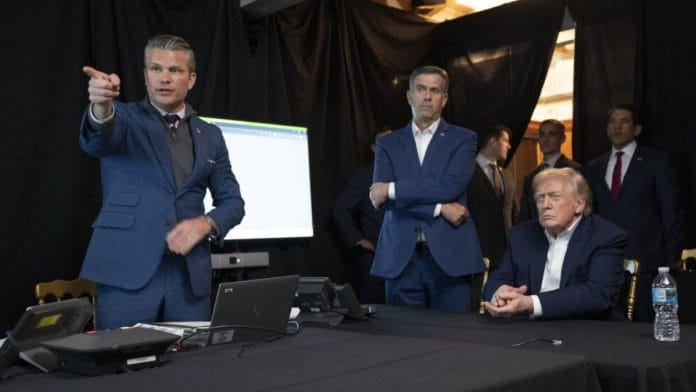
There were multiple verticals involved in the planning and execution of this mission. Besides the Pentagon, which was the lead agency, there were elements of the Department of Homeland Security (DHS), the Director of National Intelligence (DNI), and the DoJ. Considering the number of people who were ‘read-in’, it is surprising that the plans did not leak. It tells us that the procedures, and reinforces the criticality of information security.
Despite multiple agencies and elements being involved, the US could maintain a clear chain of command. In an inter-agency-unified-command structure, it is useful to have unity of command residing in one force/mission commander. This is something we should consider too, as we define our theatre command structures and organisations.
While integrating the military, we must also merge other elements of national power. This unity of command also enabled them to control the narrative. The post mission briefing was led by the President himself, followed by key members of his cabinet and the most senior military officer. Coming from the highest office, the citizenry at large was assuaged and assumed those statements to be true. The space of counter-narrative was greatly reduced.
One perplexing element of the operation remains, which hopefully would be addressed in due time. The ease with which Delta Forces could get to the President of a reasonably large country, in the capital city, in the presidential residence, inside Fuerte Tiuna, a heavily fortified military base in Caracas, and escort him out in handcuffs is puzzling. There was certainly help from inside the presidential security apparatus; the extent of this help would probably be revealed in due course of time.
This is the enduring lesson for a military mission of this nature to succeed: various elements of comprehensive national power must work in a fused and coordinated manner. All the agencies working in unison, under a unified chain of command, can bring about extraordinary outcomes at a favourable cost in blood and treasure.
Group Captain Ajay Ahlawat is a retired IAF fighter pilot. He tweets @Ahlawat2012. Views are personal.
(Edited by Saptak Datta)
Good Lord. This was not some complex operation. More and more evidence is coming out that Maduro was betrayed by his own people. The only people who fought back were his personal security who were not aware of the plot. The US waltzed in unmolested and took him. It was all theater. If this is the level of analysis from retired Indian military veterans I shudder to imagine what passes for analysis with current service members.