






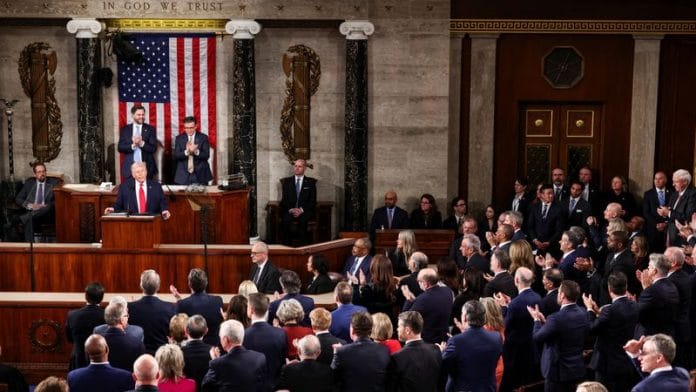



Standing before a joint session of the United States Congress to deliver the first State of the Union Address of his second term, Donald Trump proclaimed, “Members of Congress, the state of our Union is strong. Our country is winning again. In fact, we’re winning so much that we really don’t know what to do about it.” Constitutionally mandated as a periodic update to Congress on the affairs of the nation, the State of the Union Address has increasingly morphed into a high-voltage political spectacle that mirrors the growing polarisation of American politics. In tone and tenor, this address was Trumpian to the core: Combative, unapologetic, and unmistakably geared toward defining his second term as an arena of political confrontation, complete with a frontal assault on his predecessor, Joe Biden, and the Democratic Party.
Clocking in at nearly one hour and forty-seven minutes, the speech turned out to be the longest such address in modern American history. It unfolded at a critical intersection of federal governance, high-stakes geopolitics, and a looming midterm election. If such an address was meant to signal that the country stands unified despite procedural differences, this was not that moment. Instead, the address laid bare the depth of fracture in the American polity today.
The edge of American polity
The immediate shadow over the address was the recent ruling by the Supreme Court of the United States striking down the Trump administration’s use of the International Emergency Economic Powers Act (IEEPA) to impose sweeping tariffs on allies, adversaries, and partners alike. The decision dealt a sharp judicial blow to the expansive executive authority Trump had deployed, as the nation’s apex court effectively slammed the brakes on his most frequently deployed economic weapon.
In his trademark confrontational style, Trump, prior to the address, condemned the court ruling as “deeply disappointing,” singling out conservative justices-including Chief Justice John Roberts and Justices Amy Coney Barrett and Neil Gorsuch-as “fools and lapdogs for the Rhinos and the radical left Democrats,” branding them “very unpatriotic and disloyal to our Constitution” and calling the decision “an embarrassment to their families.” And rather than retreat, the administration countered swiftly, invoking Section 122 of the Trade Act of 1974 to impose new global tariffs, initially 10 per cent, later raised to 15 per cent.
The standoff exposes a deep fault line in US policymaking. Undeterred, Trump doubled down during the State of the Union Address, insisting that tariffs “paid for by foreign countries” could substantially replace the modern income tax system—an assertion challenged by economists. As the midterm election campaign heats up and Democrats sense momentum, the ruling is set to become a political flashpoint. Democrats will brand it a Republican setback, while Trump’s team casts it not as a defeat, but as a legal speed bump in his broader economic crusade.
On immigration, Trump returned to familiar battle lines. In cities like Minneapolis, the massive deployment of Immigration and Customs Enforcement (ICE) agents under the administration’s Operation Metro Surge has escalated into violent confrontations, triggered mass protests and court battles over federal authority and local oversight. Against that backdrop, Trump warned, “We can never forget that many in this room not only allowed the border invasion to happen … but indeed they would do it all over again.” Painting Democrats as complicit in chaos, he claimed, “The only thing standing between Americans and a wide-open border right now is President Donald J. Trump and our great Republican patriots in Congress,”
In a clear sign of the growing polarisation in the Congress, several Democrats boycotted the speech outright, while others sat in pointed silence. One Texas Democrat was escorted out, accused of heckling.
Every major speech Trump delivers shows an unabashed projection of economic growth, job creation, and industrial rejuvenation, even as fact checkers get busy refuting numbers and tall claims. In Trump’s worldview, tariffs are not seen as aberrations but as tools of economic leverage, adding to national strength. Macroeconomic indicators of reshoring manufacturing, energy dominance and reducing dependency on foreign supply chains are served in a cocktail with populist rhetoric. For Trump, economic strength is not merely about growth metrics, but about reasserting control over the terms of global trade and commerce, even at the expense of good ties with allies and partners.
Also read: No country is ever fully sovereign. Cold War era taught India its real meaning
Foreign policy flashpoints
Foreign policy and national security have opened another arena of high-stakes brinkmanship as US-Iran tensions threaten to boil over. Less than a year after ordering US strikes on Iranian nuclear facilities, Trump warned that Tehran could be “starting it all over again,” vowing never to allow the “world’s number one sponsor of terror” to acquire a nuclear weapon. Yet, in the same breath, he insisted that he would prefer to resolve the “problem through diplomacy.” Even as force projection intensifies, embassies in the region scale back staff, and sanctions tighten, mediation efforts via Oman and planned talks in Geneva suggest that a negotiated off-ramp is still within reach. But as Trump and a Pete Hegseth-led Department of War lean into the mantra of “peace through strength,” the assertive deployment of American military and economic coercion has emerged as the defining feature of the first year of his second term.
A recurring theme in Trump’s second term is his claim to becoming a peacemaker across global flashpoints, as he harps on his claim to a Nobel Peace Prize. As he remarked, “Pakistan and India would have been a nuclear war. 35 million people said the prime minister of Pakistan would have died if it were not for my involvement.” He then moved to other conflicts, talking of “Kosovo and Serbia, Israel and Iran, Egypt and Ethiopia, Armenia and Azerbaijan, the Congo and Rwanda and, of course, the war in Gaza, which proceeds at a very low level.”
At the level of great power politics, the tariff ruling and unapologetic deployment of military power abroad will frame the US-China competition-cooperation dynamic as Trump is slated to visit China very soon. A defining feature of Trump’s presidency is the economic framing of national and international security issues and tariffs as a tool of coercion, which has changed the grammar of international relations in significant ways. Even as America’s allies and partners seek predictability in their engagement with the United States, unpredictability is perhaps a primary tool in Trump’s negotiating style.
The prospect of Democrats making gains in the 2026 midterms and shattering the Republican trifecta over the White House, the House of Representatives, and the Senate loomed large over the address, with Trump accusing Democrats of cheating and insisting that “the only way they can get elected is to cheat.”
While he casts his predecessor as the author of economic disorder and touts a revitalised economy under his watch, critics highlight the gap between tall claims of lowering inflation and the lived reality of persistently high prices.
If there was an overriding message from Trump’s State of the Union Address, it was this: America stands at the crossroads of an era-defining struggle within its own polity—between a polarised legislature, an executive wielding power with unprecedented assertiveness, and a judiciary reasserting its primacy in constitutional interpretation and legal precedence. This tenuous recalibration of checks and balances will reshape the contours of domestic politics in the US. It will also reset the terms of US global engagement as countries across the spectrum respond to an unapologetic deployment of US economic and military power as instruments of coercion and compellence.
Monish Tourangbam is a Fellow at the Chintan Research Foundation (CRF), New Delhi. Views are personal.
(Edited by Theres Sudeep)