






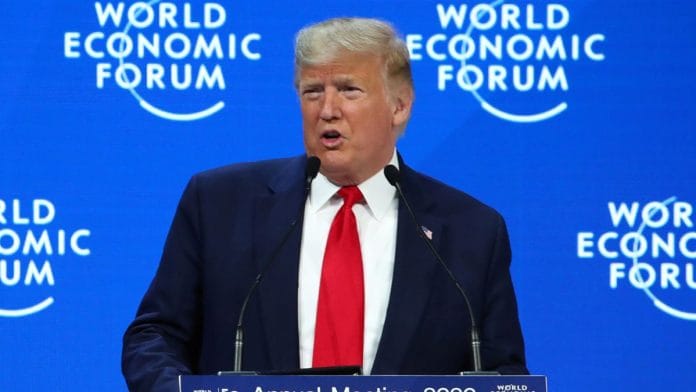



Why have we been discussing Greenland? I am sure this thought has crossed your mind several times lately. Ironically, this question, more than Greenland itself, is the story.
Before I proceed, the latest from Davos is not Macron’s blue aviators or Trump’s hour-long ramblings, which only he understood. It is not even America’s Board of Peace that Trump wishes to replace the UNSC with.
It is that Trump has agreed to a framework on Greenland and ruled out taking it by force. Now, Trump being who he is, the subject will come up again to maximum effect and more ramblings. But for now, it tells us again how thoroughly the world has become a prisoner to Donald Trump’s vagaries, tantrums and farces. He TACOs (and sometimes not) his way through global diplomacy, and somewhere in the chaos manages to sell the “big story”—frequently for it to turn out more incongruous than before.
Trump arrived at Davos this year all guns blazing, threatening, blustering, posturing about American security interest in Greenland and his endless “wins” since his inauguration.
The familiar—I ended 1,000 wars, Biden was bad and I am the Daddy—went on.
And then, almost anticlimactically, a day later, he agreed to a “framework agreement” on Greenland—that gives the United States nothing it didn’t already have.
What kept the world glued to Davos proceedings was the possibility of the transatlantic alliance rupturing over Greenland. Speculation on NATO’s collapse, Europe’s abandonment, America’s retreat (or conquest) has been doing rounds already. Between TACOing and its opposite, Trump has pushed the world’s sensibility to the edge—one of unprecedented dopiness, abject misinformation, naked neo-royalism, misplaced vanity and ugly narcissism.
The American President pursues it with aplomb at everyone’s expense. He has turned wasting time into an international pastime and a serious business. Analysts, diplomats, markets and governments now spend days deconstructing statements that collapse under minimal scrutiny. He has also pushed the world into a constant state of unreality—manufacturing dangers where none exist while ignoring real deaths, real wars and real mass violence.
Trump cannot tell victims from perpetrators or allies from adversaries. He cannot even consistently articulate what he believes American interests are. He seems to believe that his ‘word’ or ‘feeling’ alone makes things happen—logic, truth and rationality be damned.
There is little value in listing Trump’s hits and misses since his inauguration. It is tedious and reveals very little because what matters is the pattern of anarchy. Regarding Greenland, after weeks of insane rhetoric, including military threats, Trump suddenly compromised, with the same self-assuredness and comical indifference with which he had threatened force only hours earlier.
Also read: From annexation threat to negotiations: Greenland dispute weakens US leverage
Fighting for what you already possess?
The so-called framework agreement he agreed to is, in effect, something the United States already possessed. During the Cold War, the US operated not 14, as commonly cited, but 17 military bases across Greenland. After the Cold War, that number was reduced to one—Pituffik—because the global order shifted and the threat from the USSR no longer existed.
What Trump has claimed he wants, i.e. control over Greenland for US security and access to rare earths, was already achievable under existing arrangements. Even today, the US has every legal and diplomatic mechanism to expand its military presence in Greenland if it deems necessary.
This makes Trump’s threats all the more puzzling. At a time when Europe is living through the longest conventional war on its eastern borders since World War II, Europeans would gladly give an arm and a leg to keep US military power anchored in Europe. Then why threaten Denmark, Greenland and Europe for something they would willingly support?
A recent interview by Shane Smith with former Danish foreign minister Per Stig Moller, cuts through the fog. Moller, the chief architect of the 2004 defence agreement with the US, has explained how Greenland already allows the US everything it needs—in consultation with Denmark and Greenland. The 2004 treaty that he skillfully crafted and negotiated with Colin Powell and Condoleezza Rice on the American side, expanded on the original 1951 agreement, which was updated once Greenland ceased being a colony in 1953. The point to underscore is, neither Denmark nor Greenland can say “no” to increased US military presence, provided consultations occur.
Greenland, in fact, would welcome greater American engagement. The Americans were there during the Cold War. What followed decades later was Trump and JD Vance turning a clear strategic mechanism into the most absurd geopolitical spectacle of Trump’s second term.
Juxtapose this with Trump’s confusion on Russia. His rhetoric on Putin and Ukraine oscillates wildly in the favour of Russia. Yet on Greenland, he suddenly discovers Russian and Chinese threats that no one else seems to see for now.
Regardless, the US can re-establish as many bases as it wants and operate them in pockets of sovereignty. It always could. If Trump wants military control over Greenland for something like the Golden Dome, another Trumpian fantasy project for now, he already possesses every legal instrument needed to do so on the continent. The 2004 treaty provides it. He could’ve done everything he wanted without turning it into a global spectacle or making a fool of himself.
Also read: Why India shouldn’t risk joining Trump’s Gaza ‘Board of Peace’
Comedy of unintended consequences
This time, the Trump-show had consequences—deliciously unintended and ironic. Trump’s strategic buffoonery over Greenland has shaken his most committed allies in Europe: The Far-Right. Parties that until recently saw Trump as the biggest patron now find themselves deeply uneasy.
This is particularly striking given that the latest US National Security Strategy celebrated the “growing influence of patriotic European parties” as a cause for optimism. Those same patriots now face a dilemma as Trump’s approval sinks across Europe.
Alice Weidel of the Alternative for Germany accused Trump of violating a core campaign promise—non-interference in other countries. Her co-leader Tino Chrupalla rejected what he called Trump’s “Wild West methods.” France’s Jordan Bardella, Britain’s Nigel Farage and others found themselves cornered when Trump imposed or threatened 10 per cent tariffs on countries that sent troops to Greenland to signal solidarity with Danish sovereignty. But the sharpest rebuke came from Sweden’s Far-Right leader Mattias Karlsson, who wrote on X, ‘Trump increasingly resembles a reversed King Midas’ because ‘everything he touches turns to shit.’
In an unusual moment, Europe—from Left to Right—has pushed back together. The European bloc even discussed deploying its anti-coercion instrument against the US. The European parliament stalled the approval of the recently concluded EU- US trade deal.
The double whammy of a ludicrous argument on invading Greenland backed by tariff threats found no takers anywhere in Europe, instead re-energised the indispensability of Europe’s military capabilities and a re-look at China.
What has not made sense, has become the new normal. Whichever way one looks at it, this is strategic dementia.
Also read: Trump 2.0 vs 1.0 is no longer the debate. It’s about the upheaval he leaves behind
Which brings us, finally, to India
There is something profoundly ironic about how much time India has spent dissecting Trump’s Greenland tantrum. India faces existential challenges of its own and yet, Indian discourse—elite and otherwise—remains trapped in Trump-watching, every ramble of his has sucked our energy and attention.
At Davos, amid all this noise, one of the most consequential observations came from Gita Gopinath, former IMF chief economist. She pointed out that pollution has a far more severe and lasting impact on India’s economy than any tariff Trump could ever impose. Pollution, she noted, is a bigger international threat to India than trade wars and must be pursued alongside de-regulation, land and labour reforms.
However, genuine national engagement on how our internal challenges undercut our global aspirations is not considered fashionable. Trump’s greatest export is distraction with several risks.
And yet the world, even when exhausted, keeps buying it.
Swasti Rao is a Consulting Editor (International and Strategic Affairs) at ThePrint. She tweets @swasrao. Views are personal.
(Edited by Theres Sudeep)