






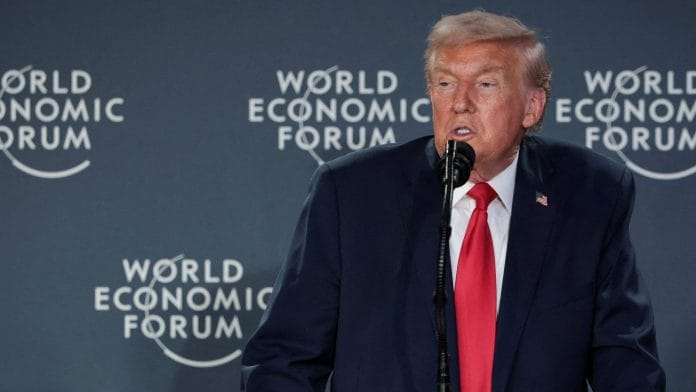



Standing at the pulpit of the 2026 World Economic Forum in the icy Swiss resort town of Davos, US President Donald Trump, referring to Greenland, brusquely said, “We want a piece of ice for world protection, and they won’t give it. You can say yes, and we will be very appreciative. Or you can say no, and we will remember.”
The remarks amounted to an unprecedented affront to the European allies, who are increasingly crossing paths with Washington in ways unseen since the end of World War II.
Trump’s frosty appearance in Davos came just after the completion of the first year of his second term. Following the dramatic end of Trump’s first presidency, former US President Joe Biden entered the White House, pledging to “restore the soul” of America-more plainly, to return the US to a predictable strategic posture toward allies, adversaries, and emerging partners.
Yet, four years later and in just one year, Trump’s second coming at the US presidency has outpaced the world’s ability to absorb and respond to the unabashed use of American power abroad, the aggressive deployment of executive authority over other institutions, and a redefined social contract at home.
Executive power unleashed
Trump’s second term stands apart in its speed, preparation, and sheer audacity, as he and his loyalists have pursued policies that have rattled both the global order and American politics. In his first term, his unexpected victory over former Secretary of State Hillary Clinton left him dependent on establishment Republicans, and despite moments of disruption, policy largely followed familiar trajectories.
This time, however, early whispers about the Heritage Foundation’s Project 2025 suggested a conservative roadmap was emerging. With a handpicked team of loyalists driving national and foreign policy, Trump’s administration has embraced a form of calculated chaos—strategic, purposeful, and designed to shake the status quo.
To supporters, Trump is decisive and unyielding. To critics, he is unpredictable, even perilous. But one thing is undeniable: his presidency is rewriting the conventional norms of US politics and foreign policy in ways no one imagined. The real question is no longer whether Trump 2.0 differs from 1.0. It is what legacy, what upheaval, he will leave behind in his wake over the next three years, when just one year has already sent global and national shockwaves.
The second Trump administration has moved with unprecedented speed, reshaping US policymaking through executive action. From United States Immigration and Customs Enforcement (ICE) operations and tariff measures to intervention in Venezuela, the impacts are immediate and far-reaching. A polarised US Congress has struggled to respond, leaving executive authority to drive the agenda and reshape the balance of power in real time.
Traditional tools of US engagement abroad, like the United States Agency for International Development (USAID) have been dismantled, and the Trump administration has moved to pull the nation out of more than 60 international organisations, including UN agencies and other multilateral platforms. The American system of “checks and balances”, meant to limit and constrain unchallenged abuse of power by any arm of the national government, has been tested like never before.
This is not the first time a president faced public backlash over executive overreach. Former presidents such as Lyndon Johnson chose not to run again amid the Vietnam War, Richard Nixon resigned over Watergate, and George W Bush faced a storm of anti-war dissent after invading Iraq on false premises. But the speed and scale with which the Trump administration has disrupted both domestic politics and foreign policy are unprecedented.
Also read: Why India shouldn’t risk joining Trump’s Gaza ‘Board of Peace’
Nothing is beyond bounds
From tariffs to immigration to alliance commitments, few issues escape Trump’s fire. Immigration, a flashpoint in America’s social and economic debates for a long time, has always stirred tension between new arrivals and established communities. The second Trump administration has intensified this divide. Whereas Emma Lazarus’ poem “The New Colossus” at the base of the Statue of Liberty famously welcomed the “tired,” the “poor,” and the “huddled masses yearning to breathe free,” contemporary immigration policy increasingly evokes the image of a fortress—an America that is more guarded than open.
In today’s world, foreign policy has become explicitly transactional. Under Trump, nothing—alliances, adversaries, or partnerships—is off-limits. Tariffs could swing up or down in hours, and unpredictability has become the norm. In response, countries are embracing diversification, building trade redundancies and reassessing reliance on even long-standing US security guarantees.
Trump framed this as a fight against “free-riding” allies, but it also challenged the very institutions that underpinned American-led globalism. The result is a global system forced to adapt to a new reality: alliances are no longer automatic, and security must be hedged across multiple partners.
This past year has seen Trumpism collide with its opposition, producing a volatile political landscape and a hyper-transactional American zeitgeist. Governance offers no brake on his campaign bravado, and the spectacle continues unabated. The real question now is: can the US political ecosystem and the broader international order contain its power?
At Davos, allies from North America and Europe made their resistance clear, challenging Trump’s vision of a world ruled by leverage, pressure, and unchallenged American primacy. The Canadian Prime Minister Mark Carney, in his speech, made no bones about it and said, “Hegemons cannot continually monetize their relationships. Allies will diversify to hedge against uncertainty.”
From climate and immigration policies to the contentious issue of Greenland and the equally complex “Board of Peace,” Trump has been clashing with European partners, creating once-in-a-generation fissures in the transatlantic alliance. As he pursues a policy agenda of “Making America Great Again” and putting “America First,” the Trump administration aims to project American power and forge international partnerships strictly on terms dictated from the White House.
In just one year, Trump’s return to power has reshaped the landscape of governance and global engagement. His audacious exercise of American influence abroad, combined with an unprecedented concentration of executive authority, has unsettled institutions and redefined the social contract between the federal government, state governments and American citizens. In the final analysis, these forces mark not just a season of upheaval but a decisive turning point with consequences reaching far beyond the American shores.
Monish Tourangbam is a Fellow at the Chintan Research Foundation, New Delhi. Views are personal.
(Edited by Saptak Datta)