






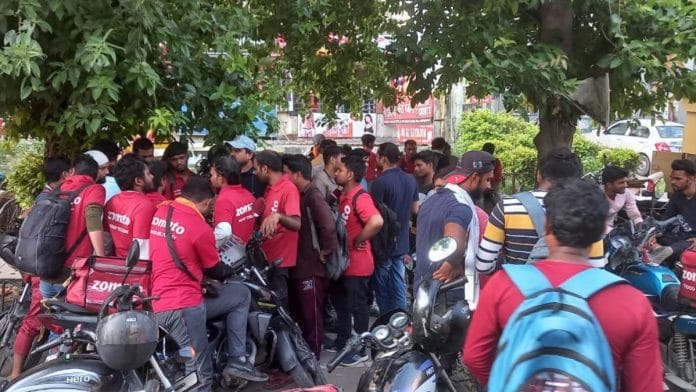



Every time India’s delivery workers surface in the news — whether for earning Rs 762 after a 15-hour shift and 28 deliveries, or for being forced to walk nearly a kilometre into an apartment complex because security won’t let their bike through — we’re invited to examine our consciences. In this familiar run-around, we look on with appropriate distress, urge each other to tip generously, and make the effort to walk down to the gate.
But this good-natured handwringing ensures that we rarely extend the same scrutiny toward the algorithms or platforms that force delivery “partners” to work 15 hours to barely scrape together a living.
Everyone has an opinion on India’s gig and platform workers. But who actually bears accountability to them?
Two recent strikes by delivery workers, on Christmas and New Year’s Eve, paralysed services across 22 cities. According to reports, nearly 3,00,000 workers participated in the protest. In high-density zones in Bengaluru, over 2,000 food packets sat undelivered during evening rush hours. The associations and unions, including Telangana Gig and Platform Workers Union and the Indian Federation of App-based Transport Workers, that called for the strike, claimed that platforms responded with desperation, even offering Rs 150 for three-kilometre deliveries. But the bulk of the workforce stayed firm and offline. Some were labelled miscreants.
The five demands
The strike was organised by people like Shaik Salauddin, founder of the TGPWU, who has spent a decade building this movement. He’s been jailed twice and faces over 50 cases. Despite that, he has taken the workers’ demands to Parliament, to state governments, and joined Rahul Gandhi’s Bharat Jodo Yatra. He told me in an interview that they aren’t asking for much: Just dialogue and a seat at the table.
“If the platforms claim to be ‘job creators’, then they should also take the responsibility of the workers,” he said. “They have acknowledged long working hours, but why isn’t there an employer-employee relationship here? My fares are decided by the platform, but I have to bear all the risk.”
The five demands of the coalition sound reasonable. They want restoration of the Rs 10-per-kilometre rate that was compressed to Rs 6 over the last few months. They also want a complete abolition of the 10-minute delivery mandate that makes dangerous driving a necessary condition of employment. They want an end to the algorithm-led practice of shadow-banning, where worker IDs are blocked based on opaque metrics or unverified customer complaints, with no chance of explanation or appeal. They also want the implementation of the Code on Social Security 2020, a “streamlined framework that extends coverage to organised, unorganised, gig, and platform workers alike.”
Of these appeals, the last has witnessed some movement. The Labour Ministry has pre-published the code’s draft rules for stakeholders’ feedback, and proposed a 90-day annual work threshold for a gig worker to be eligible for social security benefits. The rest of the demands, however, have been met with Twitter mayhem.
Deepinder Goyal, founder and CEO of Zomato, took to X to “dismantle” the legitimacy of the workers’ claims. In a series of threads, he explained that average earnings per hour for a delivery partner were Rs 102, or Rs 21,000 a month, after deducting for fuel and maintenance of their vehicle. But Salauddin’s data tells a different story.
A comprehensive 2023 study by PAIGAM, surveying 20,000 delivery workers across eight cities, found that 34 per cent earn less than Rs 10,000 a month after expenses. While 91 per cent are full-time workers, only 32 per cent reported earning between Rs 401-600 per day. “My English is not very good,” Salauddin told me, laughing, “but even I have a voice and what I am saying is valid. The Constitution protects my right to protest.”
Goyal added that the 10-minute delivery model wasn’t about rider speed but the density of dark stores positioned within two kilometres of residential clusters. Picking and packing were optimised to 2.5 minutes, which left a comfortable 7.5 minutes for an 8-minute ride at an average speed of 15-16 km/h. He also clarified that riders don’t see a timer on their app, so where’s the psychological pressure — even though the data suggests otherwise. The math, we were told, was airtight, while the lived experience and testimonies of workers (and anyone who has experienced an Indian road in the last few years) were outliers.
But Goyal wasn’t finished, pivoting instead, to fantastical philosophical terrain. He made some very grand, but ludicrous claims about the invisibility of labour before delivery workers. “This is the first time in history at this scale that the working class and consuming class interact face-to-face, transaction after transaction. And that discomfort with our own selves is why we are uncomfortable about the gig economy. We want these people to look our part, so that the guilt we feel while taking orders from them feels less,” he wrote.
Also read: New labour codes can change the harsh reality of gig work
Tips cannot subsidise platform’s responsibility
This is applause-worthy misdirection. Zomato has built a business model predicated on exploiting a market where unemployment is rampant, spent millions in venture and market capital, advertising itself as the future of convenience, scaled to a multi-billion-dollar valuation — only to then turn the tables on the customer. Yes, because it’s completely normal for a regular Indian to confront their class position before hitting “Add to Cart” every day.
But Indian elites have been interacting face-to-face with working-class labour for centuries. We have a “wala” for everything. Generations of Indians are familiar and comfortable with nannies who sit at different tables in a restaurant, minding our kids, or the driver who waits outside your office for hours. Our personal (if conditional) generosity and “double salary” festival bonuses exculpate us from pushing for minimum wages, mandated leave, or employment contracts for our domestic helpers. They also have the added effect of anointing us with a halo.
Goyal, in all this circuitous pontification, never quite arrived at a more fundamental point. Consumers are complicit in the exploitation of delivery workers, just not in the way he made it out to be. No one demanded 10-minute deliveries, but consumers did choose them. We made these platforms worth billions by rewarding the fastest, cheapest, most convenient option. We decided that having garlic arrive before the onions had finished browning was worth paying a premium for. And we can’t now pretend that we’re just along for the ride.
So yes, as many of Goyal’s acolytes have urged us, you should tip your delivery worker. Tip generously. We live in a profoundly unequal country, and when someone shows up at your door having absorbed all the stress of last-minute shopping for you, it is a moral imperative — even if India has never had a tipping culture.
But tips cannot subsidise a platform’s responsibility to offer proper wages to its workforce. You tip because it’s the decent thing to do, and not to make Zomato’s pay cut financially viable for the worker. That’s the platform’s job, not yours.
This shifting of responsibility from the corporation to the consumer has a very well-documented precedent. In her 2014 book This Changes Everything, Naomi Klein describes how the environmental movement was hijacked by “market-based solutions” that transformed a straightforward, legal fight against fossil fuel companies into a performance of consumer virtue. Around 2004, British Petroleum popularised the concept of “carbon footprint”, a PR masterstroke that put the spotlight on individual consumption over industrial emissions.
People were asked to calculate their carbon footprints or turn off lights for an hour or buy expensive eco-friendly detergent — all while the corporations responsible for the climate crisis continued operations unabated. The companies responsible for large-scale plastic pollution took this idea and ran with it, funding campaigns like “Keep America Beautiful”. They painted plastic pollution as a personal failure on the part of the public, rather than the inevitable consequences of flooding the market with non-recyclable materials. The solution, they promised, was paper straws.
Tipping is the paper straw of the gig economy — a scrupulous choice, but eventually, structurally meaningless. Platforms that manufactured a culture of 10-minute delivery have now made consumers an equal party to the exploitation of workers.
Which is a situation convenient for everyone except the workers. While Salauddin declared that the strikes had achieved the impact they had hoped for and brought the conversation to the forefront, I wonder if their demands have been obfuscated by CEO vapourings about class consciousness and consumer guilt. We can always hope that the free market will correct itself. That, as we know, works only in one direction. Workers withholding their labour are miscreants, but platforms slashing rates are just doing business.
Karanjeet Kaur is a journalist, former editor of Arré, and a partner at TWO Design. She tweets @Kaju_Katri. Views are personal.
(Edited by Saptak Datta)