






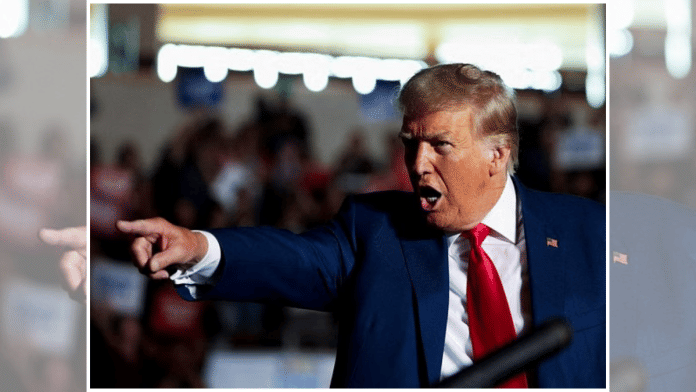



As the inferno of war engulfs West Asia and its consequences radiate far beyond the region, it is worth recalling President Trump’s speech in Riyadh roughly a year ago. Reflecting on the Gulf’s transformation, he remarked that “the gleaming marvels of Riyadh and Abu Dhabi were not created by the so-called ‘nation-builders,’ ‘neo-cons,’ or ‘liberal non-profits.’” He also asserted that “the so-called ‘nation-builders’ wrecked far more nations than they built,” and that interventionists were meddling in complex societies they scarcely understood.
Much has changed in America and across the world since that speech. The unfolding crisis today reveals a sharper, more assertive face of American hegemony, one that is high on coercion and low on consent.
From day one of his second administration, Trump and his team have wielded the megaphone to project an unabashed display of executive power, anchored in the slogans “America First” and “Make America Great Again.” Yet this confident march to remake America’s social contract at home and redefine its engagement abroad has produced a level of unpredictability rarely seen in the post-World War II era.
The Trump years have defied the conventions of modern American presidencies, reshaping the delicate balance between the executive, legislature, and judiciary. If his first term unsettled allies and adversaries alike, his second has institutionalised disruption and turned volatility into the “new normal” of American governance and global leadership.
Also Read: This is how Strait of Hormuz shock is forcing a global trade reset
Paradox of power
For much of America’s pre-eminence in the international system after World War II, when it spearheaded the institutionalisation of the global financial and security order, its globalism rested on a curious paradox of power. Building and sustaining its hegemony rested on a concoction of coercion and consent, as it sought to legitimise its pre-eminence through alliances, institutions, and the rhetoric of shared values.
Trump’s return to the Oval Office, and the way he has unleashed executive authority, has disrupted this equation. He has categorically deployed America’s economic and military power as coercive tools, without any veneer of mediation through multilateralism or diplomacy.
The weaponisation of economic interdependence, through escalating and shifting tariffs tied to geopolitical conditionality, has become central to America’s global engagement, with even close allies and strategic partners not spared. Trade reciprocity demands, backed by punitive tariffs, now define US trade policy, where compliance with Washington’s priorities increasingly determines progress in bilateral ties and multilateral platforms. The result is a global economic order under acute strain, shaped less by incremental reform than by disruptive shocks.
Why states go to war remains one of international relations’ most enduring questions, and history shows there is rarely a simple answer.
In its roughly 250 years as an independent state, the United States has fought wars both within its region and far beyond, from brief interventions to long-drawn ‘forever wars’ in Vietnam, Iraq, and Afghanistan. These conflicts often triggered domestic backlash, as their social, political, and economic costs became increasingly visible at home. Yet public opposition and policy debates in Washington have frequently proved short-lived. This creates a persistent tension: an America that seeks to limit costly foreign entanglements, yet simultaneously aims to shape the international order to its advantage.
Under Trump, this contradiction has become even sharper. Predicting even the near-term trajectory of conflicts, including the ongoing war in West Asia, has become increasingly difficult.
Also Read: Pakistan is fence-sitting on Iran War. Tehran prefers it there
Retrenchment vs overstretch
A profound shift in America’s social contract is remaking not only its global image, but also how it engages with the world, particularly its European allies. While demands for greater burden-sharing pre-date Trump and have long simmered within NATO, they have now moved from internal negotiations to the centre of alliance politics. What was once an undercurrent has become the defining discourse, pushing the Western alliance toward an uneasy and increasingly fractured functionalism.
European responses to the war in West Asia are becoming a barometer of growing disenchantment within the Western alliance, which may endure even beyond Trump’s political tenure. The question increasingly is whether NATO’s grammar has shifted from partnership to transaction, even if its fundamentals remain intact. The economic framing of security guarantees has emerged as a defining feature of the Trump doctrine, where commitments resemble services delivered conditionally, tied to financial contributions and geopolitical alignment. If embedded into US foreign policy, this approach could recast not only alliance dynamics but also relationships with strategic partners. With Washington favouring overt leverage and constant bargaining over predictability, allies and partners face a new reality that strategic alignment requires continual responsiveness to American preferences, an approach that risks becoming both exhausting and destabilising.
A deeper tension is emerging between those who still see value in a rules-based order and those who view it as a drain on American resources. Like a casino where the “house always wins,” great powers design systems that incentivise others to play by the rules while ensuring they remain at the top.
But there exists a palpable anxiety of the United States being taken for a ride by the rest of the world. The life of a great power is also a story of perennial anxiety born out of external and internal forces. It is the paradox of a power unable to mould the world completely in its own image. As one of America’s most influential National Security Advisers, Zbigniew Brzezinski, remarked, “America may be uniquely powerful in its global scope,” but because of it, “its homeland is also uniquely insecure.”
The centrality of military power in statecraft was often presumed to be fading in an era of economic globalisation and interdependence. Yet history and current geopolitical realities suggest otherwise. The world is witnessing a renewed testing of both military and economic power, not only in their evolving nature, but in how they are being deployed. From active battlefields to implicit threats of force, military power continues to serve as an omnipresent backdrop to inter-state negotiations, shaping political and economic outcomes.
Despite the rhetoric of an America seeking to avoid costly foreign wars and conserve resources, the reality tells a more complex story. What the world is witnessing is not American hegemony in retreat, but one recalibrating the terms of engagement, more unapologetic in deploying coercive tools and less reliant on the multilateral mechanisms that once helped generate consent in the international system. This marks a departure from consensus-building toward leverage-driven statecraft, signalling a more uncertain and volatile phase in the evolving global power transition.
Monish Tourangbam is a Fellow at the Chintan Research Foundation (CRF), New Delhi. Views are personal.
(Edited by Asavari Singh)