






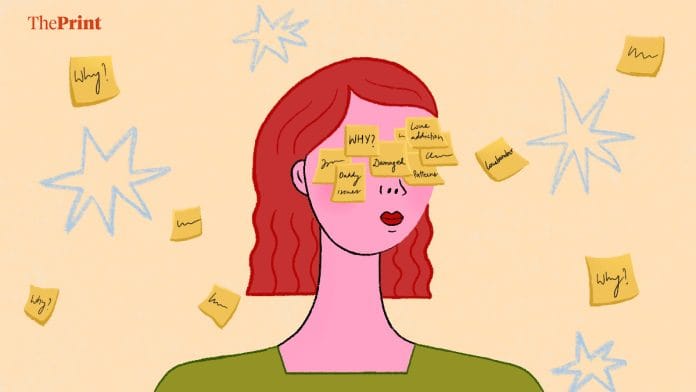



Why do I flirt like I am bullying someone into giving me attention? There are two answers. One is boring—it’s fun, tends to work on people with a sense of humour. The second is a slop of Freudian theories and whatever an average person watching therapy-style Reels makes of my ‘patterns’. No points for guessing which one has a bigger potential to start a discourse on social media. Give it two seconds, and someone will diagnose me as a neglected fat child who weaponised sarcasm for survival. Harsh, isn’t it? I built my combative personality brick by brick, and my parents keep eating all the credit.
This impulsive need to find the ‘why’ behind all our dating behaviours is getting out of hand. Every human action has to have a deeper meaning, often a psychological disorder. And just because these theories are proven right in some cases, they can easily be applied to everyone. If someone doesn’t text back, they’re avoidant. If you feel jealous watching your partner cosy up to someone else, then you have attachment trauma. He dumped you? He is a narcissist. You’re hooking up with someone who was also once dumped by someone? You two are trauma-bonded.
Did you know that if you’re obsessed in love with someone, you’re an escapist who would rather fixate on another person than deal with your own life? I did some JSTOR digging to find out that it actually applies to people who substitute real-world functioning for imagined relationships, not people who stalk their crush’s Spotify once in a while. But because Instagram content creators don’t bother giving context, everyone has to rethink their motivations.
Sophie Haigney wrote in The New York Times Magazine about another common diagnosis: “love addiction”. “Poems and songs say love should be world-shattering. The logic of love addiction suggests that it shouldn’t,” read the article. The popularity of love addiction is a “sea change” in the way people are now thinking about romantic love, Haigney said. While it is a serious issue requiring a 12-step programme, Love Addicts Anonymous, the casual use of the term dilutes its gravity. Are we all addicts for wanting to be loved? I don’t buy it.
What’s next? Is romantic love going to be declared a mental illness? We should all unplug the internet that day.
Also read: A bride enjoying her wedding day is a radical act
Hunting for damage
The thing is, modern dating discourse needs these clever theories and the provocative ‘why’ behind our choices to survive. The dating app disruption, the situationship pandemic, the myth of the male loneliness epidemic—all must stem from something broken. Something dark. Something that’s more compelling than the banal reality that people just lose interest, change their minds. Or that we’re all a bit reckless in dealing with other people’s feelings.
The Hinge match who goes cold after a week of heavy flirting is easily called a lovebomber. It’s more interesting than assuming that they got bored of you. Or got hit by a car. We love playing the victim; that way, it’s easier to deal with the emotional agony that is dating. Call whoever rejects you a monster, a narcissist, and get back to swiping some more, I guess
If all this pathologising is supposed to help us date better and be more dateable, why is it not working? It’s not like we found out the so-called psychological reasons behind our behaviours and actions, and immediately ‘fixed’ ourselves. Just because a few Reels diagnose someone as anxiously attached doesn’t mean they stop double-texting. Just because you’re told you are in a trauma bond doesn’t mean you’ll break it.
A 24-year-old analyst who was diagnosed with ‘daddy issues’ by a friend didn’t stop dating older men because of it. Now, she does it with a little bit of shame, which in her case has spiced up things a little. “If I am ‘damaged’ for liking who I like, then so be it,” she told me.
Apparently, all of us are damaged. People who make it clear on their dating profiles that they are not looking for a relationship are also fielding allegations of parental neglect or emotional avoidance by jilted hookups. Well, so what? “Even in a utopia, not everyone who you want is going to want you back,” James Greig wrote in DAZED.
It’s not that deep. It’s just dating.
This article is part of a series of columns on modern dating in India—the good, the bad and the cuddly.
The author tweets @ratanpriya4. Views are personal.
(Edited by Prasanna Bachchhav)