








After three aborted attempts at ceasefire on 14, 16, and 22 September, India and Pakistan accepted the UNSC resolution calling upon both countries to withdraw to positions held by them before 5 August. This was certainly short of India’s insistence on declaring Pakistan as the ‘aggressor state’, but the acceptance of 5 August was a vindication of India’s position that ‘infiltration is akin to aggression’.
Let us now examine the ground position on the India-Pakistan border on 5 August. In the Jammu and Kashmir sector, Chamb was under India’s control and Pakistan had occupied the Haji Pir Pass. By the time the hostilities ceased, Pakistan had taken the town of Chamb, and India had hoisted the tricolour on Haji Pir. Likewise, there had been gains and losses on both sides in the Punjab and Rajasthan sectors. While India had captured the Burki police station in Lahore, and was barely two kilometres to Sialkot — the base of operations for the J&K sector — Pakistan was in possession of the outskirts of Khem Karan in Amritsar district. In Rajasthan, the Pakistani Rangers had seized key fortifications like the Krishnagarh, and about 12,000 square miles of desert territory.
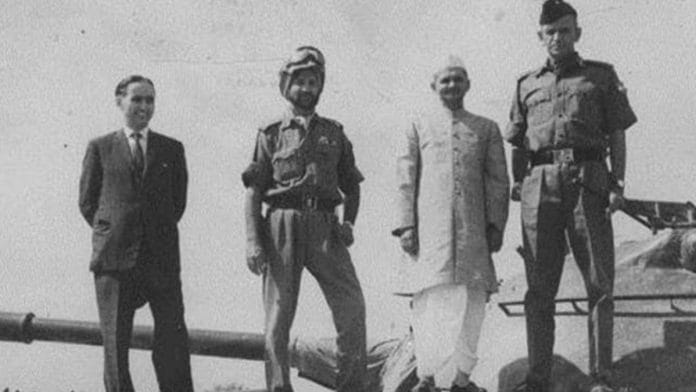
However, it was Haji Pir Pass that became an emotional leitmotif, for many jawans had shed their blood to capture this peak. But in his heart of hearts, Lal Bahadur Shastri knew that this may have to be sacrificed at the altar of peace. Kuldip Nayar, his confidant and former press secretary, wrote in Hindustan Times on 21 October 1965 that “it would be entirely erroneous to believe that by holding on the Haji Pir pass, India would effectively close the door to all the infiltrators, because there were several other routes which could be used, and were, in fact used by the Pakistan infiltrators in August 1965”.
In fact, Shastri started toning down his rhetoric after the ceasefire, making it a point to avoid any public references to Haji Pir and Tithwal, lest he create an impression that these were non-negotiable. In his briefing to the Congress Working Committee (CWC), he stated that the “return of Haji Pir depended on the ground conditions regarding the complete end of infiltration”. Meanwhile, the Opposition also raised the ante with regard to the Indus Waters Treaty, especially the payment of the last of the six instalments of Rs 80 crore that India had committed as per the terms of the World Bank agreement on the issue.
If there was pressure of public opinion on Shastri, the demands on President Ayub Khan were even higher. While India had fulfilled all her three war objectives, Pakistan had come a cropper. Operation Gibraltar had flopped miserably, they had not been able to spread disaffection in Kashmir, their war machine with the fabled Patton tanks had been grounded, and at the end of it all, the UNSC resolution acknowledged the infiltration of 5 August (Operation Gibraltar) as an act of war. This was based on the ground level reports submitted by the United Nations Military Observer Group in India and Pakistan (UNMOGIP), which had been tasked to monitor the ground level position on the UN–brokered ceasefire line (effective 1 January 1949) between the two countries.
Kosygin’s speech
Be that as it may, when the two delegations met for their first luncheon meeting at Tashkent, Soviet Premier Alexei Kosygin gave a well prepared opening address: “The history of the peoples’ of India and Pakistan knows quite a few examples when they came shoulder to shoulder in the historic struggle against foreign domination. Victory over colonialism was achieved by common efforts, and for it, they bore common sacrifices. Today, as in the past, only enemies of Pakistan and India may be interested in a clash between them”.
The speeches of Shastri and Ayub were also conciliatory. Shastri said, “Our assurance to each other not to use force would mean, therefore, that each agrees to accept the territorial integrity of the other”. Ayub also responded warmly. Avoiding a direct reference to Kashmir, he said “there is no problem between us which cannot be solved peacefully and honourably. We should address ourselves to them with all earnestness”.
However, even though the opening statements were positive, the contentious issues of Kashmir (from the side of Pakistan), the No-War Pact (from India), and exchange of territories as per the 5 August positions remained. But, Kosygin had done his homework well. He told both Shastri and Ayub that in terms of the UNSC mandate, both had to withdraw from each other’s territories, and move their forces to the 5 August line.
To Pakistan’s insistence of bringing up the Kashmir issue, Kosygin told them (more Zulfikar Ali Bhutto than Ayub Khan) that the Indian Prime Minister had flatly refused to do so. In fact, Shastri told his Soviet counterpart that “no Prime Minister of India has the authority to agree to an arrangement which might by itself result — in certain situations — in the alienation of any part of J&K”. And to buttress his point with regard to the UN, he said, “The UN has no power under its charter to decide that a sovereign state should part with any portion of its territory. Quite the contrary, the first objective and purpose of the UN is to ensure that the sovereignty and territorial integrity of each of its member states is preserved”.
In his bilateral talks with Ayub, Shastri said that while India had never accepted the two–nation theory, there were elements in Pakistan (Bhutto, for example) who were bent on making it a ‘two-hostile nation’ construct. India, on the other hand, had accepted the formation of Pakistan and wished its citizens the very best.
It was in this context that the proposed No-War Pact would ensure that both the countries devoted their time and energy to improving the lot of their citizens.
Also read: When did the 1965 India-Pakistan War start? A key point of contention at the Tashkent summit
A victory for Shastri
Finally, in what can only be called a masterpiece of diplomatic drafting, the points of view of both delegations were included — albeit in a restrained manner. With regard to India’s No-War Pact proposal, the joint statement said, “India and Pakistan agree that both sides will exert all efforts to create good neighbourly relations between the two countries, in accordance with the UN charter. They reaffirm their obligations under the charter not to have recourse to force, and to settle their disputes through peaceful means”.
The reference to J&K was made in a manner that caused no offence to India: “It was agreed that the interest of peoples’ of India and Pakistan was not served by the continuance of tension between the two countries. It was against this background that the two countries shared their respective positions”.
Thus, Tashkent was both a moral and semantic victory for Shastri, but unfortunately, this moment of triumph became a tragedy as Shastri died within a few hours of signing the agreement.
India lost Haji Pir but regained Chamb. Unfortunately, after the decisive victory of 1971, India lost Chamb again — both in the battlefield and in the subsequent negotiations at Simla in 1972.
Sanjeev Chopra is a former IAS officer and Festival Director of Valley of Words. Until recently, he was director, Lal Bahadur Shastri National Academy of Administration. He tweets @ChopraSanjeev. Views are personal.
This is the third and final article in a series on the Tashkent Declaration.
(Edited by Aamaan Alam Khan)