









The Tamil Nadu poll campaign has picked up momentum. April 23 is polling day, and the results of the 234-member Assembly will be declared on 4 May. The 2026 results could throw up a new political surprise and an unexpected twist. Around 6 crore voters will elect a new set of representatives. Twenty-one political parties have fielded around 2,200 candidates. Best permutations and combinations, fresh mandate and new faces will become MLAs from May 5 onwards for five years.
For the past 70 years, either DMK or AIADMK has ruled the state alternately. In the 2026 polls, for the first time, DMK is contesting 164 out of 234 seats, while AIADMK has fielded 167 candidates. Does this indicate largesse toward allies, or does it expose weak spots in their dominance?
Both Dravidian parties have one national party in their alliances. Both have given away what they consider ‘weak’ constituencies to allies—while the DMK has given 28 seats to the Congress, the AIADMK has allotted 27 seats to the BJP. This itself is indicative of a possible hung Assembly.
Rahul Gandhi appears detached in the DMK-Congress alliance. At heart, he was keen on a tie-up with Vijay’s TVK, but Vijay is going solo. His support base includes many women and a large male following. He attracts uncontrollable huge crowds. However, he is constantly reminded of the Karur tragedy, where 41 people lost their lives in a stampede.
Almost every party in Tamil Nadu is facing internal conflicts and contradictions over seat-sharing. Cadre protests on the streets have been widely reported on TV channels.
VCK founder-president Thol Thirumavalavan, in an interview to The Hindu, said the BJP may try to split the DMK even if it wins a majority. This statement has rattled alliance partners.
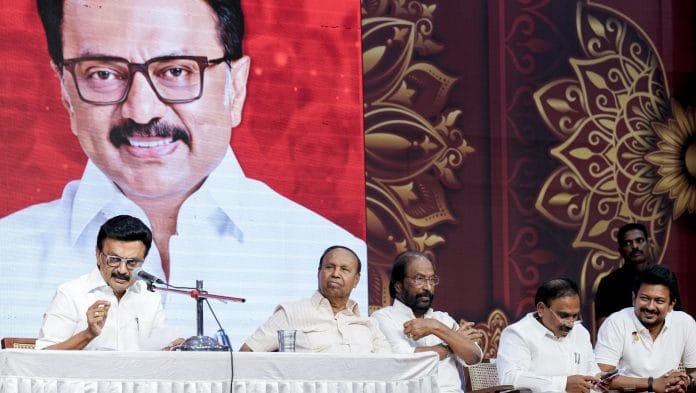
DMK is facing anti-incumbency. MK Stalin is heading a six-party Secular Progressive Alliance (SPA), but many partners are upset with DMK allotting 28 seats to Congress and 10 to Premalatha’s DMDK. Additional irritation among parties like VCK, MDMK and the two Left parties is that Rajya Sabha seats were given to Congress and DMDK. These parties have also received fewer seats compared to the 2021 election. The sudden entry of Premalatha’s DMDK has further strained relations. This will impact ground-level synergy and adds to the possibility of a hung Assembly.
There is visible unrest in Congress as well. Manickam Tagore, MP from Virudhunagar, sent a letter to Mallikarjun Kharge resigning as Chairman of the Congress Election Management & Coordination Committee for Tamil Nadu. MP from Karur S Jothimani publicly criticised the leadership, saying the work of genuine Congress workers “are being sold off”.
The BJP too has seen internal issues. The party’s former state president K Annamalai reportedly backed out of contesting the election over the seat-sharing arrangement, with some reports claiming that he was denied a ticket. The state unit has asked Piyush Goyal to convince him. It now appears that a compromise has been reached, with Annamalai agreeing to abide by the central leadership’s decision.
Also read: ‘Jana Nayagan’ projects Vijay as the future CM of Tamil Nadu. That’s the problem
Who has the upper hand?
Huge crowds are gathering at rallies of AIADMK, Vijay’s TVK and Seeman’s NTK. DMK leaders are receiving mixed responses, and MK Stalin is facing maximum anti-incumbency.
A key election issue is the drug menace. Most parties, except DMK, are focusing on illicit liquor, law and order problems, and crimes in universities. Tamil news channels, which earlier praised the DMK, are now covering all parties more evenly. Meanwhile, people are increasingly turning to social media and YouTube for live coverage. Fake AI-generated videos are also creating confusion. References to leaders like Annadurai, Kamaraj, MGR, Jayalalithaa and Karunanidhi are being misused in such content.
DMK and AIADMK have deep roots in every village of Tamil Nadu. National parties like the BJP and Congress do not have the same grassroots presence.
A new political party, TVK (Tamizh Vettri Kazhagam), led by Tamil cinema “superhero” Joseph Vijay, has entered the fray. For the first time, Tamil Nadu is witnessing a four-cornered contest.
Vijay’s entry gives a tactical boost to Christians in the state. Minority vote banks have become a double-edged factor. For the first time, some of these votes may shift from DMK to TVK, which is expected to capture 20-25 per cent of approximately 6 crore voters, due to Vijay’s huge cinema following. He has built around 5,000 fan club branches since the 1990s.
The BJP is getting a push in Tamil Nadu through the Narendra Modi-Amit Shah combination, which could benefit AIADMK leader Edappadi K Palanisamy. During Jayalalithaa’s time, the Ram Mandir agenda appeared in AIADMK’s manifesto. Jayalalithaa was seen as right-leaning and had attended Modi’s swearing-in as Gujarat chief minister. The BJP’s lotus symbol has some recognition in Tamil Nadu, and it had four MLAs in the outgoing Assembly.
Congress remains a national, nationalist-oriented party. Its alliance with DMK helps consolidate secular votes. After the Karur tragedy, Rahul Gandhi called Vijay to offer condolences. Later, in January 2026, he publicly criticised the Centre over delays in Vijay’s film Jana Nayagan, calling it an ‘attack on Tamil culture’. This led to speculation about Congress getting closer to TVK. DMK pre-empted any major shift during tough seat-sharing talks. With the intervention of Sonia Gandhi and senior leaders like P Chidambaram, Stalin ensured Congress stayed within the Secular Progressive Alliance.
Seeman’s Naam Tamizhar Katchi (NTK) is contesting alone, with about 8 per cent vote share, largely among supporters of Tamil nationalism and sympathisers of LTTE leader Prabhakaran and the Tamil Eelam cause.
DMK’s campaign speeches are heavily focused on attacking the BJP and leaders like Modi and Amit Shah. There are also controversies over remarks on Sanatana Dharma, comparing it to diseases like dengue and coronavirus. DMK’s strategy is to consolidate minority votes, but there is concern that Vijay may draw away both Christian and Muslim voters.
External factors like poll funding and cash distribution during late-night hours are also in play. For the first time, “lottery king” Santiago Martin is reportedly financing multiple parties. His family members are linked across parties—wife Leema with AIADMK, son Charles with LJK, and son-in-law Aadhav Arjuna with TVK.
Manifestos have become a “laughing stock”, with promises such as free fridge, laptop, grinder, wheelchair, WiFi for students, and even a Rs 8,000 coupon to replace old household items. Parties are competing to outdo each other in freebies.
PMK leader Anbumani Ramadoss criticised the DMK manifesto as a “comedy script” and a “sadhuranga vettai” (con game). He said that 63 of the 517 promises were repeated from 2021 with new branding.
AIADMK general secretary Edappadi K Palanisamy alleged that the DMK is fielding leaders expelled from the AIADMK, calling them “worthless currency” who have taken asylum in the DMK. He also criticised the Rs 8,000 coupon scheme.
Caste equations will also play a crucial role. With minority votes possibly split, Hindu communities like Konars, Mukkulathor, Mutharaiyar and Scheduled Castes (SCs) will play a decisive role.
The Tamil Nadu 2026 election is going to be a tough contest for everyone, with many seats likely to witness narrow winning margins, possibly below 1,000 votes.
R Rajagopalan is a veteran journalist and a political analyst. He tweets @RAJAGOPALAN1951. Views are personal.
(Edited by Prashant Dixit)