






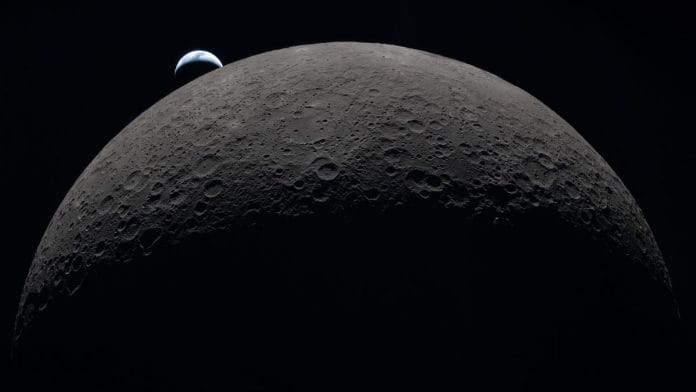



Artemis II mission’s Orion crew module, named Integrity by its four astronauts, recently made a perfect splashdown in the Pacific Ocean off the coast of San Diego, California. The successful completion of this mission marks not just a milestone for the United States but a significant new beginning for the entire world, indicating the revival of human exploration of the Moon after more than five decades.
The success of Artemis II can be assessed through multiple perspectives, and the evolving space race constitutes one of the most important among them.
There is growing discussion that the mission signals a revival of a modern-day space race. In recent times, the Moon has re-emerged as a critical arena for demonstrating a country’s technological might. It is now viewed as a focal point for tapping potential resources and establishing a long-term human presence on the lunar surface.
Among the three major space powers, Russia’s lunar programme has faced setbacks, most notably the failure of the Luna-25 robotic probe landing attempt in 2023. More recently, the Russian Academy of Sciences announced a delay in launching its next robotic lunar probe from 2027 to 2028, the same year the US is planning human lunar missions. In contrast, China’s lunar programme has progressed steadily, with successful robotic operations on the Moon and sample-return missions. China’s Chang’e 6 mission became the first to collect and return with around 2 kg of samples from the lunar far side in June 2024. It has plans to land astronauts on the Moon by 2030.
What is the new space race about?
While Artemis II is framed as an international collaborative effort under the Artemis programme, major space powers such as Russia and China are not part of it. Despite having cooperated with the US and other partners for over two decades in operating the International Space Station (ISS), Russia has chosen to remain outside the Artemis programme. This exclusion of key players has led many to argue that a new phase of competition in space exploration is currently underway.
The concept of a space race has a long history. It can be traced back to the Sputnik 1 launch by the Soviet Union in 1957, which marked the beginning of intense competition in space exploration. In response, the US launched its own satellite in 1958. This was viewed as a race for technological superiority in the space domain during the Cold War. The rivalry deepened in 1961, when Yuri Gagarin became the first human to travel into space, a major Soviet achievement. This led to the US planning the mission to the Moon and Neil Armstrong becoming the first human to step on it in 1969, establishing US dominance in space exploration.
While the Cold War era phase of the space race was largely about technological one-upmanship, the rivalry today continues in a more complex form. Major space powers such as the US, China, and Russia now recognise the scientific and strategic significance of lunar exploration. The focus has shifted toward accessing potential mineral resources on the Moon, making it increasingly a race for planetary resources.
The emerging interest in extracting Helium-3 from the Moon is a potential driver of the new space race. It’s a rare isotope of helium unavailable on the Earth, but is found in abundance on the lunar surface. It holds promise as a future fuel for nuclear fusion with minimal radioactive waste. Some theoretical studies suggest that Helium-3 could offer a promising solution for future energy security. It is not only the US, China, and Russia that have an interest in this field; but India and Japan are also investing in the potential procurement of Helium-3 from the lunar surface.
It must be noted that the emerging space race is less about immediate resource extraction and more about securing early access to establish human colonies and conduct scientific experiments. The idea is to take an early advantage in governing extraterrestrial resources.
Also read: How India’s Sparrows outsmarted Pakistan and helped conquer Siachen in 1984 Operation Meghdoot
Establishing US leadership
The Artemis programme is an offshoot of the Artemis Accords: a set of non-binding, voluntary principles established in 2020 by NASA and the US Department of State to guide safe, transparent, and sustainable space exploration. It can be seen as an early American effort to shape the legal, technological, and policy frameworks governing access to and use of lunar resources. It is an attempt to control lunar minerals on terms that align with their own strategic and economic interests. The US has intentionally kept the United Nations out of any deliberations, and has evolved a multilateral mechanism that essentially caters to its interests.
At the same time, the symbolic and political optics of placing humans on the lunar surface continue to capture global attention, fuelling discourse around which country will get there first. China has largely avoided framing its lunar ambitions in overtly competitive or ‘race’ terminology with the US. In contrast, several officials from the US, including NASA leadership, have explicitly emphasised the strategic importance of landing astronauts on the Moon before China, linking it to leadership in space exploration and the ability to shape future norms of lunar governance. And they want to do it during Trump 2.0.
While delays are common in space missions and timelines remain fluid, the US is currently targeting a human lunar landing under the Artemis programme around 2028. China, on the other hand, has indicated plans for a crewed landing by 2030.
Only time will determine who arrives first. But the success of Artemis II suggests that the US has secured an early lead in this new race to the Moon.
Ajey Lele is deputy director general at the Manohar Parrikar Institute for Defence Studies and Analyses (MP-IDSA). Views are personal.
(Edited by Prasanna Bachchhav)