






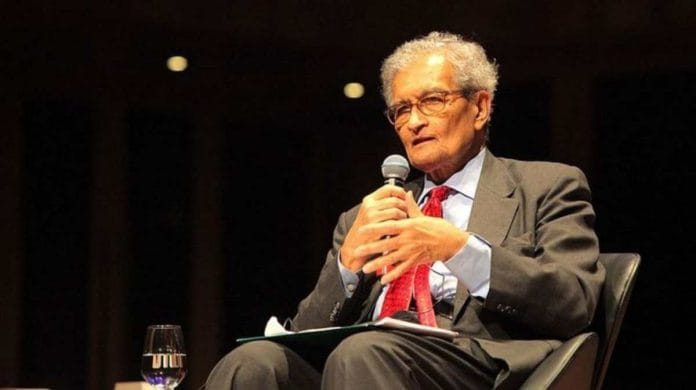



A 92-year-old Nobel laureate receiving a notice from the Election Commission of India is the sort of story that travels fast—partly because it is unexpected, partly because it is symbolic. In Amartya Sen’s case, the national poll body reportedly clarified quickly that the trigger was a clerical discrepancy and that no personal appearance was required.
The micro-controversy will pass. The larger civic lesson should not.
Behind the headline sits a democratic oddity: Millions of Indian citizens live abroad with Indian passports, and remain citizens in law. Yet, India has designed their vote to be more theoretical than usable.
Citizenship first—who has the vote, who doesn’t
First, start with principles. India does not permit dual citizenship in the conventional sense. Once an Indian citizen voluntarily acquires the citizenship of another country, Indian citizenship ends by operation of law. That is why this debate is not about the entire diaspora in the loose sense Indians use the term.
OCI cardholders—foreign citizens of Indian origin—may have strong ties to India, but they do not have political rights here. The vote belongs only to those who remain Indian citizens: Indian passport holders who have not taken a foreign passport.
The Parliament did not leave such citizens in a grey zone. Section 20A of the Representation of the People Act, 1950—operational since February 2011—created the category of the “overseas elector”. It recognises the voting right of an Indian citizen who is outside India for employment, education or otherwise, provided the person has not acquired foreign citizenship. The Republic, on paper, chose citizenship over physical presence as the basis of the franchise.
Also read: Odia Asmita is not enough for BJP to stay in power. Caste politics is catching up in Odisha
Numbers that expose the problem
Overseas voting in India is best understood through numbers that show how a right can be affirmed and then quietly throttled.
In the 2024 Lok Sabha election, there were 1,19,374 registered overseas electors on the rolls. However, only 2,958 actually voted. Kerala alone accounted for 2,670 of those votes—about nine out of every ten overseas ballots cast. Put against the scale of India’s election, the proportion is vanishing: the ECI’s own tally for 2024 is 64.64 crore votes polled. Overseas electors, therefore, supplied roughly one vote out of every 2.2 lakh votes cast.
Even registration is tiny in proportion. Official estimates place the number of NRIs at roughly 1.6 crore. Set against that, 1.19 lakh registered overseas electors is well under 1 per cent of the potential citizen-diaspora electorate. The right exists, but barely shows up on the roll.
The design explains the outcome. Section 20A offers the overseas citizen a franchise, but ties that franchise to an administrative anchor and a physical burden.
First, the anchor: An overseas elector can be enrolled only in the constituency in which the place of residence in India, as mentioned in the passport, is located. Your passport’s Indian address determines your constituency and, ultimately, your polling station.
This looks neat on paper; however, in real life, it collides with mobility. Families move. Ancestral homes are sold or rebuilt. Overseas passport renewals can produce inconsistent address trails. What is treated as a clean identifier becomes a brittle link, especially when election offices demand perfect documentary alignment.
Second, the burden: India provides no routine facility for overseas electors to vote from abroad. No embassy voting. No online voting. No general postal ballot. The registered overseas elector must appear in person at that single polling station in India, on polling day, and prove identity through the original passport. In effect, the law gives you the vote but charges you a flight ticket to use it.
This is not a marginal inconvenience; it is the central fact. It also explains the volatility in participation. In 2019, overseas elector turnout was far higher: 25,606 voted out of 99,844 registered—roughly a quarter. Five years later, it collapsed to about 2.5 per cent. The right did not disappear. The costs simply overwhelmed participation.
Also read: Five elections in 2026—and five things results will redefine for BJP and Opposition
Why do roll revisions sharpen the risk
This is why roll revision drives matter as context. Intensive verification is meant to cleanse the list of duplication and errors. Yet it is also the moment when absent citizens discover how precarious their paper franchise is. A resident voter can usually respond quickly to a notice or discrepancy. An overseas elector may be asleep in another time zone or locked into work contracts.
Even families in India can worsen matters by filing the wrong paperwork, assuming the overseas citizen should be treated as a resident voter “temporarily away”. The overseas elector is a distinct statutory category; the remedy must match the category.
So India’s present approach produces a paradox: A right that exists in law but remains expensive to exercise, fragile to maintain, and—conveniently—too small to change political incentives. Parties praise the diaspora as remitters and global advocates. A diaspora vote that functions at scale would change calculations, and the present design ensures it does not.
None of this is an argument for laxity. Remote voting, designed badly, can damage trust. But that is not an argument for freezing a right in token form. It is an argument for finishing the reform with safeguards.
A workable agenda is within reach. The Parliament and the Election Commission of India (ECI) could enable a tightly regulated postal ballot framework for overseas electors, with robust identity verification, auditable trails, and strict penalties for fraud. A second option is regulated consular voting at Indian missions—again tied to prior registration, verified identity, and secured custody. Either route would convert “theoretical” citizens into participating citizens without compromising integrity.
Alongside this, the state must fix the choke point it created. If the passport’s Indian address is the statutory anchor, passport issuance and renewal practices should preserve a stable Indian residence link for citizens abroad—or the law should recognise a strong alternative proof of last residence for enrolment. The Republic cannot insist on an anchor and then make it easy to lose.
Sen’s episode, corrected as it may have been, offers a timely reminder for every Indian passport holder abroad: You can vote—if you enrol as an overseas elector under Section 20A, anchor your claim to the India address in your passport, and show up in person at that one booth on polling day with your original passport (the enrolment route is Form 6A).
But the Republic cannot forever congratulate itself for keeping the door unlocked while placing the doorway thousands of miles away. A right that requires a flight ticket is not a universal democratic right. Section 20A was a principled start. Fifteen years later, the principle deserves completion: not a paper franchise for overseas citizens, but a usable one—secure, verifiable, and worthy of a democracy that insists every citizen counts.
KBS Sidhu is a former IAS officer who retired as Special Chief Secretary, Punjab. He tweets @kbssidhu1961. Views are personal.
(Edited by Saptak Datta)