









It’s that time of the year again. The time to look back at the year gone by, take stock of all that happened, and to understand the ramifications of decisions and actions, both short-term and long-term, and the consequences thereof. It is time to prepare the end-of-year balance sheet, both official and personal.
In the North Indian calendar, these last two weeks of December are considered a sacred period. A time of introspection, deep meditation, and spiritual grounding. Especially among Punjabis. This is the month of Poh, the tenth month of the Punjabi Bikrami lunisolar calendar, beginning the day after the Magghar full moon and ending at the Poh full moon, also coinciding with the Nanakshahi calendar. In the western calendar, this period starts around 14 December and ends at Lohri on 13 January.
My grandmother, who was of Sikh origin and married into a Punjabi warrior family, would say, “Tara dooba hai”, and traditionally there would be no Punjabi weddings during this period. For our relatives, this was a period of reverence and solemnity, commemorating the sacrifices by the Sikh Gurus in honouring and preserving the faiths of their Hindu brethren against Islamic evangelists and invaders. The sacrifices of the Sahibzadas, Mata Gujri, and innumerable Sikhs are unparalleled.
As a North Indian Punjabi, my family’s history has been deeply intertwined with that of my Sikh cousins, relatives, and neighbours. Delhi was, at one time, part of Punjab province, and then later built with the toil of Punjabis who migrated amid the genocide in West Punjab (Pakistan) during Partition.
Being a Delhi-born, educated, and married woman, I have often spent this spiritual month in solemn prayer at Gurudwara Sis Ganj Sahib, Gurudwara Rakab Ganj Sahib, Gurudwara Bangla Sahib, and Gurudwara Moti Bagh Sahib. This past week, I have also spent time sharing the quiet grief and unwavering faith of my Sikh brethren, commemorating in solemn silence the sacrifices that have helped the Sikh faith evolve.
Also Read: Bondi Beach, Bangladesh lynching — once again, the elephant in the room will be side-stepped
Secularism in Sikhism is akin to Sanatan Parampara
The Sikhs and Hindus understood secularism long before the INC dragged it into the political mainstream.
“Karta (the Creator) and Karim (the beneficent) are the names of the same God.
Razak (the provider) and Rahim (the merciful) are also the names given to Him.
Let no man in his error wrangle over differences in names.
Worship the One God who is the Lord of all.
Know that His form is one and He is the One light diffused in all.”
So said Guru Gobind Singh Ji, the 10th and last human Guru of the Sikhs. He was a warrior, a poet in Braj Bhasha, a scholar in Sanskrit, who became Guru at the age of nine after his father was martyred by the Mughals. His contribution to the perpetuation of the Sikh faith and the preservation of the Hindus is unmatched.
The above verse highlights the dominant Indian philosophical thought, which is also the very essence of Sanatan Dharma. Call Him by any name, Karta or Karim, Razak or Rahim, God is one, albeit worshipped differently by different religions. Similarly, “Ekam sat vipra bahudha vadanti” means truth is one, and wise people call it by different names.
The teachings of Guru Gobind Singh Ji suggest that religious differences are mere illusions or errors. One of his shabads says, “Recognise the whole human race as one”. He spoke of the divine light, or ‘jyoti’, present in all, irrespective of caste, creed, race, colour, or faith. He rejected sectarianism. His writings warn against “wrangling over differences”, and he insisted on worshipping one God, “the Lord of All”. The concept of ‘My God is superior to yours’ does not exist in Sikhism or Sanatan parampara. Guru Gobind Singh Ji sacrificed his life in the preservation of this philosophy, as did his father, mother, four sons, and scores of followers.
These teachings, inspired from earlier Vedic verses/texts, sowed the seeds of “secularism” as we know it today and has been enshrined in the Constitution.
Also Read: How IMF’s routine data critique was spun to discredit India’s growth story
An unnamed genocide
Genocide is a difficult word. It is laced with horror, trauma, and the crimson hues of the bloodshed of innocents. It was formally defined only in 1948 by the UN Genocide Convention, long after the acts of genocide perpetrated upon Hindus and Sikhs in their own land by murderous marauders.
In the early years of the 18th century, Guru Gobind Singh took the fateful decision to move out of the fortified city of Anandpur Sahib, under the solemn assurances of the Mughal rulers, who had sworn upon the Holy Quran that the Sikh Guru, his family, and his followers would be given safe passage. In an act of grievous treachery and betrayal, what followed was nothing short of genocide, and yet the world has repeatedly shied away from using this word to describe the barbarism that unfolded.
On 22 December 1704, Mughal forces launched a siege against the Guru at Chamkaur. The next day, as Guru Gobind Singh prepared to depart, the elder Sahibzadas, Baba Ajit Singh and Baba Jujhar Singh, who were mere teenagers, charged into battle and were martyred, along with three of the Panj Pyare. Bhai Sangat Singh, disguised as the Guru, also charged into battle, while Guru Gobind Singh Ji and the remaining two of the original Panj Pyare slipped out of the fortress under cover of darkness to carry on the battle.
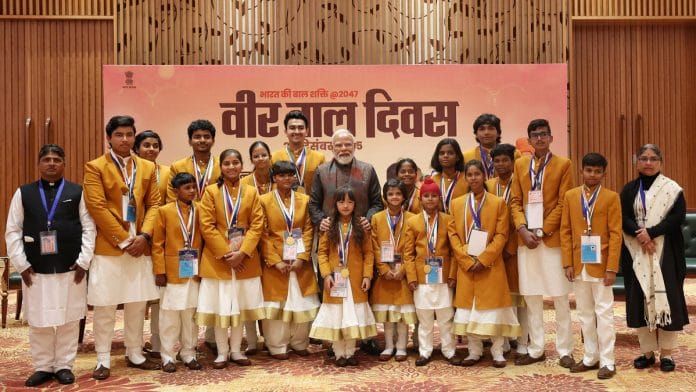
A few days later, on 25 December 1704, Mata Gujri and the younger Sahibzadas, who were mere children, were captured and imprisoned in the freezing chambers of the Thanda Burj. The ruthless Wazir Khan, the Mughal army faujdar, intimidated, coerced, enticed, and bullied the young Sahibzadas to abandon their Sikh faith and embrace Islam. But they remained steadfastly loyal to their beliefs. The unwavering resilience of two children, aged seven and nine, in the face of Mughal intimidation and torture has gone down in the annals of Sikh history, Punjab, and, one hopes, the whole of India, as this day is now recognised as Vir Bal Diwas, a commemoration made by the Hon’ble PM and now celebrated across India.
वीर बाल दिवस पर हमारे बेटे-बेटियों को शौर्य-पराक्रम और मानवता की शिक्षा देने वाली नाट्य प्रस्तुति 'नए भारत के नन्हे रक्षक' ने हृदय को छू लिया। pic.twitter.com/LMCY8GsU00
— Narendra Modi (@narendramodi) December 26, 2025
On 26 and 27 December, the two Sahibzadas and their grandmother, Mata Gujri, attained martyrdom with grace and dignity while defending their faith. This genocide is commemorated with reverence during the holy month of Poh.
Lessons learnt from the defenders of the faith
As I look back at the year that is closing, I take this time to introspect and draw from the supreme sacrifices of the Sahibzadas, the Panj Pyare, and several other warriors who gave their lives for their culture, faith, and freedom.
The year 2025 has been difficult for the Hindus. Attacked in their homeland, the sacred land of Rishi Kashyap, stripped of dignity, and shot for their religion. Some of us have even watched videos of the barbaric lynching of Hindus in neighbouring Bangladesh. Attacks on minorities in Pakistan continue unabated, with Hindu girls specifically being targeted for conversion. There have been attacks on Hindu and Sikh properties in the US, including a temple in Utah, and Hindu youth have been targeted for holding steadfastly to their religion. In London, in May 2025, three Hindu boys were targeted in a ‘suspected’ hate crime. Graffiti, intimidation, and threats to Sikhs, including those wearing the turban, have also been reported this year. And of course, the underreported destruction and desecration of the statue of Lord Vishnu at the Thailand-Cambodia border.
Yet a narrative of vilification continues, even after subjecting the community to some of the most brutal attacks in history.
As the year and the sacred month of Poh come to a close, the following words of Guru Gobind Singh are as relevant in this period of indoctrination and radicalisation as they were during the barbaric rule of Aurangzeb:
In putran ke sees par vaar diye sut chaar,
chaar muye to kya hua jeevat kayi hazaar
(For the sake of these children, I have sacrificed my four sons, and it doesn’t matter as thousands are still alive.)
My grandmother’s words resound—’Tara dooba hai’. The sacred month of Poh is also a time to take inspiration from the Gita and to fight back against oppression and injustice. A call to action, so to speak.
Sukha-duḥkhe same kṛitvā lābhālābhau jayājayau
tato yuddhāya yujyasva naivaṁ pāpam avāpsyasi
This can be translated as: “Fight for the sake of duty, treating alike happiness and distress, loss and gain, victory and defeat. Fulfilling your responsibility in this way, you will never incur sin.”
As the new year dawns, we need to concentrate on the learnings from our holy scriptures, find peace and solace within ourselves, and find the power to fight injustice, while performing sewa and penance as an antidote to what is happening in the world around us.
Meenakashi Lekhi is a BJP leader, lawyer and social activist. Her X handle is @M_Lekhi. Views are personal.
(Edited by Asavari Singh)