






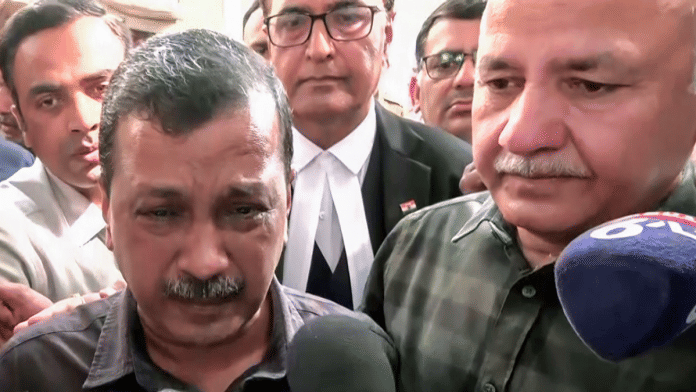



What does the trial court’s order discharging former Delhi Chief Minister Arvind Kejriwal, former Delhi Deputy CM Manish Sisodia, and 21 others tell us about the state of today’s India?
Well, it tells us a lot, and no matter which way you look at it, none of it is good news. For a start, the order suggests that the government used its investigative agencies to pursue a vendetta against its political opponents. That it jailed a chief minister, his deputy and several ministers without adequate evidence and that this vendetta was enabled at every stage by the other branches of government.
These include other opposition members of the parliamentary branch who gloried in Kejriwal’s incarceration and offered limited support. And most significantly, it includes the judiciary, which facilitated the persecution of an opposition state government by obligingly locking up everyone the government wanted jailed.
I make no personal judgments about Kejriwal’s guilt or innocence. That’s the job of the courts. The trial court has ruled that there is no case against him, and in the absence of evidence, even a trial is not necessary. Until a higher court rules otherwise, we must accept that. The government had years to gather evidence. And according to the court, it found nothing.
Role of Congress
This decision is so damaging to the government that I imagine that efforts will be made to ensure that it does not stand. The prosecution has said that it will file an appeal in the high court. Some attempt will be made to set aside the lower court’s ruling. The government will ask a higher court to rule that the trial should be allowed to go ahead. If the trial court is right and there is a paucity of evidence, then this will be a purely face-saving exercise. The overturning of the lower court’s discharge will be treated as a huge victory, and the case will plod on for years so that it can fade from public memory.
I can’t see this matter going any other way. We can all see what the government was trying to do, so it is the enablers of injustice we should talk about.
Let’s start with the Congress. The party has reason to be bitter about Kejriwal, who, during the ironically named India Against Corruption movement, levelled all kinds of irresponsible charges against the Manmohan Singh government and trashed the reputation of Sheila Dixit, one of the best Chief Ministers that Delhi has ever had.
It is also true that Kejriwal has turned out to be a not particularly savoury character, who has thrown nearly everyone who accompanied him on his India Against Corruption journey under the bus before antagonising many of his AAP colleagues as well. And yes, Kejriwal served as the advance guard for Narendra Modi, using the covert support of the RSS to demolish the UPA’s image with his movement so that Modi could sweep in and become the Great White-Bearded Hope for India.
I agree with the Congress that Kejriwal is a hard man to feel sorry for, given his record. But the Opposition has to decide what is more important for the country: the principle or the individual?
And there is a clear principle here. Should any central government be allowed to cripple an Opposition state government before an assembly election by arresting its leaders, especially when the alleged scam in question occurred much before the arrest and was, apparently, over and done with, by the time the ministers were arrested? When the only urgency was caused by political expediency?
The Congress should be much more vocal about this misuse of central authority than it has been. The true test of your commitment to democratic values is when you defend somebody you don’t like on a matter of principle. Even now, with the trial court ruling that the evidence is simply not there, Congress is still unclear which side it is on.
Also read: Where does the law stand on Himanta Biswa Sarma’s video of ‘shooting’ Muslims?
Basic rights to liberty and justice
I shall have to be careful about what I say next because I don’t want to be accused of contempt of the judiciary, an institution that I have enormous respect for. But any reasonable person will find it odd that so many judges let Sisodia remain in jail for 17 months ( Kejriwal was imprisoned for five months). If the case was so weak, shouldn’t judges have refused to go along with the government’s need to keep AAP leaders in jail?
Elsewhere in ThePrint, you will find a recording of my conversation with Justice DY Chandrachud where he concedes that judges should not imprison people who have not been found guilty of any crime unless certain well-established exceptions apply (flight risk, can tamper with evidence, may repeat a violent crime etc). Chandrachud adds that in some cases, judges are hamstrung by the provisions of certain laws but says that the principle of liberty must always apply.
The truth is that the judiciary does not always respect this principle. Even when Chandrachud was Chief Justice, the right to liberty rarely seemed to have mattered in too many cases. Any government that wants to fix its opponents or critics can lock them up without worrying about proof or the need to demonstrate to a judge that there is sufficient evidence for sending them to jail. Any situation where the judiciary becomes an enabler of injustice is deeply disturbing and a manifestation of a political system that is rotting at its core. Surely the judges themselves can see that?
Chandrachud argued that judges in lower courts were scared to grant bail in case people said afterwards that they had been paid off. I don’t know if that’s true. But even if it is, then what about the higher judiciary? Is it just simpler and easier to go along with the prosecution?
So yes the discharge of Kejriwal and the others accused in this case reflects badly on the central government. But what is more worrying is the institutional failures that followed the decision to arrest the AAP leaders. So let’s forget about how we feel about Modi and Kejriwal personally for a moment. Let’s focus instead on whether we are becoming a society where citizens are losing their basic rights to liberty and justice because some of the institutions of democracy are becoming enablers of authoritarianism.
Vir Sanghvi is a print and television journalist and talk show host. He tweets @virsanghvi. Views are personal.
(Edited by Saptak Datta)
We should also talk about the cronyism in Delhi Liquor Policy, to generate political funds for AAP.
“I agree with the Congress that Kejriwal is a hard man to feel sorry for, given his record. But the Opposition has to decide what is more important for the country: the principle or the individual?”
So very true…But he is REALLY a difficult man to like.Full disclosure…I voted for him once.