









The bomb crashed through the sign of the Red Cross, painted over the spotless white roof, cutting through two floors of No. 3 Canadian Stationary Hospital. The surgeons Ethelbert Meek and Abner Sage died instantly, together with nurses, operating-room staff and their critically-injured patient. The fire, which followed, claimed many more lives. Later, military chaplain GH Andrews recalled: “There were flags with a red cross flying, and lights were turned on them so that they would show prominently. The Germans could not possibly have mistaken the building they bombed for anything else.”
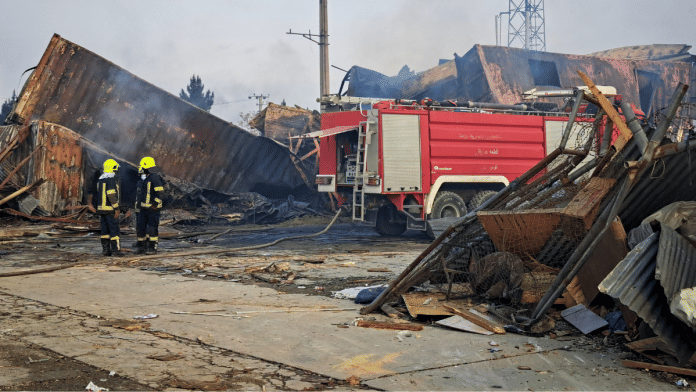
Four hundred people died this week when Pakistan Air Force combat jets hit the Omar Addiction Treatment Hospital in Kabul—the carnage a reminder that precision-strike technology has done nothing to diminish the murderous character of war since the destruction of No. 3 Hospital on 29 May 1918.
Everywhere, the conventions that protected civilian lives even in war have been disintegrating. The bombing of hospitals in Gaza is just the most egregious example; America has hit a school in Iran; Iran has bombed hospitals in Israel; Saudi Arabia levelled a hospital in northern Yemen; the Taliban, who now rule Afghanistan, themselves conducted suicide attacks on hospitals and terrorised doctors.
Few leaders even bother to apologise for these crimes, as President Barack Obama did in 2015, after American jets bombed a hospital in Kunduz, killing dozens of doctors and patients. Law scholar Peter Margulies noted that a military investigation of the bombing established commanders had shown callous disregard for human life—yet, no one was prosecuted for war crimes.
Also read: India’s long war with Maoists has a huge void — no number of dead bodies can fill it
The laws of killing
Ever since 1949, the Geneva Conventions have promised protection of the sick and wounded in war—civilian or military, friend or foe. There are circumstances in which the immunities can be lifted—for example, when a hospital is misused for military or intelligence purposes, or civilians participate in combat. Even then, however, international humanitarian law states that no attack is legitimate if it causes “loss of civilian life, injury to civilians, damage to civilian objects, or a combination thereof, which would be excessive in relation to the concrete and direct military advantage anticipated.”
The bombing of the No. 3 Hospital was very far from the greatest crime of the First World War. Large numbers of hospital ships were sunk by German submarines, as part of a policy of unrestricted warfare against all enemy shipping. Lieutenants Ludwig Dithmar and John Boldt, the ranking officers on the German submarine U86, were convicted for machine-gunning the survivors of the hospital ship “Llandovery Castle”
For those watching the killing, though, there was one thing that distinguished the hospital bombings: The end was death, not military victory. The answer, some argued, was counter-savagery. “They will do what they think they can do with impunity, and they will avoid that which entails punishment,” wrote the novelist Arthur Conan Doyle. Like many others, Doyle advocated for the bombing of German cities and for prisoners of war to be billeted in hospitals, to deter attack.
Even though many shared Doyle’s rage, some warned his prescription would lead to greater savagery. The eminent historian Arnold Toynbee, in a famous pamphlet on crimes committed during the German invasion of Belgium in 1915, argued for the careful documentation of events as a foundation for future efforts to ensure legal accountability. Leonard Hobhouse—a trenchant critic of British imperialism—warned of the dangers of sacrificing ethical principle in the pursuit of national objectives, even justice itself.
These warnings were ignored. The bombing of cities in the First World War became a template for the even greater savagery of the Second World War.
Learning from the Nazi genocide of the Second World War, the world seemed to move towards making war subject to law and reason. These ends were, however, almost immediately subverted. The Western Allies, driven by anticommunism, eagerly rehabilitated key Nazis as well as Imperial Japanese war criminals. For their part, the Soviets pursued exactly the kinds of means of industrialised mass killing they had condemned during the war—a grim pursuit revealed after dozens died in an Anthrax outbreak later traced to a secret bioweapons laboratory near Sverdlovsk.
Also read: Tracing the story of Iran’s nuclear programme & turning points as Israel-US try to obliterate it
Taming moral impulses
For the most part, the post-Second World War effort to hold nation-states accountable for military action died amid the Cold War. Large-scale massacres of civilians during the Korean conflict, like the slaughter at No Gun Ri, as well as the execution of civilians and prisoners by the North, went unpunished. The war in Korea, by some—inevitably controversial—expert estimates, claimed more civilian deaths as a percentage of the population than the Second World War before it, and Vietnam after. The scholar Kelly Greenhill has argued that civilian deaths in modern conflicts have been systematically under-reported, undermining hopes that war has been tamed.
To conclude that efforts to impose restraint and rules on the conduct of war are therefore useless, though, would be misguided. The endemic violation of traffic laws, for example, does not mean that there is no purpose to having such regulations. The philosopher Michael Walzer argued, in a famous 1977 book, that the real challenge was for humans to carefully consider when wars were just—and subject themselves to those principles.
Following the Second World War, the Great Powers soon abandoned even the pretence of subjecting themselves to the rules they had just arrived at. The evidence that American troops had massacred civilians at My Lai—gathered among others by the United States House of Representatives—did not lead to the imprisonment of perpetrators. Former Senator Bob Kerry publicly admitted to murdering more than a dozen villagers in Vietnam in cold blood, including children and women. The confession of murder, though, did not lead to any legal consequences.
The savageries of apartheid South Africa in Angola and Mozambique; the carpet-bombing of Afghan villages during the Soviet intervention; America’s secret support of genocidal wars in South America and its in-full-public-view destruction of Fallujah in Iraq: Each of these dismantled, brick by brick, hopes that people everywhere might be spared at least some of the horror of war.
Also read: Empires inflicted a century of regime change on Iran. Each wanted a compliant, powerless nation
The nature of war
Leaders have begun to claim that brutality is an organic element of conflict, like the stench of gunpowder and decomposing bodies. The American Defence Secretary, Pete Hegseth, is fond of quoting General William Sherman, who declared that “war is hell.” The General, though, also made clear that war was a choice, not an inevitability. “Wars do not usually result from just causes but from pretexts,” he told cadets in 1879. “There probably never was a just cause why men should slaughter each other by wholesale, but there are such things as ambition, selfishness, folly, madness, in communities as in individuals.”
The General understood that the purpose of war is not bloodletting, but securing strategic ends: Ends which may be driven by hubris and greed, or have some bearing on justice. There are militaries which demonstrated, too, that war does not have to descend into mindless killing. The Pakistan Army, which disgraced itself in 1971, showed respect for civilian lives in 1965. The Indian Army has committed many crimes in counter-insurgency, but never resorted to the kinds of massive killing unleashed by other countries.
Little consequence, more likely than not, will face Pakistan’s Generals for their crime in Kabul. The killing of recovering drug addicts in a country ruled by an Islamist despotism is not something that will diminish America’s “Favourite Field Marshal”—especially in the eyes of a President who has shown no qualms about killing civilians.
To kill without moral burden seduces: As the horror of the two World Wars recedes from our memories, leaders and nations see ever less reason to place shackles on their power. Lacking restraint on technologies of lethality or the ends to which they are put, we have lurched dangerously close to a perilous state which threatens not just human life, but the survival of civilisation.
Praveen Swami is contributing editor at ThePrint. His X handle is @praveenswami. Views are personal.
(Edited by Theres Sudeep)
Swami spends an entire essay mourning the death of the Geneva Conventions — the same conventions that also ban using hospitals as military bunkers and hiding rockets in schools. Hamas does exactly that, on camera, repeatedly. Yet Hamas gets zero mentions. Gaza appears once, solely to blame Israel.
So apparently, humanitarian law is sacred — just not sacred enough to apply to everyone breaking it.
Nice sermon, Praveen. Kudos about the blind spot.