









As the Rashtriya Swayamsevak Sangh or RSS steps into its next century, it has evolved into an institution that has preserved the nation’s civilisational ethos and helped shape its contours for the years ahead. It is impolitic to bind the RSS into a single ideological sphere, and it ignores the institution’s continuous social experiment to build a cohesive, continuous tradition in a diverse and divided nation.
On Dussehra in 1925, when Dr KB Hedgewar and others laid the foundation of the RSS, the idea was not merely to be a part of the Independence struggle but awaken the nation’s civilisational values. The Sangh acted as a bridge connecting the ancient civilisation of the subcontinent, societal realities of colonial India, and aspirations of a young India entering the 21st century. And its biggest contribution has been in the realm of bridging caste-based disparities entrenched in Indian society.
The RSS refers to its exercise in bringing parity in the Hindu society as samajik samrasta. The phrase does not have a true equivalent in English. Be it social harmony, unity, or even social resilience, the terms fall short of explaining the word to its fullest meaning and spirit. Samrasta is not just a word; it is an experiment in dialogue to achieve equity, divinity, sincerity, equality, and complementarity.
RSS as a ‘social laboratory’
In order to understand the Sangh’s contribution to samajik samrasta, one must first understand the lived experiences and intellectual trajectory of its founder and first Sarsanghchalak. Hedgewar, a doctor trained in Calcutta (Kolkata) and an active member of the revolutionary circles, carried a burning question within him: Why did India, with all its civilisational strength, fall to colonial subjugation? His answer was that India was enslaved not because of a lack of bravery or intellect, but because Indian society grew weak, fragmented by divisions of caste, region, and language. If such fissures persisted, he warned, even after the British departed, India would remain vulnerable to domination by others and to losing its Independence again.
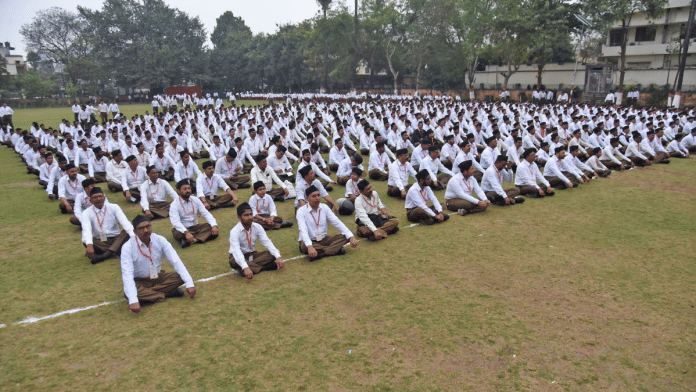
Thus, the RSS was envisaged as a “social laboratory” where young men from diverse castes and regions could come together, eat together, and learn the discipline of collective living. The daily shakha was not simply a drill but an embodied pedagogy of social cohesion. The Sangh’s approach to end untouchability was less about abstract resolutions and more about realism and pragmatism, with an emphasis on lived experiences.
Successive leaders deepened this social vision. MS Golwalkar faced the monumental challenge of communal violence during Partition. Yet, even amid this turbulence, he worked to consolidate Indian society. In 1969, the Udupi conference drew together saints and seers across sects and caste groups, and gave a call for the complete eradication of caste-based discrimination. It was an unprecedented step toward addressing caste inequality.
MD Deoras, the third Sarsanghchalak, was perhaps the most forthright in confronting caste-based discrimination. In his landmark lecture at Vasant Vyakhyanmala in Pune, he drew inspiration from Abraham Lincoln’s words, “If slavery is not wrong, then nothing is wrong.”
‘If untouchability is not wrong, then nothing is wrong,” Deoras said. To him, untouchability was no small error but a “bhayankar bhool”—a tragic blunder of society that must be erased without compromise. He challenged the orthodoxy that clung to outdated practices merely because they were inherited: “This is my father’s well, even if its water is salty, I shall drink it.” Such fatalism, he argued, had no place in a modern India striving for equality. In 1983, he institutionalised these efforts through the formation of the Samajik Samrasta Manch.
Today, Sarsanghchalak Mohan Bhagwat has put forth a clear roadmap for Sangh, sanghatan (organisation), and samaj (society): unless the caste-based discrimination is eliminated, Indians will not be able to create an egalitarian society.
Also read: Corruption was widely documented in medieval India. Spies kept an eye on kings, bureaucracy
Thinkers, activists of RSS
The Sangh practices what it preaches—contrary to the opinions of naysayers—and it ventures closer to the essence of Gandhian teaching of improving the individual morally and spiritually, thereby changing the external environment. MK Gandhi’s first encounter with the RSS was in 1934, when he visited the Wardha camp and witnessed the communal eating and living style of RSS swayamsevaks (volunteers), devoid of any caste-based segregation. It found mention in a September 1947 issue of the weekly magazine Harijan.
The Sangh ecosystem nurtures thinkers and activists. Dattopant Thengadi created linkages between social justice and labour rights. KN Govindacharya articulated the formula of “social engineering”, which influenced not just the BJP but also Dalit leaders such as Kanshi Ram, who openly praised Govindacharya for coining the term. Deendayal Upadhyaya’s philosophy of ‘integral humanism’ and the vision of antyodaya—empowerment of the last person—remains a cornerstone of socio-political discourse.
The centenary of the RSS is not just the chronicle of an organisation, but a chapter in India’s national consciousness. By embedding nationalism in everyday practice, mobilising millions for service, and fostering a discourse of fraternity, the Sangh has positioned social harmony as the bedrock of a strong nation.
Aditi Narayani is an assistant professor of sociology at Lakshmibai College, Delhi University. She tweets @AditiNarayani. Views are personal.
(Edited by Prasanna Bachchhav)
Ek Google search se aise “non critical articles ” ki sacchai pata chal jaati hai .. don’t take anything on face value .. her father is in the bjp .. why should anyone be surprised by the nature and what this article wants us to think about RSS
I did a Quick Google search on her – HER FATHER IS IN THE BJP – NOT SURPRISED BY THIS “SUPPORTIVE ARTICLE” 😂😂😂
RSS APOLOGIST – WHY DOESNT RSS OPPOSE WHEN MUSLIM HOUSES ARE BULLDOZED ?? DANGEROUS RSS IDEOLOGY ALIGNED PROFESSOR
YEH LOG DHEERE DHEERE SAMAJ KO BADALNA JAANTE HAI – ACCHE KE LIYE NAHI BURE KE LIYE .. DANGEROUS PROFESSOR WITH DANGEROUS IDEAS..
How do such people get professorship in DU ?? ah – because they get Patronage and support and career boost by spewing such falsehoods and mainstreaming hate and whitewashing the history of the RSS