






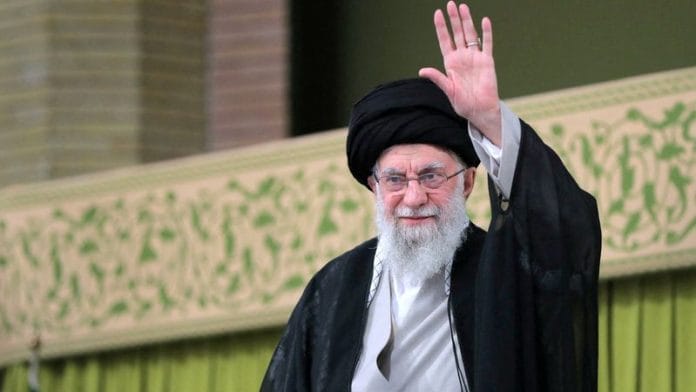



President Donald Trump’s decision to eliminate Iran’s Supreme Leader will be debated as strategy. It should also be understood as precedent.
This was not a battlefield exchange. It was regime decapitation — the deliberate removal of the apex of a sovereign political system. That choice alters more than Iran’s internal trajectory. It shifts the grammar of international conduct.
The central question is not whether the strike was tactically successful. It is whether it advances stability — or accelerates systemic erosion. The case for the strike rests on deterrence. Iran had entrenched itself across the Levant through proxies, missile networks, and calibrated escalation. Its nuclear posture remained ambiguous. From Washington and Tel Aviv’s perspective, incremental responses had failed to reset the balance. Decisive force, therefore, was framed as necessary.
Saudi Arabia’s position appears more cautious but not indifferent. Riyadh has no interest in an emboldened Iran. Yet it also has no appetite for regional war that would endanger its economic transformation agenda. Quiet coordination paired with public restraint reflects that duality.
But decapitation is not transformation. Iran’s political order is institutional, not merely personal. The Islamic Revolutionary Guard Corps, clerical oversight bodies, security networks, and economic patronage structures are deeply embedded. The removal of a supreme leader may trigger elite competition. It may also consolidate harder factions under a narrative of martyrdom and resistance.
A shift
Leadership removal can disrupt. It can also radicalise succession. The historical record offers caution. Iraq after 2003 did not stabilise through shock; it fragmented. Libya after 2011 did not democratise; it fractured. The killing of Gen Qasem Soleimani did not dismantle Iran’s regional influence; it reshaped it.
Regime decapitation is a high-voltage instrument. It may produce a deterrent effect in the short term. It rarely produces durable equilibrium on its own. The deeper consequence lies in norm mutation.
When the targeted killing of a head of state is framed as a political opening — even as a moral act — a threshold moves. What was once extraordinary becomes arguable. What was once taboo becomes tactical.
The United States remains militarily preeminent, but it no longer operates in an uncontested system. China watches carefully. Russia calculates within constraints. Regional actors hedge. The more the use of force becomes normalised as an instrument of political restructuring, the more the international order shifts from rules to capability. That shift matters beyond West Asia.
The Gulf states now confront a paradox. They depend on US security guarantees. They also depend on regional stability to sustain investor confidence and economic diversification. None of them seeks open war. Yet Iranian retaliation — whether direct or through proxy networks — could target energy infrastructure or shipping routes.
The Strait of Hormuz remains the most sensitive artery in global energy flows. Iran need not block it and disrupt economic stability. Risk premiums alone are enough to unsettle markets. Oil volatility is not a regional problem. It is global macroeconomics. And, this is where India enters the equation.
India’s exposure is structural. A significant share of its crude imports originates in the Gulf. Price spikes translate into inflationary pressure and fiscal strain. Strategic reserves offer cushion, but not insulation. The Indian diaspora across the Gulf is both a human reality and an economic one. Remittances are substantial. Crisis preparedness cannot be rhetorical.
Connectivity ambitions through Iran — particularly Chabahar — become more fragile in a wartime sanctions environment. Even limited escalation complicates operational certainty. India, therefore, faces a disciplined balancing act.
Also read: Khamenei is dead. What is the next political objective for US and Israel in Iran?
The task for India
Strategic autonomy in this scenario is not a slogan. It is a survival doctrine in a fragmenting order. India’s partnerships with the United States and Israel are consequential — in defence, technology, intelligence cooperation. Its historical engagement with Iran reflects geography and connectivity logic. Its economic interdependence with Gulf states is foundational.
In such a moment, rhetorical alignment carries cost. Appeasing regime change undermines India’s long-standing commitment to sovereignty and non-intervention. Silence, however, is not a strategy. India’s voice must be anchored in four principles: restraint, de-escalation, maritime security, and protection of civilians. These are not abstractions. They are interest-driven positions in a system where precedent is becoming fluid.
Will Trump’s decision stabilise the region? In the short term, it may reassert deterrence. But it may also induce recalculation within Iran’s elite.
In the medium term, much depends on succession dynamics in Tehran and escalation control between Israel and Iran’s networks. If retaliation spirals, deterrence credibility will be tested repeatedly.
In the longer term, stability will not emerge from shock alone. It will require tacit understandings, back channels, calibrated signalling, and renewed red-line management. West Asia can only be stabilised by managed equilibrium.
We are in a hinge moment, but hinge moments do not predetermine collapse. They intensify agency. They magnify the consequences of language and precedent. If force becomes the primary instrument of political restructuring, the system will harden accordingly. Nuclear hedging will accelerate. Risk tolerance will narrow. Miscalculation margins will shrink.
This is geopolitics at high altitude, and the air is increasingly thin.
The task for India — and for other middle powers — is to preserve balance while great powers test thresholds. Not through moral grandstanding. Not through reflexive alignment. But through disciplined statecraft.
There is a temptation in parts of India’s public discourse to cheer Israel’s actions as if they were automatically aligned with India’s strategic interests. That is a category error. Israel’s threat perception is existential and immediate; its doctrine is shaped by geography, demography, and a history of survival against encirclement. India’s strategic environment is different. Our geography is continental and maritime. Our exposure is economic and demographic. Our vulnerability lies not in annihilation rhetoric but in energy volatility, diaspora risk, and systemic instability. The danger arises when the public conflates admiration for another country’s resolve with imitation of its doctrine. Strategic empathy is wise. Strategic mimicry is not.
To wish for a failed Iran is to misunderstand what failure in a state of nearly 90 million people at the crossroads of West and Central Asia would mean. Fragmentation would not produce tranquillity. It would produce militia politics, competing centres of coercion, and a prolonged struggle over territory and legitimacy. Energy markets would convulse. Shipping lanes would face chronic disruption. Radicalisation would not diminish; it could metastasise.
Regime decapitation may remove a man. It does not dissolve a structure overnight. In fact, external assault often strengthens the narrative core of a system. Martyrdom can unify what dissent once divided. The Islamic Republic may emerge weakened — but it may also emerge harder.
India is not Israel. Our strategic doctrine cannot be derivative of another state’s security logic. Strategic autonomy requires precisely this clarity: understanding where interests overlap and where they diverge. Applauding disruption may satisfy emotion; it does not constitute policy.
President Trump has made a decisive call. Whether it proves strategically correct will depend less on the strike itself than on what follows. We are living in a hinge moment — not the end of order, but the testing of it.
The author is a former foreign secretary, and was India’s ambassador to the US. She tweets @NMenonRao. Views are personal.
(Edited by Aamaan Alam Khan)