






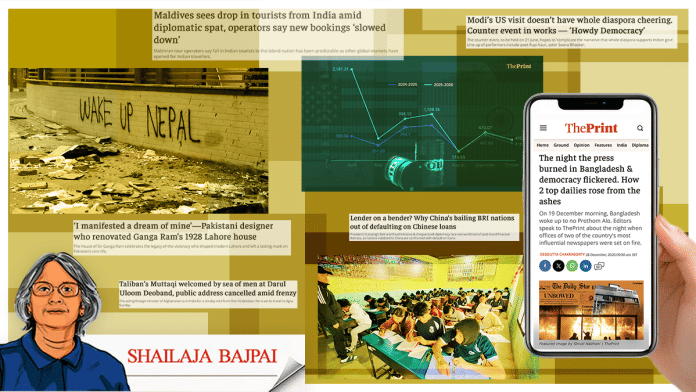



Around the world in 365 days.
That’s quite literally what we did in 2025. Going round and round the world in circles, almost dizzy from the frenetic pace of developments across the globe.
News was being made everywhere. From 15 people killed at Australia’s Bondi Beach and an armed conflict between Thailand and Cambodia, to a former Korean prime minister convicted of insurrection and Japan electing its first woman prime minister.
Closer to home, there were ‘sham’ elections in Myanmar, political unrest in Bangladesh, protests and a new regime in Nepal and the India-Pakistan conflict after the Pahalgam terror attack. As for China, it’s always in the news, but in 2025, it shook the world by restricting the export of several rare earths, over which it has a virtual monopoly.
Move to the Middle East—the Syrian government and Kurdish forces reached an accord and then broke it, the US and Israel attacked Iran, there was Gaza and the ‘Board of Peace’, a defence pact for Saudi Arabia, Turkey, and Pakistan…
In Africa, Sudan’s relentless and endless civil war rages on. In eastern Europe, the Ukraine-Russia war continues despite all talks. In South America, Venezuela saw its president stolen from beneath its very eyes by the US.
And then there’s western Europe, northern Europe, Canada, and the US—all at odds with Donald Trump, the 47th president of the United States, to varying degrees.
If anyone has made the world spin on its head, it’s that man, Donald Trump. One year after his return to the Oval Office, following a gap of four years, he has single-handedly made foreign affairs and diplomacy the most critical, the most hectic, and the most bewildering beat for journalists around the world.
And that goes for ThePrint, too. In this Readers’ Editor column, we’ll look at how ThePrint, with its limited resources, reports and tries to make sense of a turbulent world—and of Donald Trump—for its readers.
“Trump is a narcissist,” said Swasti Rao, Consulting Editor (International and Strategic Affairs), ThePrint. “Certain things are expected of him, like pulling out of multilateral agencies, but Greenland? He comes out all guns blazing… It’s an uncertain world.”
Also read: ThePrint at 8. Readers are evangelists, critics, and asserting their ‘right’
Making sense of Trump
There’s the world according to Trump, and then there’s the rest of it. Together, they dominated 2025.
A little data from ThePrint proves this. It also tells you how seriously we took the world.
In 2025, 40 episodes of Cut the Clutter with Shekhar Gupta discussed Trump’s words or actions. Shekhar tackled geopolitical developments in 43 episodes—obviously, there was some overlap.
My colleague, video journalist Mahira Khan, who provided these figures, said this was out of 194 episodes of CTC last year. That’s a sizeable number, especially when so much happened in India during 2025.
Another figure: From October to December 2025, ThePrint published 314 byline stories on global affairs, defence, and diplomacy—second only to the output on domestic politics. And that was done by just three reporters on the beats: Snehesh Alex Philip, Editor, Defence and Diplomacy, and Principal Correspondents Keshav Padmanabhan and Debdutta Chakraborty.
“We publish between four and five stories daily,” said Philip. “Readers are very interested in these issues, and these stories do very well. Mostly, Trump was deciding the focus of the news agenda.”
And I haven’t even come to Praveen Swami, Contributing Editor at ThePrint, on national security and regional geopolitics. His numbers are equally high, not for Trump, but on global affairs.
I also looked at the figures for Swasti Rao—she devoted about a third of her video show, ThePrint World View, to issues concerning President Trump.
There’s high viewership for videos on security and the world: “It’s our better-performing area,” said Janki Dave, Editor (Operations).
And then there’s Opinion. Besides Shekhar Gupta, Praveen Swami and Rao, “there is a diverse pool of foreign policy analysts that help ThePrint readers make sense of this upended world order,” explained Rama Lakshmi, Editor, Ground Reports and Opinion. This includes Rajesh Rajagopalan, Sidharth Raimedhi, Rishi Gupta, Monish Tourangbam, Ayesha Siddiqa and Sana Hashmi.
“Even columnists who don’t regularly write on geopolitics are being drawn into the subject with their sharp socio-political analysis. That’s how the new world order is affecting everyone,” she added.
Also read: ‘More careful than colourful’—ThePrint’s reporting on the Air India crash put facts first
Busiest year
Those who have been reporting on the world say that 2025 was the busiest of years.
For Keshav Padmanabhan, “Twenty-four hours is not enough in a day to wrap your head around everything happening—to get it right as quickly as possible.”
It can be “overwhelming,” said Debdutta Chakraborty. “Sometimes, it’s such a news-heavy day that I don’t get time to see personal messages,” she added.
Rao agrees. “I haven’t been able to sleep! The world is changing, there is so much churning, it’s been a great time. Of course, it’s been turbulent, but we ought to understand the longstanding tensions, conflicts that have manifested themselves, besides what Trump has been doing.”
However, Trump has constantly forced everyone to look where they hardly did before — Greenland and Venezuela being just the most prominent examples.
“The problem with Trump is the uncertainty and inconsistency—everything is fast-moving. You are trying to wrap your head around one thing, and he does something else,” said Rao.
Philip said that it’s been a “demanding and unforgiving period—and you end up working many weekends.”
So how do you cover this uncertain world in a way that makes sense of it?
Also read: Pahalgam, Pakistan generals, pitches—what readers wrote to us in May
Who covers what?
ThePrint team divides its resources: While Philip oversees all coverage and reports on defence, Padmanabhan concentrates on the Ministry of External Affairs, diplomacy, Europe and the US. That leaves Chakraborty to look at South Asia. One more young, budding journalist, Vaibhav Pant, joined them in January. Pant is an alum of ThePrint School of Journalism.
While all of them file stories on routine developments, they’re clear in their minds that their objective is different.
“Our biggest challenge is to think out of the box,” said Philip, “Bring value to our readers. We have to ask ourselves, ‘Why should readers come to us?’”
Especially when events in other parts of the world occur while we are sleeping, and the international news media have already covered them.
Padmanabhan said it’s madness living across time zones. He thinks hard about how to take the story forward and focus the lens on “what hasn’t been told, what lens should I look through…I ask myself, why is this newsworthy and important for our readers? What impact does it have on us? Why does it matter to an Indian?”
Rao’s approach is the same. “The Indian perspective is the hook,” she said. “My mantra is to understand and explain the internal dynamics and how one theatre of action is impacted by others… interconnections and intersecting interests are what I look for.”
Trying to make sense of the bewildering pace and variety of events is crucial. “We’re doing more explainers now,” said Philip. “On Greenland, we explained why Trump wants it. When he mixed up Iceland and Greenland [at Davos], we looked at how the two are very different.”
Padmanabhan also has a fondness for data-driven stories. “I love numbers and graphs, so stories on trade, etc, satisfy me,” he said.
For Chakraborty, who looks at events closer to home, the Indian perspective and interest are inherent in all her coverage. “We know and understand a bit about our neighbourhood, so for me it’s mostly trying to make sense of things,” she said.
‘Go To Pakistan’, the weekday column on the neighbouring country, is her daily responsibility—and one she’s proud of. “I feel nobody does it like us—a dedicated column about Pakistan. It’s about social and cultural life as well as political.”
She’s particularly pleased with a piece she wrote about Sir Ganga Ram’s house being renovated in Lahore and a professor at Lahore University who teaches Sanskrit.
She has developed a network of Pakistani journalists, academics and others on Instagram, whom she reaches out to for information and views. “Social media is my most important source,” she said.
Chakraborty also travelled to Nepal during last year’s protests by Gen Z, which helped overthrow the existing government. It was her first ground assignment, in another country. She was also the first to reach Pokhara for an Agniveer story.
She filed many reports that gave readers a real feel of the situation in Nepal. “My biggest learning is that the reality on the ground is often very different from what you read or see on social media. Nothing is so black and white,” she said.
Understanding the world
There’s one question that I had to ask this team: Sitting in Delhi, how do you understand the ground reality and provide readers with credible information?
“Read, read, read,” was the common reply. They read, watch, and listen to the western media, Al Jazeera, the BBC, Chinese news media, and specialised journals such as Foreign Policy. Padmanabhan turns to books for a “deep dive”—and “luckily, I had good history teachers!” he said.
They speak to MEA officials, former Indian diplomats, and academics. Chakraborty contacts local journalists and professors in neighbouring countries. “I reach out to as many people as I can on social media—experts, individuals…” she said, “I don’t mind asking the stupidest questions.”
An increasingly important source of particulars is the international diplomatic community in New Delhi. Ambassadors and other officials have visited ThePrint office to interact with the editorial team. The reporters remain in touch with embassies.
“We try to get direct information as much as possible instead of going by news media sources,” explained Philip.
The biggest obstacle Chakraborty faces is speaking to people in other countries. “This is a rocky neighbourhood; people are reluctant to speak. Equations have changed. I have to convince them.” This is true of Bangladesh as much as Pakistan.
Although they have no idea what tomorrow brings, the team is now more comfortable with their work lives and their timelines. The new normal is the unexpected, the inexplicable.
“It’s saner now. Less scrambling around. We know what has to be done,” said Padmanabhan.
I would like to end by sharing some of the stories our young reporters have done, as they reflect on events around the world.
Here is Keshav Padmnabhan:
Lender on a bender? Why China’s bailing BRI nations out of defaulting on Chinese loans
A few from Debdutta Chakraborty
‘I manifested a dream of mine’—Pakistani designer who renovated Ganga Ram’s 1928 Lahore house
In Nepal, young dreams of serving in Indian Army crash as Agnipath halts a centuries-old tradition
Shailaja Bajpai is ThePrint’s Readers’ Editor. Please write in with your views and complaints to readers.editor@theprint.in
(Edited by Theres Sudeep)