






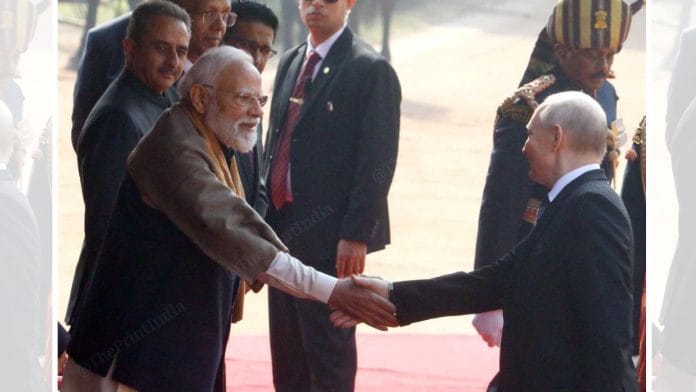



As Russian President Vladimir Putin meets Prime Minister Narendra Modi in Delhi, it’s worth noting how countries around the world view this bonhomie, which continues to build on the long-standing friendship between the two nations. Putin’s visit reinforces that India-Russia relations have remained strong, consistent and non-interfering in the realms of their respective national interests and security.
The core Marxist idea that “the state will wither away” once the ideal Communist society is achieved has been proved wrong by Putin. While his predecessors paved the way for the breakup of the erstwhile Union of Soviet Socialist Republic (USSR), Putin has strengthened the state and positioned Russia once again as a front-runner in global power politics, with the potential to challenge the US.
US duplicity—hard to hide
For the White House, Putin’s visit to India comes at a time when US and Western sanctions on Russia, imposed in the wake of the Russia–Ukraine conflict, are expected to have a cascading effect on India. Rolling out his punitive measures against India for refusing to toe the US and Western line on condemning Russia, and for continuing to buy Russian oil—thereby increasing Moscow’s resources to fight the Ukraine war—Trump would see this visit as a challenge to his leverage over New Delhi.
The White House should realise that Trump has himself compromised his authority by engaging deeply with Russia, not only through continued talks to resolve the Russia–Ukraine crisis but also by increasing imports from Russia. Fertiliser exports from Russia to the United States have rebounded in 2025 after falling in 2023 and 2024. US duty-free imports of Russian platinum-group metals—palladium and rhodium—used in catalytic converters, along with enriched uranium, are on their way to higher levels this year. In total, imports from Russia are up nearly 30 percent from 2024 and could reach close to $5 billion by the end of the year. It is becoming difficult for Trump’s staff in the White House to explain this duplicity.
While the US would not like to burn all bridges with India, it may define a threshold when it comes to defence and nuclear cooperation between India and Russia. It is in Washington’s best interests to put the India-US nuclear deal to more productive use and ensure that this energy cooperation works.
Also read: Chennai to the Arctic—India-Russia RELOS gives New Delhi new maritime access
Lesson for EU on balancing ties
As for the European Union and other Western countries, there appears to be a more practical view of India–Russia relations in the wake of Putin’s visit. While they cannot go against the US position on Russia, nor fully circumvent US pressure on trade with Russia, they seem to be deepening their engagement with India—especially through trade, green-energy cooperation and supply-chain mechanisms. The market size of India, and its influence in South–South cooperation, is too critical for the EU to take the tougher stand against New Delhi that Trump would prefer.
A recent “rare joint article” by diplomats of three Western countries—the UK, France and Germany—published in an English daily and criticising Putin for the Ukraine war, is seen as a serious violation of diplomatic prerogatives, to say the least. The EU, the US or any other Western power is free to suggest that New Delhi use its influence over Russia to accept a ceasefire and return to the negotiating table unconditionally. But it is neither prudent nor pragmatic for them to expect India to decouple from Moscow or waver on negotiations for a Free Trade Agreement (FTA).
Meanwhile, in a five-pillar strategy unveiled on Wednesday, the European Commission outlined a comprehensive vision for closer bilateral relations with India, covering a wide range of areas—including sustainable fuels, green hydrogen, critical raw materials, artificial intelligence, advanced microchips, cybersecurity, crisis management, defence policy and legal migration—paving the way for an EU–India summit in early 2026. Interestingly, this comes at a time when a small contingent of Indian troops took part in large-scale joint military exercises with Russia and Belarus, known as Zapad 2025, near the border with Poland and Lithuania in September.
China’s present view, India’s future
China could view Putin’s India visit as a fitting response to Trump’s attempts to isolate Russia, punish India and impose unreasonable tariffs on China. Beijing may also see the visit as an assertion of India’s strategic autonomy, but would likely remain cautious in wholeheartedly applauding it. Any India–Russia defence or critical-minerals deal would undermine China’s supremacy in trade, help New Delhi address its military imbalance, and complicate Beijing–Moscow ties.
Western capitals closely monitoring Putin’s India visit should recognise that India’s strategic, economic and security interests mandate strong relationships with Russia, China and the United States. While the European Union and its member states struggle to maintain a balance in their foreign relations and exercise economic autonomy, New Delhi has worked to open separate, independent and non-conflicting channels with Russia, China and the US.
The India–Russia relationship needs to move beyond photo sessions and result in increased trade, defence cooperation and a shared understanding of India’s security concerns in the region. Russia ranks 26th among India’s top export destinations, with only 1.1% of India’s merchandise exports going to Russia in 2024. Of India’s global merchandise exports, around 1% goes to Russia—a share that has remained largely unchanged over the past five years. The real outcome of Putin’s visit should be assessed in terms of trade gains, geopolitical balance and India’s ability to secure its strategic position and strengthen its role in the region.
Seshadri Chari is the former editor of ‘Organiser’. He tweets @seshadrichari. Views are personal.
(Edited by Prashant Dixit)