






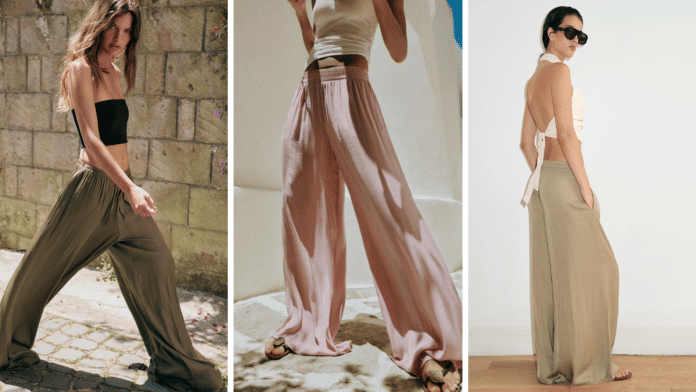


Every few months, the internet finds a new public enemy to complain about. Sometimes it’s skinny jeans, sometimes it’s Stanley cups and this month the collective attention of the fashion police has turned to Zara’s wide-legged palazzos, dubbed the “Death Pants.”
These nefarious pants are supposedly trying to kill their owner, as many social media posts claim broken bones, falls and other accidents. Consumers across the world have been sharing videos of themselves nearly toppling over in the Rs 2,350 pants, warning followers that the pants are “trying to kill them” and adding enough suspense to make you think that Zara was about to release its own line of weaponry.
Not to dismiss anyone’s injuries, but the problem is just the styling. A fundamental understanding of the fit has always been a prerequisite of fashion. If your blazer is three sizes too big, it looks sloppy. Your shoes, two sizes too small, result in agony.
You wouldn’t wear a maxi dress that pools at your feet six inches behind you. Yet somehow, when it comes to long, wide-leg palazzos, the blame for trip hazards seems to be squarely aimed at the retailer. An odd standard to maintain. It also says something about the nature of the modern internet to brand minor inconveniences as “life-or-death situations.”
A pair of pants that simply requires hemming is now being treated as a public safety hazard.
Also Read: Dua Lipa just killed the Stanley Cup era. Long live the boring water bottle
Forget fashion police, call the fashion doctor
The language and speed of hyperbole know no bounds. Fashion experts, like professional stylists, have even been on hand to point out that this is not specific to Zara. Any pair of wide-leg pants will be problematic to walk in if the inseam is too long relative to the wearer’s height and choice of footwear.
So, here’s the solution (brace yourselves, it’s revolutionary): Hem the pants properly, pair them with shoes that’ll make it easier to walk in the outfit, and make sure the pants don’t drag. Pathbreaking, I know. What if you buy trousers designed to be worn with heels, and then you wear them with tissue-thin flip-flops?
That’s a styling decision, not a criminal cover-up.
Clothing doesn’t automatically alter its length to accommodate your footwear switcheroo. “Ready-to-wear” clothing is cut to standard measurements. Two people can purchase the same pair and have drastically different experiences. That’s where alteration and tailoring come in.
Believe it or not, people have been paying for tailors to customise their garments for centuries.
That doesn’t absolve brands of responsibility, naturally. Retailers could benefit from providing clearer inseam options, better guidance and offering more diverse length variations like petite and tall styles. Consumers deserve clothing that fits without extensive, additional work.
But branding a piece of clothing as “Death Pants” does seem a bit far-fetched. We all learned to suck in our tummies for the skinny jeans, we can learn to hold up Pur pants while climbing the staircase.
Every trend comes with trade-offs.
Stilettos aren’t exactly famous for comfort; corsets don’t offer the range of motion you get in a sports bra. Wide-leg pants come with a basic expectation of length awareness. Perhaps the most amusing aspect of this online debate is the implicit belief that fashion should eliminate every possibility of user error. If that’s the case, a whole variety of women’s clothing should come with a hazard label.
The internet is ready to cut off your finger for a minor cut. There is no between.
If your pants continually trip you, pool around your ankles or become an unavoidable hazard on staircases, the most likely culprit isn’t a particular brand, but your tailor or your shoe choice. Or, better yet, just don’t wear it. Good fashion isn’t just about wearing something straight off the rack; it’s about making it work for you, your body type and comfort levels. So no, your Zara “Death Pants” aren’t plotting a coup.
They’re just waiting for the right inseam. The internet could maybe use a tailor and a little less drama.
Views are personal.
(Edited by Insha Jalil Waziri)