






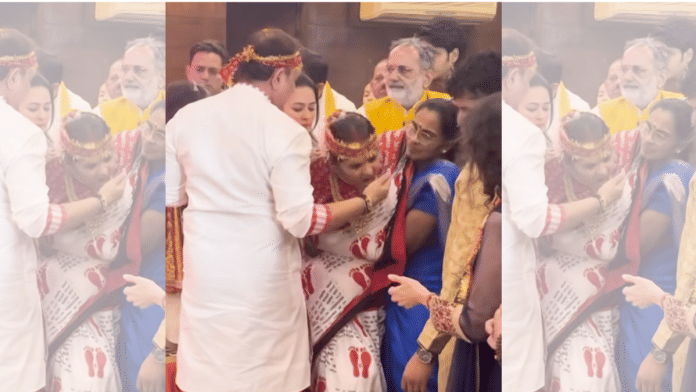



Actor Sudha Chandran’s trance viral video shocks you mid-scroll. Here is a woman whose art roots in revolution, who has fought every odd and carved each role of hers with dignity. And yet, that hard-earned authority does not place her beyond scrutiny. Questioning this eccentric spiritual moment does not diminish her legacy. In fact, genuine respect allows space for concern. Agreeable or not, reverence should not demand silence, especially if something that’s been glorified could be harmful.
In the video, we see the acclaimed Bharatnatyam dancer in a trance-like moment — dancing uncontrollably, completely disconnected from her surroundings, and even tries to “bite” people around her. While she calls it a “blessing”, many online said that the logic outdoes the blessing here, and a question arises: What are we celebrating in the name of spirituality. What we see in the video is not a passing spiritual fancy or a neutral spectacle; it is psychologically ambiguous, and the fact that someone as influential as Chandran is participating in it warrants a closer look.
“It is a moment everyone wants to live in,” she said after the video went viral.
“Maa Shakti aapke andar aake voh energy de rahi hai (Goddess Shakti enters your body, gives you energy). I am one of those blessed souls aur mere zariye logon ko voh blessings mil rahe hai (And through me others are getting that blessing as well), it is the happiest moment in my life,” she said responding to trolls online.
Ideally, nothing is explicitly amiss with practising your own rituals or proclaiming oneself as blessed. Yet, Maa Shakti is not a state of perpetual ferocity. We see Chandran clad in a stark red-and-white saree, with bulging eyes, and within moments, she loses her composure. This should not be labelled as a divine or enlightened state. For vulnerable viewers, struggling with mental health issues, identity crises, or spiritual confusion, such imagery can normalise “loss of control” as something aspirational. This is a dangerous message.
Spirituality, by its very nature, is inward. When deeply personal moments are externalised and mass-consumed on social media, they lose context and nuance. What remains, therefore, is a performance to “manifest” virality. More so, while it is rational not to justify one’s “spiritual experiences”, but if the experience causes harm to others, as we see her “biting” questions must be raised and answered.
Also Read: To be proud or not to be — the question most Bengalis are wondering
Music intersecting emotional release
Trance states are not reserved for the divine. It is the music. Music impacts your brain. Certain repetitive beats and rhythms can alter consciousness and help you release “suppressed emotions”. For example, metal music—when metalheads listen to it, they instinctively begin to head-bang. Metal often channels rage and frustration, and the body responds to it. In a similar way, rhythmic patterns like the Ayoub rhythm are also known to induce trance-like states. Music and rhythms can unlock buried grief, suppressed fury, or emotional excess, bringing them to the surface.
So what we see in the video could be just “human” and not something divine. The issue arises when we label fleeting emotional release as higher consciousness and name it spiritual awakening.
These intense viral episodes may propel people toward questionable places and scams in the name of “kundalini awakenings” and other “body-jerking” workshops that affirm enlightenment with no psychological backing. Neurologists Jean Charcot and Sigmund Freud both linked religious experiences with neurosis. One might call it extreme, but it highlights a very important truth, that certain practices can overlap with psychological vulnerability.
Also Read: Bareilly birthday party attack puts all friendships with Muslims on trial in India
Awareness began with the ‘biting’ moment
The most concerning part of the video, however, was not the dance, but the “biting” moment. This is where our awareness must intervene.
While she chooses to call it a “blessing” and refuses to listen to logic, the question remains: Is it safe. If devotion propels violence, even unintentionally, it becomes a hazard. Healthy spirituality is marked by “self-control”, accountability, and harmonious relationships with oneself, with others, nature and even “God”.
Unchecked immersion overrides responsibility. If spirituality disconnects us from care, consent, and safety, it becomes an imbalance.
Spirituality must be grounded in psychological awareness. Blind celebration helps no one. The truth of being spiritual must not strip us away from mankind; it should strengthen the basics of it, “humanity”.
Respect for such an artist as Sudha Chandran and faith means having the conscience to ask the uncomfortable questions when devotion begins to look like a loss.
Shatakshi Ganguly is an alum of ThePrint School of Journalism currently interning with ThePrint.
(Edited by Insha Jalil Waziri)