





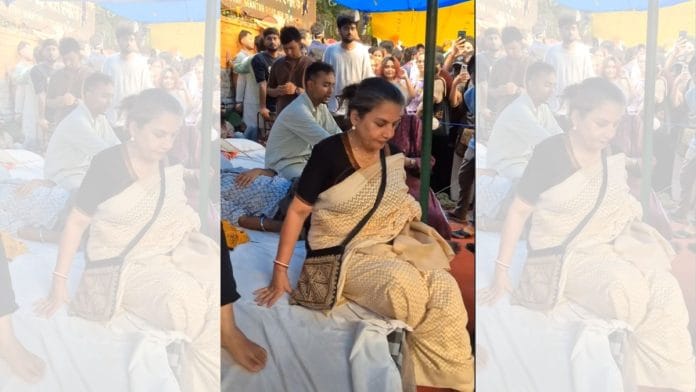


On the afternoon of July 20, 75-year-old Shabana Azmi walked alongside students in the “Sansad Chalo” march, organised by the Cockroach Janta Party (CJP) to protest the alleged NEET paper leak. She suffered an asthma attack from the tear gas but, luckily, had her inhaler on hand.
“After catching my breath, I went right back and spoke to the students who had been lathi-charged. Their spirit is unprecedented. My salaams to all of them,” she told the media.
But this isn’t the first time Azmi has spoken up against the system. Her history of dissent goes back more than forty years. At a time when most artistes weigh their words carefully, particularly when commenting on an issue of national interest, or simply dodge the question with, “I am an artist, not a politician,” Azmi and her art has held a rare and stubborn consistency.
She has been unbothered by who happens to be in power. Wherever India’s institutions have failed their most vulnerable, she has always shown up.
Her cinema is a commentary
Azmi has been practising much of her activism through her films.
Her debut in 1974 with Shyam Benegal’s Ankur arrived like a jolt to Hindi cinema’s typical heroine. The film was inspired by a newspaper report about the Telangana Movement of 1946-1951, in which peasants resisted the feudal exploitation of landlords, who owned obscenely large tracts of land. Azmi played a married servant who embodied the intersection of caste, class, and gender oppression. Her portrayal of rural power dynamics won her the first of five National Film Awards.
It was followed by Nishant (1975), which examined feudal exploitation in rural India. From hereon, politically conscious storytelling became a defining feature of Azmi’s career. Kissa Kursi Ka (1977) was perhaps the most overtly political film she appeared in. It was a satire on political corruption and authoritarianism, and was famously banned during the Emergency. The film’s prints were reportedly destroyed.
The same year, Azmi appeared in Satyajit Ray’s Shatranj Ke Khilari (1977) in a supporting role. It examined the decline of the Nawabs of Awadh with the expansion of British colonial rule. She also featured in Albert Pinto Ko Gussa Kyoon Aata Hai (1980), which is a tale of the capitalists versus mill workers. The film touched upon labour politics, trade unions, class consciousness, and the frustrations of the urban working class. Then came Paar (1984), which examined caste violence, rural poverty, and migration. Its famous sequence of villagers driving pigs across a river remains one of Indian cinema’s most powerful images of structural oppression.
By the 1990s, Azmi was taking on subjects Indian cinema still largely avoided.
For instance, caste discrimination and social reform through the story of an inter-caste marriage in Antarnaad (1991); patriarchy, compulsory heterosexuality, and religious conservatism in Fire (1996); feudal politics and gender violence in Mrityudand (1997); and electoral politics, criminal networks, and gendered power in Godmother (1999).
Across five decades, her films kept returning to the same well: women, institutions, and the gap between the two. In more than 120 films, Azmi has consistently chosen roles that function as social commentary. It is proof that popular art doesn’t have to choose between entertainment and conscience.
The same spine off screen
What sets Azmi apart from many of her contemporaries is that her activism has always stood on its own—unconcerned with who was in power.
Her first recorded protest dates back to 1985, when she joined a hunger strike against the demolition of a Mumbai slum. She had gone to a government office for an unrelated meeting. There, she watched a screening of Anand Patwardhan’s documentary Humara Shahar on Mumbai’s housing crisis. The next thing you know, she was at the affected slum, participating in the hunger strike for ten days, with nothing but the clothes she was wearing.
This act, in fact, turned into a decades-long association with Nivara Hakk, a housing rights organisation she eventually joined formally. She campaigning against slum demolitions and for housing as a basic right beyond that one incident.
After the 1989 murder of street theatre activist Safdar Hashmi, who was killed while performing a play criticising political corruption, Azmi drew a direct line between the Congress government’s silence and its willingness to celebrate cultural events regardless.
Years later, she recalled the event the Congress government’s own “cultural annihilation” under powerful Delhi leader HKL Bhagat, as the capital city hosted the International Film Festival of India just months after Hashmi’s killing. Azmi invoked the episode as she publicly compared the muted response of I&B Minister Smriti Irani over threats to actor Deepika Padukone and Sanjay Leela Bhansali over the row surrounding Padmavat.
The comparison cut both ways politically. Azmi used a Congress-era failure as the yardstick to criticise a BJP minister, which is precisely why she has resisted being labelled as partisan.
Her protest against the NEET paper leak is also in the same league. The connecting dot, for Azmi, has always been a discomfort with power going unquestioned.
If her cinema asked audiences to sit with uncomfortable realities, her activism has simply asked governments to do the same. Few public figures in India have managed to keep that instinct running, across five decades and through the regimes of different political parties.
(Edited by Aakriti Handa)