






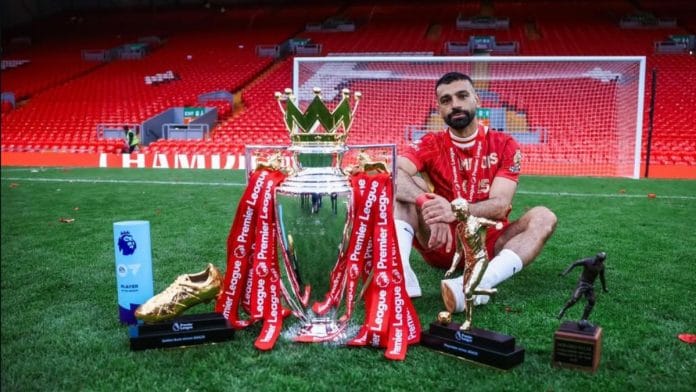



It is time for the ‘Egyptian King’ to wave goodbye to the fans at Anfield and ‘walk alone’. Mohammad Salah, the lightning-fast right-winger, is walking away from Liverpool.
It is not just a player leaving, but the end of an era that reshaped the club’s modern identity in the English Premier League (EPL). He has scored 255 goals in 435 appearances for the club in all competitions, making him the third-highest goal scorer in the club’s history.
Salah in Liverpool
When Salah arrived in Liverpool from Italian club AS Roma in 2017 for a club record fee of £36.9 million, he already had a lot on his shoulders—to prove himself once again at one of the most historically decorated clubs in Europe. After all, he was a ‘flop’ in his two-year stint with another English giant, Chelsea FC. And, players at his level do not get a second chance!
Salah capitalised on this opportunity and went on to become one of the greatest players in the league. But let’s not reduce Salah’s Liverpool career just to mere numbers. Liverpool had lethal forwards and strikers before—Robbie Fowler, Michael Owen, Fernando Torres and Luis Suárez, whose 2013-14 season can outperform Salah’s best version.
Salah’s uniqueness, however, lies in consistency—consistency in the most electrifying and competitive European league. Season after season, through tactical adjustments, injuries, and teammates leaving the club, he has always scored goals and assisted.
Under German coach Jürgen Klopp, Liverpool found its long-lost glory. The team evolved into one of the most formidable sides in Europe, defined by its high-intensity pressing and positive mentality. Klopp pushed Salah to become the perfect expression of that system—a winger who moved like a striker, exploited spaces, finished precisely, and drew defenders beyond their limits.
But over time, things took an unusual turn. While Klopp’s system elevated Salah, the ‘Egyptian King’ also began to outgrow it. As Liverpool’s False-9 formation faltered at times, Salah always stepped up, proving his consistency. This is exactly what separates Salah from other players who experience sharp peaks and sudden dips.
Over the years, especially under Klopp, Salah subtly changed his playing tactics. He relied less on his explosive speed and focused more on positioning, passing, intelligence, and sense of timing. That doesn’t mean he didn’t use his pace to his advantage. The sudden change in pace at the right wing often baffled the defenders, who couldn’t predict his next move.
The legacy that Salah has built over nine years in Liverpool is obviously not about consistency alone—it is clubbed with crucial moments at the right time. Let’s take a look at the 2018 Champions League final, where Real Madrid thrashed Liverpool 3-1. Salah had to walk off the pitch in the first half due to a ligament injury in his shoulder. History could have been made then for Liverpool and Salah.
But God had a separate plan for them. Just a year later, Salah scored the opening goal in the Champions League final against Tottenham Hotspur, setting Liverpool on course for their sixth European trophy. The victory at the European competition was followed by the long-awaited league title in the 2019–20 EPL season, ending a 30-year drought. In both cases, Salah played a pivotal role.
The loss in 2018 was needed. It had set the stage for redemption.
Also read: Behind Messi’s 900th goal is a three-year game plan for Argentina’s World Cup bid
Beyond Liverpool and football
The cult of Salah goes beyond football and the club. In a city like Liverpool—fiercely protective of its culture—Salah became something more than a footballer. A study by Cambridge University points out that there was a 16-19 per cent drop in hate crimes in Merseyside (the county of Liverpool and Everton) after Salah joined The Reds. The study also states that anti-Muslim tweets by Liverpool fans roughly halved, coming down to 3 to 4 per cent from 7 per cent. Salah became ‘one of their own’ and was never considered an outsider.
In a recent interview, Ranjit Bajaj, director of Minerva Academy Football, told ThePrint, “Salah became so popular that most of the babies born in Merseyside were named after him.”
Where does Salah then stand among Liverpool greats? The club has a rich history with legendary icons—Kenny Dalglish, whose influence transcended generations, and Steven Gerrard, the definition of loyalty and leadership. Time will tell whether Salah can break through this list.
Views are personal.
(Edited by Theres Sudeep)