









Beef has attained mythical status in India. Thanks to the Bharatiya Janata Party’s beef with Kerala, the meat has become the ultimate form of culinary protest. But most of what we eat in Kerala isn’t beef. It’s buff.
Kerala Story 2’s trailer has renewed the beef brouhaha. No one is force-feeding anyone beef in Kerala (or anywhere else in India). I’d even wager a bet that those posting pictures of “beef” (looking at you, Prakash Raj) or videos of them eating “beef” in protest of the movie are probably eating buff.
The meat has become more activism than accuracy.
The Kerala tourism ad hits the nail on the head: We have no beef with anyone.
It’s an ironic truth that no one wants to acknowledge. Despite the hullabaloo surrounding beef and Kerala, the state prefers buffalo or pothu. A substitute for the real deal in beef-banned states is also hugely coveted in Kerala.
My grandmother, who grew up in the town of Thallayolaparambu in the Kottayam district, says that there was no beef available there, only buff. It was only when she moved to Kochi, after her marriage, that she first encountered beef. Even then, she always preferred buff — “It just tastes better,” she says.
But the harsh truth is that in Kerala, beef was always the substitute, bought when buffalo isn’t available.
Also Read: The Kerala Story 2 faces ‘no beef with anyone’ jibe. State chooses irony over outrage
Why is buff the preferred meat?
While my grandmother can’t pinpoint a reason why pothu is tastier, the good people on Reddit have their theories — cows slaughtered in the state are old or sick. Buffalo slaughter, on the other hand, has no such restrictions. It corresponds with what I’ve seen at home.
“People also slaughter young cows, sold as veal,” my grandmother said. That, she says, is tastier than beef and even pothu. But it’s rare to come by and far more expensive than everyday beef or buff.
But many, like my grandmother, also believe in the Ayurvedic principle that “buff cools the body, whereas beef heats it”. And in Kerala’s tropical climate, no one wants to get any hotter.
Today’s buff-beef dichotomy has been shaped more by politics than taste or Ayurveda logic. BJP’s opposition to beef changed the way it’s seen in Kerala and across India.
Not only did it become an act of protest to eat beef, its culinary status was also elevated. It became a delicacy that only a select few could truly understand and savour.
Also Read: Does The Kerala Story 2 show God’s Own Country as centre of terrorism? Pinarayi Vijayan says so
Beef is buff, buff is beef
When I took my grandmother’s “beef” fry to a friend’s home in Delhi, it became a hot property — “beef from Kerala” was the trending topic of the night. I remember someone asked me if it was real beef or that “buff nonsense”. It was that buff nonsense, but pothu roast is a real delicacy.
When I offered to make Kerala-style stew for a friend who was craving it, he told me to wait till he found beef in Bengaluru. Never mind that the stew that he had on his trip to Kerala was made with buff.
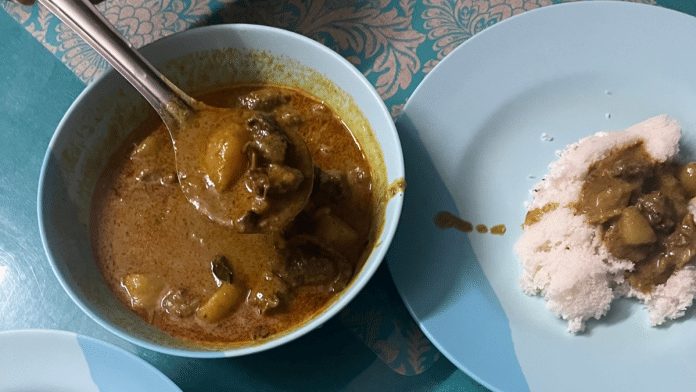
Sundays at home in Kerala mean one thing — beef curry and puttu. But even my grandmother’s iconic Sunday “beef” curry was made with buffalo. Beef was always synonymous with buff. In fact, most of what is called “beef” in Kerala is usually, more often than not, buff.
And when beef was banned but buff was still available, it quickly became seen as lesser than, which was historically never the case.
The myth had become fact. Beef was superior, beef was what people from Kerala ate, and beef was the symbol of the protest.
But Kerala’s love affair with beef is just a case of nomenclature. Beef is the catch-all term for cow, buffalo and ox meat in the state.
So the next time you see pothu roast on the menu of a Kerala restaurant, don’t be disappointed. It’s as authentic as it gets.
Views are personal.
(Edited by Insha Jalil Waziri)