






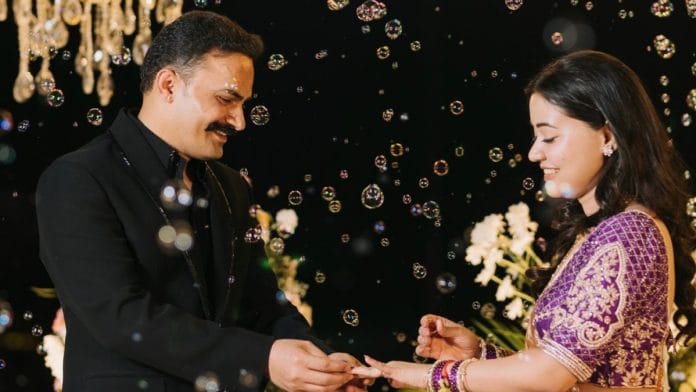



It was always billed as the mother of all weddings in the IPS world. But it still surprised many. If the Ambanis gave us a masterclass in choreographed excess, UP cadre officers KK Bishnoi and Anshika Verma’s Jodhpur wedding tried hard to keep up. Videos from the grand affair just kept coming: rituals, Reels, rules, carefully staged moments, and then some not-so-carefully staged ones.
The clips were just teasers—the full Bollywood production was playing out at a Rajasthan palace. Days-long celebrations, dreamy photographs, and designer clothes dominated feeds for days.
And this wasn’t just any wedding. It was a power couple spectacle: Two IPS officers, the groom a Yogi Adityanath favourite, a guest list thick with the uniformed elite, and a buzz that had been building for weeks. If you mattered in the IPS cadre, you were there. By the time it began, the wedding had already outgrown itself: it had become an event where everything was designed to be seen.
Such a display of extravagance sits uneasily with the image of humble “public servants”. Of course, a public servant is not enjoined to asceticism, but when the display veers into excess, it draws attention—not the good kind.
One such clip from the Doodh Pilai ritual made the internet collectively go, “Did that just happen?” The ritual involves the groom symbolically suckling from his mother—a supposed, final act of nurturing before her son steps into married life. Instead, it was physically performed with theatrical insistence. Then it was recorded and broadcast for public consumption.
A mother suckling her grown son was discomforting to many unfamiliar with the traditions of the Bishnoi community, where ideas of nurturing and care carry cultural weight.
But when a ritual becomes a spectacle, it raises an important question: should every tradition be performed in its most literal form, especially when the person is no ordinary citizen but a bearer of state authority? What might have remained a symbolic, private moment became a visual centrepiece that is now being defended by many as culture.
Complications of power
Then there was the ghunghat. After the shy-and-demure bride ceiling was shattered by a carefree, laughing Deepika Padukone and a bold, confident Priyanka Chopra, the partially veiled face of an IPS officer—be it for custom—felt like a regression.
While a ghunghat is often defended as tradition, it is resisted and discarded by women for what it represents: control, constraint, modesty, and a negotiation of choice. When a young IPS officer is seen donning it with dozens of other women at the wedding, it does not remain a personal preference. It travels to homes where such “choices” are rarely free of pressure. It gives controlling people an easy script: “If an IPS officer can follow this, why can’t you?”
This is the real risk: the aspiration they represent, the practices they end up legitimising, and the impact it has on countless people who look up to them.
The sight of a drunk IPS officer dancing at his wedding also shocked many in the cadre. It is normal for any other groom. But a uniform carries an expectation of discipline. No one is saying he should not have had alcohol, but optics matter. And here, the optics were hard to ignore. In IPS WhatsApp groups, his behaviour drew discomfiture from colleagues.
Thus, the line between the personal and the political is seldom as clear as one might wish. It is an unfortunate truth, but public figures do not get to choose which parts of their lives are consequential. Influence can’t be switched on and off.
Young aspirants preparing for the civil services are watching. Families negotiating social expectations are watching. What, then, are they to make of a wedding that revels in palatial excess while invoking tradition as its justification?
None of this is to suggest that tradition must be abandoned at the altar of modernity, or that personal joy must yield entirely to public expectation. But there has to be a measure of discernment.
There is, of course, an easy defence: This is personal, this is culture, this is choice. But power complicates all three. When you represent the country, your choices do not remain entirely your own.
Views are personal.
(Edited by Prasanna Bachchhav)