






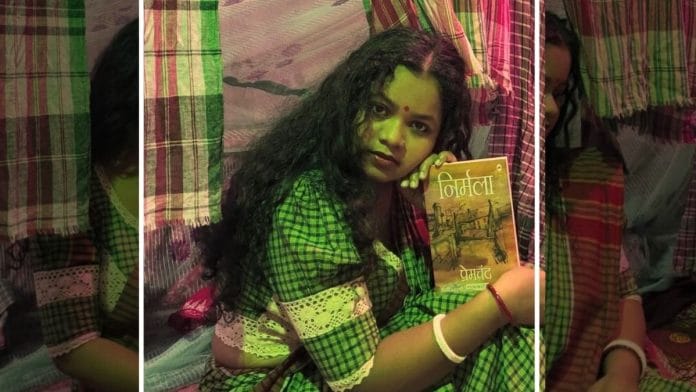



A young woman sits before her phone camera and begins speaking about Stanley Kubrick, Munshi Premchand and Khaled Hosseini. Not from an FTII classroom, but from a modest home in rural Bengal’s East Midnapore. She speaks calmly and fluently, but her accent is unmistakably Bengali.
Pujarini Pradhan has nearly six lakh followers on Instagram. But her ascent to social media fame was achieved without a ring light or a carefully curated bookshelf meant to signal intellectual credibility. Yet within minutes, she discusses caste and feminism with a clarity and earnestness that feels lived rather than theorised.
Pujarini wears a simple saree or salwar suit in most of her videos; her background is her modest home with chipped walls and open wiring. Her many viral videos revolve around the mundane: the books she is reading, loves she loved, reflections on her daily life in the village, and social commentary ranging from women’s rights to education.
She shares her life’s journey candidly, speaking about her marriage, the higher education she couldn’t pursue, and the opportunity social media gave her. Her following grew rapidly because of the contrast between the language she speaks and the social strata she belongs to. And that is somewhat unsettling, one of India’s most stubborn hierarchies: who gets to sound intelligent in English.
For decades, English in India has functioned as a social signal. It marks class, education, access, and mobility. The accent matters, the topic matters, the vocabulary matters. The confidence to occupy intellectual space matters even more. Entire industr,ies from coaching institutes to influencer culture revolve around reproducing a certain kind of English-speaking persona, which is always urban, polished, and aspirational.
Pujarini disrupts that template almost by accident.
She considers herself in the league of Ranu Mondal and Kacha Badam fame Bhuban Badyakar. And she also knows what rattles her audience. “What people find interesting about me is that I am poor and still have access to something reserved for the privileged,” she said in one of her Instagram Reels.
Recently, in another Reel, she breaks down class and privilege, discussing a post that ridiculed a vegetable vendor for having an iPhone. “When poor people get access to something not for them, the value of it drops. Suddenly, it becomes cringe,” she said.
She does not look like the India we associate with the English-speaking elite. She is a lower-middle-class woman who wanted to continue studying but, like many in rural India, was married off early. She says she was angry at her mother for deciding for her. Soon, familial expectations like domesticity and motherhood bound Pujarini. But she decided to step out of it.
Pujarini speaks only English, but without performing the social codes usually attached to it. She offers no apology for her accent, nor does she attempt to smooth it into the cadence favoured by the urban elite.
Also read: Why is our Holi playlist still stuck with Balam Pichkari? It’s 13 years already
India’s class anxieties
For generations, India treated English as a password into the world of ideas. Universities, schools, and literary festivals often reinforce the idea that serious conversations about culture or politics must be conducted in a particular register in English: fluent, urbane, often detached from the social realities it claims to analyse. Those who spoke it imperfectly were expected to remain quiet or deferential.
Social media, for all its chaos, has begun to chip away at that structure. Suddenly, commentary is not the monopoly of those with institutional backing or metropolitan polish. Pujarini is one of the successful examples.
But even in this supposedly democratised space, certain aesthetics dominate: the well-lit room, the influencer cadence, the familiar grammar of aspirational self-branding.
Pujarini’s videos feel different because they resist just that. They are simple, direct, and occasionally uneven. Yet they carry the unmistakable excitement of someone discovering ideas and wanting to share them. She wants to make more money and buy land to build a home she can call her own—not her parents’ or in-laws’. There is also something very feminist about that act.
For many women across India, intellectual life has historically been a luxury, something postponed indefinitely by marriage, children or restrictions at home. The idea of sitting down to read voraciously, think critically and speak publicly about literature or politics is still not easily available to women outside urban professional circles.
When Pujarini does it on Instagram, she is not just producing “content”. She is claiming time, attention and authority: three things women from modest backgrounds are rarely encouraged to demand.
Her popularity suggests that audiences are hungry for this kind of authenticity. The fascination with her videos often begins with curiosity: how is a rural woman speaking fluent English and discussing Japanese filmmakers? But it quickly evolves into something else. Viewers stay because the conversations are thoughtful and the curiosity feels genuine.
Ultimately, what she represents is the democratisation of English as well as intellectual aspiration.
Pujarini speaks, reads, argues and reflects in the language she has taught herself to inhabit. That reveals something uncomfortable about India’s class anxieties: the real barrier was never English itself. It was the assumption about who had the right to use it.
(Edited by Saptak Datta)