









Lionel Messi’s three-day GOAT tour in India should have been historic. It should have felt like a moment football fans in this country would tell their grandchildren about.
But, Messi came. India’s elites clicked selfies. And football watched from outside the gates.
It was all ‘messy’ and embarrassing. Football was window dressing and Messi was the ultimate accessory. And, Luis Suárez and Rodrigo de Paul, who accompanied the football legend were mere props in Messi’s shadow.
For actual Messi fans, the ones who grew up idolising him, the ones who saved money for jerseys, who debated Ronaldo vs Messi in school corridors, this tour felt distant.
They didn’t experience the Argentine legend, they watched the elites experience him.
Conversations were more about the likes of Shah Rukh Khan, Kareena Kapoor, Elvish Yadav and Jannat Zubair meeting Messi, than football.
To make things worse, the tour began with the Kolkata fiasco, where fans were unable to see the football star who was closely surrounded by officials and politicians. They vandalised seats and stormed the pitch at Salt Lake Stadium. It soured the optics of the trip from the onset.
Though Hyderabad, Mumbai and Delhi made things better with tightened security and proper management, the tour was an embarrassment for Indian football—which was barely mentioned in Messi’s three-day tour.
Messi as a trophy
The most uncomfortable part of the tour was watching Messi reduced to a backdrop. A silent figure standing next to people smiling into cameras, ticking off a bucket-list moment. The conversations weren’t about tactics, legacy, or the evolution of the sport. They were about access.
“I met Messi” became the headline, not why he was here.
And this culture of proximity worship, where being near greatness matters more than engaging with it, perfectly reflects India’s elite ecosystem.
The sport didn’t matter. Messi did. Or rather, Messi as a status symbol did.
Perhaps the clearest indicator of how shallow the tour was lies in how Suárez and de Paul were treated. These aren’t random names.
Suárez is one of the greatest goalscorers, while de Paul is a World Cup-winning midfielder. Yet, in India, they barely existed. They were ignored because they didn’t carry the same social currency.
There were no meaningful interactions, no spotlight on their journeys, no attempt to use their presence to deepen football discourse.
This was never about football. It was about one man and one photo.
Football without football
India constantly complains that football doesn’t grow here because fans don’t care enough. But when the greatest footballer of this generation visits, the system ensures that Indian football and the fans are the last priority.
If there was ever a moment to do things right, this was it. The solution wasn’t complicated or unrealistic.
What if Messi shared the pitch with Indian legends, Sunil Chhetri, Subhasish Bose and Vishal Kaith. It didn’t have to be competitive. It didn’t have to be perfect. It just had to be real.
That single match would have done more for Indian football than multiple show-up events. Kids would have seen their heroes acknowledged. Fans would have gone home with memories instead of screenshots of other people’s selfies.
To make matters worse, the organisers went a step further and insulted our legends by making Chhetri wear Messi’s GOAT Tour shirt.
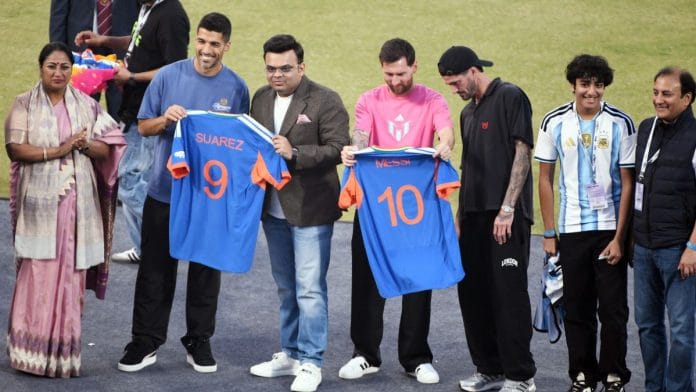
And in Delhi, the final stop of Messi’s GOAT Tour, BCCI president Jay Shah presented Messi, Suárez, and de Paul with Indian cricket jerseys bearing their names.
Maybe because football jerseys are less glamorous and less popular?
It was the ultimate disrespect, not just to the sport, but to the Indian players who have sacrificed everything to keep football alive in a country obsessed with cricket.
India doesn’t lack football lovers. It lacks institutions and organisers who respect them.
And Messi, one of the greatest footballers of all time, deserved better. But more importantly, Indian football fans deserved better.
Views are personal.
(Edited by Theres Sudeep)