






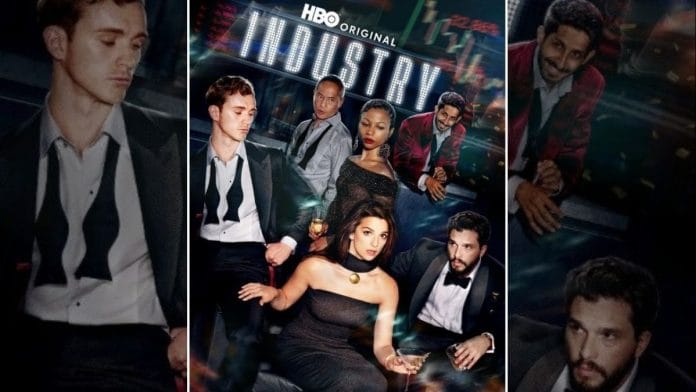



HBO’s Industry has introduced us to women in finance in a way television never dared to before. If American Psycho gave us Patrick Bateman—the caricatured finance bro embodying the most grotesque side of masculine greed—Yasmin Kara-Hanani channels convicted sex offender and Jeffrey Epstein’s former partner Ghislaine Maxwell. Turns out, the glass ceiling is also the gateway to moral hell, which is not a male-dominated field.
In the last four seasons, Hanani’s character, played by Marisa Abela, has been defined by her trauma. Predator father, sleezy bosses, heroin-addict boyfriend, and so on. Whatever she did with her agency seemed like a response to the horrible way people had treated her. Her “best friend” on the show, and one of the most well-written female characters in TV drama history, Harper Stern, played by My’Hala, says in one of the episodes that Hanani always plays either a sex object or a victim, depending on whatever men want her to be in the moment.
The main problem in other shows is the way writers strip villains of their menace by overexplaining their backstories and trauma-driven motives. Industry doesn’t do that—it first makes you root for innocent characters and then shocks you by making them do unspeakable things.
Hanani is proven to be a talentless girl at first. She’s a sweet publishing house heiress who doesn’t have what it takes to make it big in the finance world. So, she starts serving coffee and lunch to her coworkers and seniors to make them like her. She doesn’t have the hunger to succeed, only an identity to build separate from her rich father.
It makes sense that Hanani goes crazy when her father cuts her off—then we see her come into her own. Without skills, she only has her social capital, her proximity to wealth, to climb up the corporate ladder, and she doesn’t care if she’s stooping too low to get there.
Dismissing sexual abuse survivors by asking, “Are you sure?”, brokering big deals and doing little frauds to save the day. “Yasmin, for her part, has played an alarmingly literal game of F**k, Marry, Kill,” Inkoo Kang wrote in The New Yorker.
Stern still defends Hanani when someone calls her a sadist, “Don’t talk about Yasmin like that, she’s a survivor. You have no clue what she’s been through.” Well, how much empathy does a survivor deserve if she becomes her abuser?
Critics are going to be busy analysing her character for decades. In the end, the light behind her eyes dies out, and she is ready to host the devil because it makes her feel “necessary”.
Also read: Life in Delhi isn’t easy for Northeast Indians. Racism is always round the corner
The lone wolf
Moving on, there’s the American prodigy, hustling hard to infiltrate the British high class—Harper Stern. She’s called a sociopath by fans of the show. She takes what she wants—and her shorting venture literally profits only if other people fail. She declares at the beginning of the show—‘I am not a victim‘. And then goes on to raise hell, grow her pile of cash, and betray anyone and everyone to win at the game.
She has come from no wealth and hasn’t felt an iota of support growing up. Maybe that’s why Stern functions as a lone wolf. However, unlike Hanani, she never becomes ‘unwoke’.
Fighting against racial discrimination and the Big Boys’ Club, Stern wins big, repeatedly. And she does it all without a college degree. She plays dirty games, cheats the law, and, as if the universe is backing her, she never really gets caught. While her peers spend it all away to buy fancy cars, a country estate, and other such treats, she is never seen celebrating. She does everything simply for the love of the game. Winning for the sake of winning.
Stern also loves anyone willing to go the extra mile for clout and cash. “I love a woman who doesn’t leave money on the table,” she said about Sweetpea Golightly, who is a woman in finance and an OnlyFans creator on the show. A very real category of women who capture the zeitgeist of the late 2020s.
Golightly is one of the most sincere people on the show. She understands money, and she’s not ashamed of doing all it takes to earn it as much as possible. The way she moves through the world, avoiding conflict and ignoring slutshaming, it’s easy to mistake her as a silly girl with foolish dreams. But she’s anything but that. In one episode, when she’s asked how things are at work (where men hold power), she says, “Patriarchy swings between patronising and lecherous.” A line that deserves thunderous applause for its cross-cultural reality.
She’s the kind of woman who says, “I agree” when you praise her competence. And she knows exactly what she deserves. In the end, when she wins a cheque of $2 million as her reward for winning the biggest stock-short-dip game, she’s hardly impressed. “I could have earned more selling feet pics,” she said.
(Edited by Saptak Datta)