






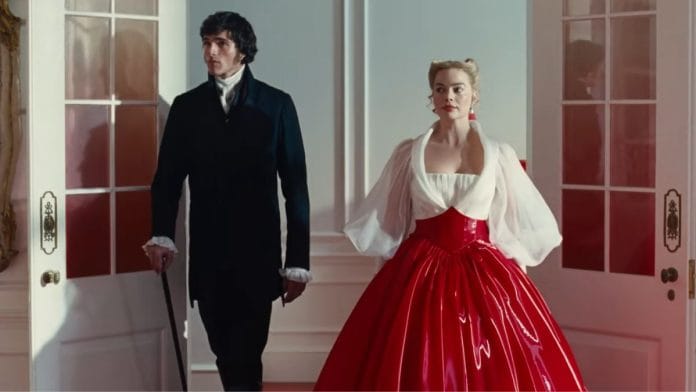



To say that Emily Brontë is probably rolling in her grave is an understatement after the release of Emerald Fennell’s latest film Wuthering Heights, which is based on the novel of the same name by the 19th-century poet.
Brontë’s Wuthering Heights is a subversive tale of relationships, trauma, and the slow insanity of existence. She challenged Victorian morality, social conventions, and class structures through her one and only novel. The sensibility that is visible in her poems is on display for the world in Wuthering Heights. In contrast, Fennell’s work is a poor two-dimensional interpretation.
Ms Fennell, did you read the book? Or even the Wikipedia plot? The SparkNotes? Or is your adaptation, sorry, “reimagining” based on what you thought the book was about?
Before I saw the film, I was in high spirits. As an avid reader and a proud holder of a master’s in Victorian Literature, I was convinced that my favourite genre was having a renaissance. But now, I am appalled.
A cacophony
Fennell’s characters lack depth, development, or any real quality — a rare feat to achieve when you have access to the talents of Margot Robbie and Jacob Elordi. Elordi, who played the Creature in Guillermo del Toro’s 2025 film Frankenstein, was a queer choice as Heathcliff. Brontë’s anti-hero is a concoction of rage and jealousy, tormented by his past. Elordi’s Heathcliff, on the other hand, is reminiscent of a jilted teenager — horny and a little obsessive, with nary an idea of what he truly wants. But that I suppose is the central theme of Fennell’s work. No one has any clue what the other person wants or is doing.
For two hours and 16 minutes, audiences fail to understand what the director wants to say. From her Sofia Coppola meets A Midsummer Night’s Dream-esque aesthetic that was both jarring and clashing to the latex and Oktoberfest-inspired costume for Robbie’s Catherine, the film is a cacophony. The film, which brings to shame one of the greatest novels, is taped together with an inconsistent storyline, with a fake 19th-century bow on top. Even if I went looking for the gothic aspect of the film with Sherlock Holmes’s magnifying glass, I would not be able to locate it.
Even putting aside the questionable design choices and the lack of any real direction, my biggest problem with the so-called love story is the whitewashing of its lead character. Heathcliff is not White. I repeat, he is not White. He is one of the few lead characters of his time who was not of the same race. His racial ambiguity and possible gypsy or Romani heritage are a crucial plot point in Brontë’s seminal work. It is the bare minimum required. And to say that you always pictured him as White shows your prejudice. We no longer live in a world where Black or coloured male leads are a rarity. For a filmmaker such as Fennell, who prides herself on defying norms and breaking new ground, casting a person of colour as the male lead would not have been unconventional, but the downplaying is.
How can the maker of a film as thought-provoking as Promising Young Woman (2020) make this, whatever “this” was?
Also read: What if your partner doesn’t believe in Valentine’s Day and you do
A failed reimagining
It is not that book lovers or literature majors do not enjoy reimaginings, as long as they are done properly and follow the central themes of the book. Fennell’s work seems to gloss over half of Brontë’s book, once again raising the question of whether she really even read it. In an interview ahead of the film’s release, Fennell said that she based the film on her interpretation of the book when she first read it at 14 years old.
Let us take into consideration Joe Wright’s 2005 cult-classic Pride & Prejudice, an adaptation of Jane Austen’s masterpiece of the same name. Wright, by all means, takes many liberties, but still manages to deliver one of the most iconic portrayals of the novel. Even Helen Fielding’s Bridget Jones Diary (2001), a retelling of Austen’s work starring Renée Zellweger in the titular role, managed to bring the story out of its Regency era confines and plunge it into the modern world.
Even Greta Gerwig’s Little Women (2019), a story from across the pond, went on to become a celebrated, modern reimagining of Louisa May Alcott’s coming-of-age classic.
Reimaginings are not the problem; if they were, the world would’ve long forgotten Alicia Silverstone’s Cher Horowitz from Clueless (1995), which answers the question “what if Austen’s Emma was a valley girl in the late 90s”.
Even other adaptations of Brontë’s work, while not all of which were by-the-book adaptations, were much more palatable than Fennell’s.
In the years since, it seems almost as though Fennell has forgotten about the consequences of Heathcliff and Catherine’s sadomasochism and selfishness, as she ends the film with Catherine’s death. There is no pining, no ghosts, and the “passion” is laughable at best.
A bit on the nose, but to show how much Catherine’s father drank, the scene where he is found dead takes place with a background of mountains of bottles. Or the very odd “dog play” that is put on show for Nelly (Hong Chau) when she comes to take Isabella (Alison Oliver) away from Wuthering Heights after her marriage to Heathcliff. Even the iconic “Whatever our souls are made of, his and mine are the same,” or the “You said I killed you — haunt me, then” are delivered with such lacklustre that one almost misses them if they are not on the lookout for it.
I would have been fine had Fennell not dragged the name of a beloved author into her “retelling”. Slap on an avant-garde sticker along with a five-foot restraining order from Brontë’s Wuthering Heights, and the film would not have been so triggering. Emerald Fennell’s Wuthering Heights is confusing at best, a rage-bait at worst.
For lovers of Brontë or literature, I have but one advice when watching Fennell’s work: Abandon all hope, ye who enter here.
Views are personal.
(Edited by Aamaan Alam Khan)