






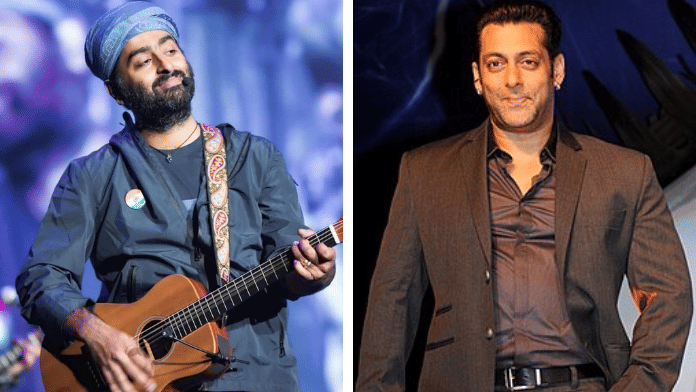



The voice of romance and heartbreak in Hindi films, Arijit Singh, announced his retirement from playback singing, causing much, well, heartbreak. But Singh, in the span of just 14 years, has made an impact on Bollywood that is akin to Kishore Kumar and Mohammed Rafi. Some will remember Arijit Singh for ‘Tum Hi Ho’ from the 2013 cult-classic film Aashiqui 2, others for the 300-odd songs that followed. But for me, he will always be ‘THAT GUY’ who not just survived Salman Khan’s wrath but went on to create a legacy that will be remembered for decades to come.
Bollywood’s history has it that things don’t usually end well once someone falls out with Salman Khan. Even though Khan has repeatedly denied these claims, several actors and musicians, from Aishwarya Rai Bachchan, Vivek Oberoi, to Himesh Reshammiya, have spoken about facing professional setbacks after similar fallouts.
They, of course, don’t get work in Khan’s projects or in his banner. But they are often also boycotted from the Hindi film industry. So when reports of tension between Khan and Singh first started to arise, many assumed the singer’s career would surely take a hit.
But before I talk about why Singh thrived, let’s rewind to the awards night of 2014, where the fiasco started.
Singh, exhausted from tours and recording sessions, walked on stage in casual clothes, with his slippers on, to accept an award. Khan, who was hosting, joked, “So gaye the (Did you fall asleep).” To which Singh responded, “Aap logon ne sula diya yaar (You guys made me fall asleep).” What was meant to be harmless banter quickly spiralled into controversy, with many interpreting it as “an insult to Salman Bhai”.
Soon after, rumours began that Singh had been blacklisted from Khan’s films and that his songs were removed from projects like Bajrangi Bhaijaan (2015), Kick (2014) and Sultan (2016). In 2016, Singh posted a public apology on his Facebook page, hoping to clear the air and retain his work in Sultan. The post was later deleted, and as a result the gossip mills worked overtime to cook speculations about friction between the two.
What didn’t change, however, was Singh’s career and his music.
While the industry and fans debated the fallout, Singh kept releasing hit after hit. His songs dominated charts, his concerts sold out worldwide, and his voice became deeply woven into mainstream Hindi cinema. Over time, he sang more than 300 songs, collaborating with almost every major composer in Bollywood.
In 2025, while hosting the reality show Bigg Boss 19, Khan finally addressed the long-standing fallout. He referred to it as a “misunderstanding”, largely from his side, and confirmed that he and Singh were on good terms. He also revealed that Singh had sung for him in films like Tiger 3 (2023) and the upcoming Battle of Galwan (2016).
Looking back at the decade, everyone will agree that Singh didn’t just outlast the controversy; he rose above it. He never slandered Khan publicly. Never used the incident to get sympathy. His career never stalled. His collaborations never stopped. Work was his worship, and that paid off.
And, when the misunderstanding was finally cleared, it was Khan — whose ego is known to be so big that it can compete with the Statue of Unity — who did most of the explaining.
Now, I don’t intend to say that other artists were less talented. But in an industry which ruthlessly cuts ties and takes sides, only an exceptional, once-in-a-generation kind of talent tends to find its way through the noise. His voice carries a raw emotion that is deeply personal as well as universally relatable. More than technique, it is his ability to make listeners feel every word of the lyric, which makes him stand apart from others. His commitment to his craft is beyond any and every fallout or controversy.
And that quite simply is Arijit Singh for me. He is the voice that rises above the din of controversy and chaos.
Views are personal.
(Edited by Insha Jalil Waziri)