






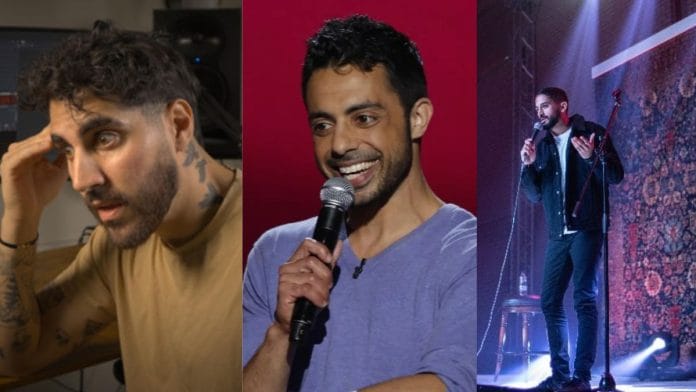



When wars erupt, comedians go to work. Because when the world begins speaking only in the language of missiles, retaliation and escalation, humour becomes one of the few ways left to translate what is happening. More and more of us want to hear what the Middle Eastern comics are saying: on stand-up stages, in viral Instagram Reels, and in short sketches shared across millions of phones.
But many of these Middle Eastern voices—Saad Alessa, Rudy Ayoub, and Sammy Obeid—doing this translating are not in the war zones themselves. They belong to a generation of hyphenated comedians — Arab-American, Lebanese-American, Palestinian-American — who often live and perform in the United States while watching their homelands unravel from afar.
Their comedy, which ranges from impersonation of Donald Trump and Benjamin Netanyahu to dark humour about life in war-ravaged areas, travels across the same global digital networks that carry footage of the devastation itself.
Stripping war vocabulary
Kuwaiti-American comedian Saad Alessa has been among those turning geopolitics into satire as tensions in the region rise. His jokes often begin with the strange vocabulary of war itself. Words like “escalation”, he says, sound oddly bureaucratic, as if they belong in a boardroom rather than a battlefield.
The humour works because audiences recognise the absurdity behind the language. Wars are rarely described in human terms anymore. They arrive wrapped in euphemisms. Comedy strips those away.
Alessa also jokes about family chat groups: concerned uncles, conspiracy-theorist cousins, and the one relative who meticulously forwards updates from “credible sources”. In one reel, he admonishes them: “Habibi, look outside the window. What source?”
It could easily resemble our own Indian family WhatsApp groups on a Monday morning. Until the joke lands and you realise that the people in those chats may actually be living under bombardment.
Much of Alessa’s material leans into dark humour. He joked that he will “lose his mind” if he read another comment about homosexual people being thrown off roofs in Gaza. “There are no roofs in Gaza anymore,” he said. “They’re all levelled, just like the people hiding in the closets.”
A similar instinct runs through the sketches of Lebanese-American comedian Rudy Ayoub. His online videos often explore the strange position Arabs and Muslims occupy in global conversations about conflict. In one sketch, he spoofs Donald Trump by pulling up his old tweets accusing Barack Obama of wanting war with Iran, only to juxtapose them with recent developments.
“Mr President, you said you will end all wars?” Ayoub asks in one skit. “I never said that,” replies Ayoub, dressed as Trump. He pulls up more Trump tweets in which he said the exact opposite, a slam dunk.
In another skit, Ayoub’s fictional boss (also played by Ayoub) asks him about a missed deadline. Ayoub replies that he has been distracted. “By what?” his boss asks. Then come visuals of bombing and attacks in the Middle East, including Gaza. He quickly goes back to a deadpan expression as he nods about work.
Ayoub’s characters are constantly asked to explain wars they did not start, geopolitics they did not design, and histories outsiders barely understand. The joke, often, is the expectation itself.
Palestinian-American comedian Sammy Obeid often approaches the conflict in Palestine almost like a lecture before turning the argument into a punchline. He calls himself a math comic and lays out his reasoning with numbers and data, methodically dismantling counterarguments regarding the war.
In one video, he explains why he thinks the US bombed Iran. It is about oil, obviously. “Iran has the world’s third largest oil reserves, but it’s not about the oil?” he says as he explains the numbers, the reserves, the costs. He also jokes about the constant bombardment of Iran. “We might owe flat earthers an apology after Israel gets finished with us,” he said.
In another set, Obeid breaks down the cost of the war the US has incurred so far. Then, hilariously, he says a brown uncle would have done it for cheaper.
The effect is disarming. When stripped of official language, the logic of war can sound strangely contradictory.
Also read: Zohran Mamdani’s shaky politics has come home to bite
Comedians as interpreters
What comedians like Alessa and Ayoub are doing today is not entirely new. Political satire has long flourished in moments of global anxiety.
During World War II, comedians mocked fascism long before it became fashionable. Just pick up a copy of Jewish Humor in the Holocaust: Humor as a Survival Strategy. In later decades, comics such as George Carlin dissected the language of power, exposing how governments dressed violence in careful vocabulary. Satire became a way to puncture narratives of the powerful.
In the Arab world, that tradition found one of its most influential voices in Bassem Youssef. A heart surgeon-turned-television host, Youssef rose to prominence during the Arab Spring with his wildly popular Egyptian show Al-Bernameg. Week after week, he mocked political hypocrisy, media propaganda and authoritarian theatrics, transforming satire into commentary watched by millions.
The risks were real. Satire, especially in politically sensitive environments, often walks a narrow line between humour and dissent.
For Arab-American comedians today, that tension takes a different shape.
Iranian-American comic Maz Jobrani has spent decades translating Middle Eastern geopolitics for Western audiences through stand-up. Then there is Max Amini, a huge name in stand-up comedy and the first Iranian-American comic to headline a show at Madison Square Garden. He has not joked about the war; instead, he has shown solidarity for the lives lost and spoken against the toppled regime in Iran in his stand-up shows and TV interviews.
Beneath the humour runs a constant undertone of war fatigue, the weary recognition that crises arrive with exhausting regularity.
What binds these comedians together is not style. Some perform polished stand-up routines. Others rely on short digital sketches or character-driven satire. What they share instead is a role: they are interpreters.
In a region often narrated by diplomats, generals and politicians, comedians translate events into something more recognisable: everyday experience. The punchline becomes a way to articulate frustrations that statistics cannot.
Social media has dramatically expanded the reach of that commentary. A joke filmed in Los Angeles can travel across millions of screens within hours, reaching viewers in Beirut, Tehran or Gaza. But that reach also reveals a paradox: the distance between where the comics live and where their stories originate.
It is a complicated position, close enough to feel the grief, far enough to have the microphone.
Yet that distance is also what allows their voices to travel. In an age when information wars unfold alongside real ones, the awareness the West needs often spreads through those who can access Western platforms.
Comedy, in that sense, has become a form of unofficial journalism.
Comedians cannot stop wars or negotiate ceasefires. But they can puncture the stories that surround them: mocking propaganda, exposing contradictions, and reminding audiences that behind every headline is a human reality struggling to make sense of chaos.
And sometimes, the only way to confront that chaos is with a joke.
Views are personal.
(Edited by Ratan Priya)